Chinese semiconductor thread II

tokenanalyst

Lieutenant General
Registered Member

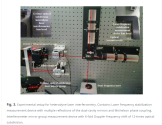
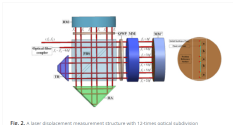
High-precision 12-times optical subdivision heterodyne laser interferometer for short-distance measurement​

Xi'an Institute of Optics and Precision Mechanics of CAS, Xi'an,

Abstract​


Heterodyne laser interferometers are based on high-directional and high-coherence laser wavelengths, have broad application prospects in the fields of nano-scale multi-axis joint control of ultra-precision five-axis machine tools and sub-nano alignment positioning of high-end lithography machines. It is necessary to improve the measurement accuracy of the measurement mirror group to enhance its theoretical resolution limit. However, traditional heterodyne methods are limited by optical subdivision accuracy and spatial positioning accuracy. To meet this challenge, we propose a high-precision 12-times optical subdivision heterodyne laser interferometer for short-distance measurement, which not only avoids the problems of measurement accuracy reduction due to insufficient optical subdivision multiples and the difficulty of adjustment due to the increase in the number of reflections, but also reduces the influence of periodic nonlinear errors. By introducing space position and equal optical path, it makes better use of the Doppler frequency shift information superposition characteristic of short distance interferometry, compared with the traditional 4-times optical subdivision mirror group. It further proves the advantages of the proposed 12-times optical subdivision mirror group in short distance high-precision measurement, and its theoretical resolution is better than 0.103 nm. Experiments prove that the actual test results show the dynamic resolution is better than 1 nm, the dynamic error in vertical movement state is better than ±10nm@20 mm, the dynamic error in horizontal movement state is better than 35 nm@20 mm, and the stable step measurement error is better than ±1 nm. Therefore, the proposed method is effective for ultra-precise positioning and ultra-precise displacement measurement.

1764807769335.png1764807811723.png

Please, Log in or Register to view URLs content!
 

Michael90

Senior Member
Registered Member
Are you sure that's only for 1 supernode? That number would mean the CM384 is more than 4x as expensive than a GB200 NVL72 by cost per tflop and I remember multiple sources saying the CM384 is actually significantly cheaper per tflop.
Yeah, I think there must be a mistake there, else it doesn’t make sense for it to be that expensive.
 

lockedemosthenes1

Just Hatched
Registered Member
Yeah, I think there must be a mistake there, else it doesn’t make sense for it to be that expensive.
Well, 384 Ascend 910C , if one chip is 200,000 RMB, then the total cost of NPUs is 76,800,000 RMB, and consider the CPU and other storage and the link between NPU, the cost is quite reasonable.
 

tphuang

General
Staff member
Super Moderator
VIP Professional
Registered Member
Are you sure that's only for 1 supernode? That number would mean the CM384 is more than 4x as expensive than a GB200 NVL72 by cost per tflop and I remember multiple sources saying the CM384 is actually significantly cheaper per tflop.
it does seem expensive, but consider there are also 192 Kunpeng CPUs, all the additional DRAMs (it's multiple times that of NVL72), optical interconnects and storage.

Normally, when hyperscalers like Meta buys NVL72, they still need to buy all the cables, wires, cooling, transceivers and everything else with it and install them. They would have the servers then get built at some Foxconn factory. All that cost money.
 

tokenanalyst

Lieutenant General
Registered Member

Starshine Semiconductor secures over 100 million RMB in Series C funding within a year!​


Starshine Semiconductor (formerly Zhejiang Xingyao Semiconductor) has completed a Series C funding round of over 100 million RMB, jointly led by Wenzhou Venture Capital Fund and Hengyuan Yu Fund. This follows its Series B financing earlier in the year, marking two major investments within just one year.

Founded in 2020, Xingyao Semiconductor specializes in RF filter chips and RF front-end modules, serving global markets with high-quality, comprehensive solutions. The funds will be used to advance R&D, expand production capacity, enhance delivery capabilities, and strengthen market presence and ecosystem partnerships.

The company has:​
  • Developed over 120 RF filters and 30 RF module products, including key components like duplexers, triplets, quadplexers, receivers, transmitters, and power amplifiers.​
  • Shipped more than 2 billion units of core products, with growing demand.​
  • In 2024, launched a 5G RF filter wafer production line in Wenzhou Bay New Area, investing 750 million RMB. As of November 2025, it achieves 7,000 wafers/month with over 98% yield, ensuring stable mass production.​
  • In May 2025, successfully acquired Wisol’s Tianjin packaging and testing facility—a first instance of Chinese capital acquiring foreign tech assets in the sector—offering a monthly capacity of 250 million pieces (based on duplexers) with industry-leading efficiency.​
This milestone establishes Xingyao Semiconductor as one of China's few companies capable of independently developing full-range RF front-end solutions. The project also marks Wenzhou’s first wafer fabrication plant, significantly advancing the city’s IC industry and positioning it as a key player in China’s semiconductor "third pole" development.

Please, Log in or Register to view URLs content!
 
Top