US Military News, Reports, Data, etc.

nativechicken

Junior Member
Registered Member
Pentagon can very quickly have a massive space constellation up with tens of thousands of aircraft tracking satellites. What is China's plan to counter/match this capability?

Make AWACs redundant

Please, Log in or Register to view URLs content!
There is no mention in the original text of any tens of thousands of satellites. Only one thing can be confirmed now: the U.S. Space Force signed a $4.16 billion launch contract with SpaceX. Based on Falcon 9's pricing, it's approximately $70 million per launch (commercial price; prices for NASA and defense contracts are higher than commercial launches, often exceeding $100 million per launch).
According to launch cost calculations, $4.16 billion can fund about 60 launches. At 50 satellites per launch, the total number of satellites would be around 3,000. The first batch mentioned in the text is scheduled for launch around 2028, with deployment planned to be completed in the 2030s (likely around 2035).
Judging from the illustrations in the text, the satellites do not appear to be flat-panel layouts but rather traditional configurations, with unknown weights. Frankly, based on the mass of Starlink v1 satellites at about 250 kg each, these satellites are relatively small and have limited capabilities. At 250 kg per satellite, the payload capacity is still quite limited, which is why Starlink v1 satellites don’t even carry chemical propulsion for attitude control, relying instead on electric propulsion for slow orbital raising.
Considering that if the external design is not flat-panel, the actual satellite mass and the dispenser’s allocation capacity are likely limited (meaning the actual launch might not carry 50 satellites but rather 15–25).
Given the known satellite design, which requires deploying radar antennas, onboard AI, and presumably a not-too-small solar panel capacity (to power high-performance computing boards, which generate heat and require cooling systems, thus needing larger solar panels), plus laser communication equipment (reportedly about 10 kg each, typically requiring four—two for transmitting and two for receiving, with at least two channels for chain data transmission), I think around 1,000–1,500 satellites would likely meet the requirements.
This scale is sufficient for continuous, uninterrupted Earth observation. For reference, China’s Jilin-1 optical/radar observation constellation, as I recall, has a scale of around 300 satellites, which can achieve revisit times of under 10 minutes. With 1,000–1,500 satellites, that’s already 3–5 times the scale, and radar generally has a wider field of view than optical sensors. Therefore, 1,000–1,500 satellites is most likely the current deployment scale for this constellation.
I hope you won’t criticize me, but I believe this baseline is quite reasonable. Simply put, Starlink is designed to meet ground communication service needs. Since a single satellite’s capacity is insufficient to serve certain areas during its pass, high-density deployment is necessary, hence the requirement for tens of thousands of satellites.
For defense satellites, deploying tens of thousands of such satellites would be a blatant waste of money. Maintaining a constellation of tens of thousands of satellites is itself a money pit. Starlink satellites currently have a lifespan of about 5 years (small satellites of this size in low Earth orbit typically last around that long). For 10,000 satellites, that means replacing 2,000 per year (requiring 40 Falcon 9 launches). For 50,000 satellites, that’s replacing 10,000 per year.
These defense satellites have zero economic value; launching them is just burning money for fun. Moreover, a sensing constellation of this scale is essentially only useful against China. What other adversary besides China would the U.S. need such a massive satellite constellation to counter? Completely unnecessary. China is the U.S.’s only real challenger; the rest are just participating for the sake of it.
How likely is a war between the U.S. and China? What’s the point of maintaining such a money-burning system? (If it were up to me, even 1,000 satellites would be too many.)
Besides, this thing is nowhere near comparable to E-3/E-7. E-7 can provide a lot of intelligence support and even direct targeting capabilities for aircraft, and it’s much more convenient. Satellites are far more troublesome.
So, if the U.S. wants its finances to collapse faster, it can fantasize about tens of thousands of satellites. Otherwise, if it truly wants to compete with China in the long term and slowly win back ground, it should follow China’s example: a constellation of a few hundred satellites is sufficient for all-weather, continuous sensing.
 

nativechicken

Junior Member
Registered Member
I've recalibrated my memory (meaning I used AI to search related news and verified the facts) and found that by the end of 2025, with 138 satellites, China had already achieved a 10-minute revisit. At the 300-satellite level, it can achieve a 5-minute revisit. Therefore, I personally believe it is highly likely that the number of deployed satellites will not exceed 1,000. The satellites are also definitely relatively heavy, at least around 500 kg each.
 

siegecrossbow

Field Marshall
Staff member
Super Moderator
Detecting aircraft is only a very small portion of an AWAC’s role. What’s more important is coordinating and guiding your own aerial/ground based assets. If AWACs were as simple as putting a big radar in a plane then you don’t need that many operators.
 

Lethe

Captain
FY26 Golden Fleet Shipbuilding Plan.jpg

giphy.gif


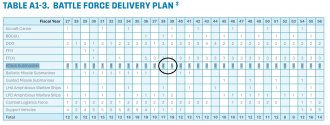
SSN procurements are consistent at 2/yr across the entire period charted, which aligns with long-term inventory target of 66 boats. From FY'27 to FY'37, deliveries fall short of that cadence by 2 boats. 4 boats in FY'38 recovers that deficit (i.e. 2 boats above baseline 2/yr), while 5 boats in FY'39 provides the three additional boats necessary to cover the transfer of three SSNs to Australia in the 2030s. Boats currently under contract have delivery schedules running to early 2034, so those FY'38-39 boats are entirely imaginary at this point. It's no wonder the Block VII contract negotiations are taking so long, like trying to fit a round peg into a square hole...
 
Last edited:

SlothmanAllen

Senior Member
Registered Member
View attachment 176251

giphy.gif


SSN procurements are consistent at 2/yr across the entire period charted, which aligns with long-term inventory target of 66 boats. From FY'27 to FY'37, deliveries fall short of that cadence by 2 boats. 4 boats in FY'38 recovers that deficit (i.e. 2 boats above baseline 2/yr), while 5 boats in FY'39 provides the three additional boats necessary to cover the transfer of three SSNs to Australia in the 2030s. Boats currently under contract have delivery schedules running to early 2034, so those FY'38-39 boats are entirely imaginary at this point. It's no wonder the Block VII contract negotiations are taking so long, like trying to fit a round peg into a square hole...
You know what is crazy, go look at the 1980's delivery rate for Los Angeles and Ohio. They actually had the capacity back then to deliver four to five boats per year.

In fact, they commissioned six Los Angeles and one Ohio class in 1981. That is 60,312 tonnes of submarines. From 1980 to 1990 they commissioned 46 nuclear submarines - 35 Los Angeles and 11 Ohio. The chart you provided has 75 submarines being procured over a 29 year period. So they went from 4.6 boats per year in the 80s to 2.5 over this time span.

Crazy how much the industry has declined in America!
 
Last edited:

Lethe

Captain
You know what is crazy, go look at the 1980's delivery rate for Los Angeles and Ohio. They actually had the capacity back then to deliver four to five boats per year.

In fact, they commissioned six Los Angeles and one Ohio class in 1981. That is 60,312 tonnes of submarines. From 1980 to 1990 they commissioned 46 nuclear submarines - 35 Los Angeles and 11 Ohio. The chart you provided has 75 submarines being procured over a 29 year period. So they went from 4.6 boats per year in the 80s to 2.5 over this time span.

Crazy how much the industry has declined in America!

You raise an interesting point. It is not that there is a fundamental obstacle to the United States producing the number of SSNs that USN requires. For as you point out, they've achieved significantly greater production rates in the past. Beyond adequately resourcing the entire production pipeline (including numbers of appropriately skilled workers), and the considerable time required to translate those investments into measurable output, the fundamental challenge is one of timing.

The basic formulation offered in various official documents is that one Columbia SSBN requires twice as much work as a Virginia Block V SSN with VPM, which in turn requires 25% more work than a Block IV boat. Obviously this is a very high level simplification of more complex realities, but it implies that a production pipeline that can deliver one Columbia SSBN and two Block V Virginia SSNs per year, as is the near-terrm objective, should be able to deliver 4-5 non-VPM Virginia class SSNs per year once that SSBN program wraps up. Even if near-term deliveries ultimately fall short of that 1+2 cadence, a long-term rate of at least 3 SSNs/yr should be readily achievable. That is to say, the fundamental challenge for the United States in sustaining and growing its SSN inventory is the requirement to simultaneously deliver the Columbia SSBN program and, to a lesser extent, compensate for the retirement of Ohio SSGNs by implementing Virginia Block V/VI with VPM. Which is to say that it's a timing (sequencing, planning) problem. To these near-term challenges we can now add the intent to transfer at least three Virginia SSNs to Australia in the 2030s.

I suspect that the main reason USN's asserted SSN requirement remains at the level of 66 boats that was first articulated in the 2016 Force Structure Assessment is because that number is dictated by the above medium-term supply-side constraints. Revising the SSN inventory objective further upwards would only underline the significant discrepancy between the current inventory and that objective, without offering any prospects for ameliorating it. The implication is that once additional production space begins to open up as the Columbia SSBN program begins to wind down, there will be a motive to revisit that SSN inventory objective to build the case for increasing SSN production beyond 2 boats/yr post-Columbia. Accordingly, it is possible to envision that, in the mid-2030s, USN may suddenly discern a requirement for e.g. 80 rather than 66 SSNs.
 
Last edited:

SlothmanAllen

Senior Member
Registered Member
You raise an interesting point. It is not that there is a fundamental obstacle to the United States producing the number of SSNs that USN requires. For as you point out, they've achieved significantly greater production rates in the past.
Exactly, and they managed to do that without modern robotics and manufacturing methods.

The most important element to having a successful manufacturing industry isn't robotics or automation, but it is a large, relatively low wage, high skill workforce. This is what the United States had during the 80's and earlier and is exactly what it is lacking today.
 
Top