Russian Military News, Reports, Data, etc.

sahureka

Junior Member
Registered Member
They needed something cheap. BTR-22 uses the same components as the BTR-82A except that it has the rear entrance door whereas the BTR-82A has two doors on the side, which is it's main point of criticism. This results in Russia having two currently mass produced mainline infantry carrier vehicles with less than desirable exit door layout. The other being the BMP-3 which has its exit door on the upper rear, which you have to jump from. This is in contrast to both the Soviet era BMP-1, the BMP-2 and the MT-LB which have the proper rear exits.

Bumerang of course has the proper rear exits.

However the Bumerang also costs like $4 fo $5 million which might be double of the BMP-3 and the BTR-82A is even cheaper than the BMP-3. If you have a $4 million dollar APC vs. a $2 million dollar APC, the $2 million balance can buy you a lot of drones. So while the extra $2 million can buy you valuable protection over the cheaper vehicle, that is still a lot of drones. The extra protection isn't going to last you long enough given how tanks also fall under these drones. It's better to use the extra drones to sanitize the zone to make it safe, for an assault.

The lack of proper rear exits has been a good reason to run programs refitting and modernizing BMP-1 as the 1AM, the -2 as the -2M, and the MT-LB.

The BMP-3 also has its version with the proper lower rear door with front engine, the BMP-3M. Again, production isn't on the table as they needed a non stop flow of BMP-3 to cover losses and damage.

BTR-82A vs. BMP-3. Reasons why the BTR-82A is the better battle taxi.

- Cheaper.
- Lighter helps with the mud.
- Welded steel construction. Steel doesn't burn like aluminum can. BMP-3, Bradley, and M-113, use mixed aluminum and steel. BMP-1 and -2 uses all welded steel. Latest Chinese IFV and APC also went with all steel.
- Wheels don't make the same noise tracks make. The extra stealth factor can make the difference between landing your troops and getting spotted.
- The increased ride height of the BTR-82A gives an edge in mine survival. Compared to it's BTR-80 predecessor, the BTR-82A has a reinforced floor for minefield protection, Kevlar and spall linings all over.
- The 100mm shell storage inside the BMP-3 can cause a catastrophic cook off if the vehicle is penetrated. These vehicles should not carry 100mm shell ammo if carrying troops, and only carry shells if they are in mission solely for engaging enemy positions.
- The extra height does means the BTR-82A is more likely to turn over compared to the BMP-3.

Latest version of BTR-82A added thermals and ATGM, same combat module is also on BMP-1 modernization.

Given the front eats up vehicles like there's no tomorrow, you need a constant high volume uninterrupted stream of vehicle to feed the front's needs. Uninterrupted is the key word here.
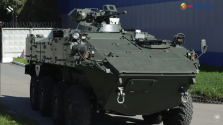
The hatches are only a small part of the differences between this new BTR and the BTR-82.
On the BTR-82A (also known as the BTR-22), the propulsion and transmission system was moved forward to the right of the driver. Only in this way was it possible to create the two hatches on the rear of the vehicle. Therefore, it is not simply a modification of the BTR-82, but can be considered a completely new vehicle that took inspiration from its predecessor, with some similarities and perhaps some components. However, the hull must have been completely redesigned to integrate the new engine and transmission layout, in addition, as the Russians write, to adjustments based on lessons learned during recent conflicts
 

Soldier30

Captain
Registered Member
An operator of the Russian robotic platform NRTK "Courier" demonstrated a version of the robot with a smoke generator and the process of deploying UDSh smoke bombs.
The standardized Russian UDSh smoke bomb is designed for deploying camouflaging aerosol screens. The UDSh smoke bomb weighs 13.5 kg and has a diameter of 320 mm. It creates a smoke screen lasting 8-10 minutes and extending 100-150 meters. Details in the video.


Tam

Brigadier
Registered Member
The hatches are only a small part of the differences between this new BTR and the BTR-82.
On the BTR-82A (also known as the BTR-22), the propulsion and transmission system was moved forward to the right of the driver. Only in this way was it possible to create the two hatches on the rear of the vehicle. Therefore, it is not simply a modification of the BTR-82, but can be considered a completely new vehicle that took inspiration from its predecessor, with some similarities and perhaps some components. However, the hull must have been completely redesigned to integrate the new engine and transmission layout, in addition, as the Russians write, to adjustments based on lessons learned during recent conflicts

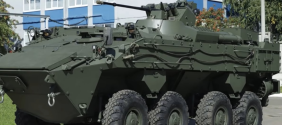
At the cost of sounding pedantic, BTR-82A is the name of the current APC. "A" gets added for the combat module with the 30mm 2A72. Technically the latest batch is now BTR-82AT, with improved thermal sights added and an ATGM. BTR-22 is the one that features a new hull. BTR-82AM is for pre-existing BTR-80 and BTR-80A converted and modernized to this standard, while "A" and "AT" are new build.

The number is likely for the year the design was made. BTR-80 means starting in 1980. Despite coming into service only in the 2000s, BTR-82 might have been first put into paper in 1982.

BTR-87 introduced a rear hatch, engine moved to front right. The designation would have meant it was first put into paper in 1987.

Please, Log in or Register to view URLs content!

BTR-90 would have been first designed in 1990. Eight wheeler IFV using BMP-3 engine and BMP-2 turret. But hatches are still on the side.


BTR-22 would have meant it was first put into paper in 2022 and incorporate all lessons in the war.

Bumerang has two versions, APC called K-16 and IFV called K-17. I assume the first was designed in 2016 and the second in 2017.

Ukraine has a modification of the BTR-80 called BTR-94. We assume it was first designed in 1994. That was before they changed their BTR designation to single digits, BTR-3 and BTR-4, for example.


BTR-87 was something the Russians kept playing around in defense expos, upgrading it after another, and was last shown in 2019. But the way the hull looks, they may have decided to kill the original 87 design and overhauled the concept for the BTR-22.


Last edited:

Soldier30

Captain
Registered Member
Kalashnikov Concern delivered a batch of new Izh-Enduro electric motorcycles and Izh-ScootWay electric scooters to the Russian military. The motorcycles and scooters are equipped with special trailers with a load capacity of up to 200 kg. The equipment was developed to meet the needs of military personnel, who require a quiet vehicle that is particularly effective when operating behind enemy lines. Specifications of the Izh-Enduro electric motorcycle: brushless synchronous IPMSM motor with a power output of 4 kW. Battery type: Li-Ion, transmission: clutch/4-speed. The motorcycle has a range of up to 100 km, depending on operating conditions, a maximum speed of up to 120 km/h, and a weight of 100 kg. Specifications of the Izh-ScootWay electric scooter: battery type: Li-Po, range of up to 100 km, load capacity of up to 300 kg.


sheogorath

Colonel
Registered Member
The number is likely for the year the design was made. BTR-80 means starting in 1980. Despite coming into service only in the 2000s, BTR-82 might have been first put into paper in 1982.
The BTR-82 is an 00's evolution of the BTR-80A, though, which entered service in the 90's as a cheaper alternative to the BTR-90
 
Last edited:

Tam

Brigadier
Registered Member
The BTR-82 is an 00's evolution of the BTR-80A, though, which entered service in the 90's as a cheaper alternative to the BTR-90

The number doesn't denote when it entered service but when it's concept was first laid into paper. You can have something drawn, then the project got tabled, only to be revived at a much later date.
 

spaarg0451

New Member
Registered Member
Please, Log in or Register to view URLs content!
UAC, S7 Group, and GTLC signed a memorandum on the delivery of 100 Tu-214 aircraft

As part of the NAIS 2026 civil aviation infrastructure exhibition, the parties signed a tripartite cooperation memorandum. The document develops the agreements of 2024 and confirms the parties' intention to deliver 100 medium-haul Tu-214 aircraft, including aircraft with enhanced operational characteristics adapted to the operating model of S7 Airlines.

In accordance with the document, the parties plan to sign agreements defining the terms, volumes, and other essential conditions of the deal by the end of 2026. The start of serial aircraft deliveries is scheduled for 2029.

The memorandum fixes the progress made over the past period. Thus, within the framework of joint working groups, S7 Airlines and the United Aircraft Corporation of the Rostec State Corporation have defined the technical appearance of the Tu-214, the necessary refinements to the operational documentation, and the layout of the cabin, which will accommodate up to 213 passengers.

GTLC will act as a financial partner and customer in the project, responsible for organizing the financing and deliveries of new aircraft.

The full cycle of aircraft operation will be ensured by S7 Group companies: the S7 Technics engineering center will become an authorized partner for the technical maintenance of the new type of aircraft, and the S7 Training training center will be responsible for providing a full cycle of training for flight crews and ground staff.

To coordinate all project details, the parties agreed to continue their cooperation in specialized working groups. The focus will be on the economics of operation, the technical maintenance program, the configuration of onboard systems, and the financial and contractual model of deliveries.
 

Tam

Brigadier
Registered Member
Kalashnikov Concern delivered a batch of new Izh-Enduro electric motorcycles and Izh-ScootWay electric scooters to the Russian military. The motorcycles and scooters are equipped with special trailers with a load capacity of up to 200 kg. The equipment was developed to meet the needs of military personnel, who require a quiet vehicle that is particularly effective when operating behind enemy lines. Specifications of the Izh-Enduro electric motorcycle: brushless synchronous IPMSM motor with a power output of 4 kW. Battery type: Li-Ion, transmission: clutch/4-speed. The motorcycle has a range of up to 100 km, depending on operating conditions, a maximum speed of up to 120 km/h, and a weight of 100 kg. Specifications of the Izh-ScootWay electric scooter: battery type: Li-Po, range of up to 100 km, load capacity of up to 300 kg.


Electric bikes are very quiet, which lends to fast stealthy assaults. Assaults using armored vehicles, especially with tracked ones, are too noisy and can be heard from a distance, which can alert artillery and drone operators.

Wheeled vehicles, BTRs, MRAPs, are quieter, but still has internal combustion engine. So too are motorcycles and ATVs. I would not be surprised to see electric ATVs if they are not used already.
 

Soldier30

Captain
Registered Member
Personnel training at a training ground in the Southern Military District for Russian mobile air defense fire teams, formed from contract reservists and designed to protect rear infrastructure facilities from drone attacks. The reservists are learning tactics for repelling air attacks in conditions resembling actual combat.

 
Top