
Russian Military News, Reports, Data, etc.

Tam

Lieutenant General
Registered Member
New loitering drone based on the ZALA KUB family. Unlike Lancets, KUBs are meant to strike stationary targets like fortifications using global satellite positioning navigation.

"The first footage of the new Russian kamikaze drone, the Kub-16, being used in combat in Ukraine. Specifications and close-up footage of the drone have not yet been published. The video shows the arrival of Ukrainian troops and the Kub-16 drone striking a building where a Ukrainian unit is temporarily stationed. The video has been edited to remove any dead bodies."
 

Totoro

Major
VIP Professional
Another major tech trend that i didnot paid attention is that male UAV capabilities.
What Russia really lacks and what has been hurting it in Ukraine, due to said lack, is HALE recon capabilities. A large drone, either a jet powered one or turboprop one (less preferable) holding a large customizable space in its long nose, enough for a side looking sensor. Radar one or EO one, customizable per mission needs. Of course, sensor would need to be of large enough aperture and, in radar payload case, of high enough power input. It'd probably need to be something close to the weight class of RQ4. (14 ton mtow) That's compared to U2 mtow of 18 tons. That's still larger than the largest in-development recon drone Russia has, the Sokol Altius, which is 8 tons mtow. But even the Altius is seemingly too hard for Russian aerospace sector to develop. It's been in development since 2011. Had a first flight in 2016. Yet to date there are just 3-4 prototypes flying. There was a 2021 contract to deliver a small batch of Altius drones to actually be handed over to Ruaf, but to date there have been zero news about that batch actually being produced or reaching any RuAF units. So that's likely experiencing severe delays as well.

But even Altius is really too small for what I am describing above. Large aperture sensors need large aircraft, especially if half-useful mission times are expected. At least 18 hours, preferably 24. Looking at Altius, there's simply no room there for such large aperture sensors. And without those, without enough power for side looking radar - the aircraft would be unable to provide good enough imagery from 200 km away. Which is needed to survey the frontline and 50 km beyond the frontline from a fairly safe distance of 150-200 km away. Anything closer than that risks semi-regular Ukrainian interception attempts.

For all the resources invested in RuAF aircraft - su57, flankers, transport planes and such - it's bewildering that such a crucial category as heavy recon drones, heck even semi-heavy recon drones like Altius, have been left out and have not been able to to be developed in the last 15 years. If Russia had hundreds of recon satellites that might not matter AS much but since Russia is fairly behind on the satellite front, having a fleet of sort of persisting heavy recon drones would go a long, long way to help it survey the area beyond the very front line better.
 

pmc

Brigadier
Registered Member
I think you not understood this Ukraine conflict. Russia is using smaller drones like Zala and Orlon for recon. Crimea is center of Ukraine and as does Belarus. not much runway. I think some version of Shahed drones also gives recon at fairly good distance.
The example of Forpost-R is from the earliest time in conflict. and after that it was improved thats why it was shown in three Royal Kingdom exhibition. They say it can do the work of much larger drones in Mideast heat. this also point to improvement in Russia Radar, EO and communication capabilities.
now question. Can a HALE drone survive against Ukranian air defense from early on? most probably not. Can it be effective.
a large drones over Western Ukraine gives Nato radar and AWACS plenty of time.
how Russia actually fight this war. It used combination of MIG-31 and Su-34M to deal with HIMARS/Drones. the reason is that Mobile air defense like Tor, buk and Pantsir are usually in hidden position and they need some time to be at launch position. so the earliest detection better. think about NATO satellites abilities.
There are some large Sukhoi drones like S-70 and other air launched from Su-57 but we have to see there result.
Please, Log in or Register to view URLs content!
According to the soldiers, the Tor-M2 Arctic has proven itself in the South Donetsk sector, successfully navigating any terrain and capable of crossing water obstacles. "It's based on a DT-30, a two-link, 30-ton amphibious transporter, a modernized version. It's impervious to all obstacles. It can drive through forest belts. It crushes trees, most trees. It can swim. It swims at 5 km/h. You can install a propeller, and then it'll swim at around 15-25 km/h," said a driver-mechanic with the call sign Kudrya.
 

Atomicfrog

Major
Registered Member
What Russia really lacks and what has been hurting it in Ukraine, due to said lack, is HALE recon capabilities. A large drone, either a jet powered one or turboprop one (less preferable) holding a large customizable space in its long nose, enough for a side looking sensor. Radar one or EO one, customizable per mission needs. Of course, sensor would need to be of large enough aperture and, in radar payload case, of high enough power input. It'd probably need to be something close to the weight class of RQ4. (14 ton mtow) That's compared to U2 mtow of 18 tons. That's still larger than the largest in-development recon drone Russia has, the Sokol Altius, which is 8 tons mtow. But even the Altius is seemingly too hard for Russian aerospace sector to develop. It's been in development since 2011. Had a first flight in 2016. Yet to date there are just 3-4 prototypes flying. There was a 2021 contract to deliver a small batch of Altius drones to actually be handed over to Ruaf, but to date there have been zero news about that batch actually being produced or reaching any RuAF units. So that's likely experiencing severe delays as well.

But even Altius is really too small for what I am describing above. Large aperture sensors need large aircraft, especially if half-useful mission times are expected. At least 18 hours, preferably 24. Looking at Altius, there's simply no room there for such large aperture sensors. And without those, without enough power for side looking radar - the aircraft would be unable to provide good enough imagery from 200 km away. Which is needed to survey the frontline and 50 km beyond the frontline from a fairly safe distance of 150-200 km away. Anything closer than that risks semi-regular Ukrainian interception attempts.

For all the resources invested in RuAF aircraft - su57, flankers, transport planes and such - it's bewildering that such a crucial category as heavy recon drones, heck even semi-heavy recon drones like Altius, have been left out and have not been able to to be developed in the last 15 years. If Russia had hundreds of recon satellites that might not matter AS much but since Russia is fairly behind on the satellite front, having a fleet of sort of persisting heavy recon drones would go a long, long way to help it survey the area beyond the very front line better.
Anything that fly slow above Ukraine will be shutdown... even more if its big and slow.
 

Tam

Lieutenant General
Registered Member
HALE won't work, for the same reason MALE won't work. Both sides, Ukrainians especially, are like fighting ants, beavers and worms. They constantly burrow, build tunnels, put artillery and tank pieces inside pits and cover them religiously. They do this especially in forested areas. From a height, given the haze, the fog, the clouds, you're not going to see them.

To detect positions, you need drones that will fly low, slow and hover. Examine a suspected place. Examine suspicious squares and patches on the ground. Examine for antennas and Starlink arrays. Look for flashes and smoke for artillery. Look for smoke and heat emiited by generators. Look for trash thrown away. Look for careless soldiers who decided to go out of their holes to stretch or pee. Follow pickups and ATVs delivering supplies. Follow ground drones and heavy drones delivering supplies.

The result is you have dense coverage of wired and wireless drones, winged drones to Mavics, loitering, looking. Many of these things, like small radars and ECW, small enough to be carried by hand, are going to be missed by drones flying at a great height.

Drones flying from a great height require very high resolution optics that can be very expensive. Recon drones flying from a low altitude look like they are using optics as cheap and with the same grade as security cameras you can buy at Amazon. This enables them to be built cheaply and in scale.

Large drones require runaways and air bases. Good luck when the Ukrainians hit those bases and hangers with ATACMs, Himars, Storm Shadows and long range kamekaze drones. In contrast, small recon drones like the Orlans, Supercats and Z-16s can be carried by hand and loaded in a car. They can be carried by a van, launched with a sling, and recovered anywhere where they parachute.

Russians have drones that do fly high, but they are rarely discussed at all. These are repeater drones that allow for signals to go well over the horizon and at great distances. They tend to be small, and slow, and could be modified versions of Orlans or Gerberas but I'm only speculating because the amount of info released is near zero, other than a phrase or mention in Telegram blogs.

The Russians have another kind of drone which is also rarely discussed and that is a ground and contour terrain mapping drone. These drones, likely modified Orlans, probably designated Orlan-20, map terrain contours to a very high degree of accuracy, and on the assumption that mapping by satellite isn't as accurate or precise and suffer from errors. The information is used for terrain contour navigation with cruise missiles and quite possibly with low flying long ranged drones like Gerans. The information is also used by artillery units so they know the exact height and angle their own units are and of their targets, to allow for precise calculation of their shells.
 

Tam

Lieutenant General
Registered Member
Also to add, to obtain, process, resolve and analyze very high resolution images taken from a high altitude in real time, you need high bandwidth transmission, clearly internet or 5G or wifi speeds that must be broadcasted to a satellite or a high flying repeater. Russia appears to be working on such an infrastructure. But until that happens, Russia has to rely on a dense cloud of low flying drones to sniff out hideouts and heavily camouflaged positions.

Rossoborenexport shows promo video revealing drone dropped warheads and warheads used for loitering munitions like Kubs and Lancets. Drone munitions have gone from field improvised to cottage industry to full scale defense military complex.


AI narrated propaganda video has interesting details of Russia's anti-drone ammunition for assault rifles and details how they work.


Soldier30

Captain
Registered Member
The first footage of the Russian robotic system "Courier," equipped with a North Korean-made Type 75 107mm multiple rocket launcher (MLRS), firing. This is likely a test version of the MLRS-equipped robot and will not be developed further.


pmc

Brigadier
Registered Member
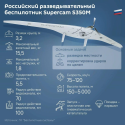
This SuperCAM is silent stealthy. 5000m altitude. manpad will not even see it.
5.5hours.

Please, Log in or Register to view URLs content!

1775791412064.png
Please, Log in or Register to view URLs content!

Supercam Drone Specifications: What Makes It Unique​

The Supercam Drone is a type of fixed-wing UAV with a wingspan of approximately 3.2 meters, enabling it to reach speeds of up to 120 km/h and stay airborne for up to four hours. Its loaded weight is up to 14 kg, and its payload is up to 5 kg, including high-resolution cameras and thermal imagers. According to Wikipedia, its flight range in surveillance mode is up to 240 km, with a 70-100 km interference-free data transmission.

The electric motor is quiet and efficient, making the drone stealthy—like a shadow gliding over the battlefield. Equipped with GPS and automatic takeoff and landing systems, it can operate autonomously, evading detection. In 2025, radio detectors were added that detect approaching interceptors and automatically evade them, according to a post on X from Militarnyi.

Compared to similar drones, such as Ukrainian ones, the Supercam stands out for its weather resistance: it can withstand winds up to 15 m/s and temperatures from -30 to +40°C. These aren't just numbers – they offer a real advantage in winter operations, where other drones freeze or lose signal.

Detailed analysis of sensors and systems​

Sensors are the heart of the supercam drone. Electro-optical cameras offer resolution up to 4K, while thermal imagers operate in the 8-14 µm range, allowing them to detect heat from vehicles at a distance of 5 km. AES-256 encrypted communication protects data, and AI integration enables real-time image analysis.

For advanced users, the ejection system launches the drone in seconds, and the parachute landing minimizes damage. Beginners will appreciate the intuitive control interface, similar to a mobile app, allowing them to set routes with a single tap.
This $56b for expanding satellite coverage, reusable rockets, space station etc. further emphasis on space. I dont see any accelerated importance on AWACS.
Please, Log in or Register to view URLs content!
Russia will allocate 4.5 trillion rubles to the development of reusable rockets and spacecraft.
Russian Prime Minister
Please, Log in or Register to view URLs content!
announced that the government will allocate 4.5 trillion rubles to the creation of the Russian Orbital Station (ROS) and the development of reusable rockets.
He said this at a meeting of the Russian Cabinet of Ministers.
"At the president's direction, we've developed and launched a specialized national project this year with a total funding of approximately 4.5 trillion rubles. These funds will be used to expand the satellite constellation, create our own orbital station, develop efficient reusable rockets, and other priority areas," TASS quoted him as saying.
Please, Log in or Register to view URLs content!
emphasized that special attention will be paid to personnel and highly qualified specialists in the field of astronautics.
Please, Log in or Register to view URLs content!

Russia will return to the space industry's elite: the launch of the Amur-SPG reusable rocket has been accelerated by two years.​

The prototype will be sent into orbit in 2028 instead of 2030​

The year 2028 will be crucial for the development of Russian space exploration, when Russia plans to launch the first prototype of a reusable first stage rocket. This was announced by First Deputy Prime Minister Denis Manturov.
The launch and landing of the experimental prototype is scheduled for 2028. This is a very important step.
Denis Manturov, Deputy Prime Minister of the Russian Federation
In his statement, Manturov spoke about the Amur-SPG methane rocket, the first real attempt to catch up with SpaceX in terms of launch costs.
For a long time, Russia relied on the reliable but disposable Soyuz rocket, but the new project's use of methane instead of kerosene makes the engines more durable and suitable for repeated use.
In addition to the United States and Russia, reusable rocket projects are being developed in China, India, and Europe, but they have not yet reached orbital flights.
It's curious that, literally in January 2026, Roscosmos stated that Amur-LNG
Please, Log in or Register to view URLs content!
, but the deadlines have shifted not to the right, but to the left.
Earlier, www1.ru reported that the universal control system for the new Russian launch vehicle, Amur-SPG, is almost
Please, Log in or Register to view URLs content!
 

Tam

Lieutenant General
Registered Member
Promotion propaganda video with AI narration has interesting new information. New EV motor cross bike for stealthy assaults.

Tracked vehicles have a notorious problem of being loud and noisy. Enough to call FPV operators to take out that APC or IFV. Wheeled vehicles cut down the noise radius, enabling troop disembarkation closer to the conflict zone before detection, but internal combustion engine still gives it away. By turning to EV, you also cut off engine noise, allowing for stealthier assaults.


Tam

Lieutenant General
Registered Member
This from pro-Ukrainian channel, but gives a convenient overview of Russia's winged drones. However there are a few holes here.

Molniya drones while flimsy and potentially problematic, has become a major problem for the Ukrainians at the front lines, so much that suspected facilities producing them were targeted by Ukrainian long range drones. However there does not seem to have any effect on the presence of Molniya on the battlefield. The Molniya has increasingly and popular cheap winged artillery substitute for the Russians. A version of the Molniya is seen with fiberoptic wires and another is used as a mothership for FPV drones.

One problem for interceptor drones that if targeted attack drone begins it's dive, or is already on a dive angle, it is virtually impossible to intercept. There's a case of a Ukrainian interceptor drone closing in on a Molniya, but the Molniya began it's dive on a pickup target. The moment the Molniya dived the interceptor was dusted and could only observe the Molniya's target become a fireball.

Flying higher and faster also makes the strike drone difficult to intercept by interceptor drones, noting the failure of Ukrainian assistance to Arab nations to defend against the Shaheds from Iran. Trying to take out a strike drone via fighter aircraft is also problematic. Using an AAM is far too expensive, and taking one out with a gun can be too close to a fighter that debris could damage it. The slow speed of the drone can also be difficult for a fighter jet to sustain.

Some of the numbers spouted on the production of Gerans are old. There were some claims among Ukrainian reports, which the Russians have no interest or benefit to verify, that as many as 700 drones were being built each day. While we may not know the actual number, what's sure is that they are made in large numbers with enough spares that the Russians are willing to expend them on tactical targets, such as command or drone operator positions, field headquarters, MLRS vehicles, trains, ammunition and supply depots. Such attacks have appeared frequently. In this function, it is paired to an ISR drone, sometimes which the Gerbera decoy drone is employed by attaching a camera. Some Gerans are also using optical cameras, allowing them to precisely target tactical objectives, fuel depots, trains and trucks, and electrical substations, like a loitering munition. During massed raids, Gerans and Gerberas with cameras can be used to spot targets, such as AD assets, and the operator can call an Iskander strike, and the drone itself is used to verify damage or kill.

 
Top