Renminbi (RMB)/Yuan Appreciation & Internationalization

fishrubber99

Junior Member
Registered Member
This is literal madness. 2.5% for a country (no offense to Pakistan) who has been in near-default multiple times, and is still facing loan repayment issues.

China's own government raises at ~1.3%. (Completely risk free rate of return)

This is literal madness, chinese markets need to mature by facing some pain I guess.

Edit: Finally was able to make sense of this issuance. AIIB/ADB jointly have guaranteed 95% of the debt issuance, which coupled with strong ratings for both, makes the coupon rate realistic.

Please, Log in or Register to view URLs content!

The debt issued is ¥1.75 billion yuan which is a marginal amount, and most of that amount is guaranteed by the Asian development bank and Asian infrastructure investment bank which is why the interest rate is so low, calm down
 

Wrought

Captain
Registered Member
Trade settlement is the main vehicle by which yuan usage continues to rise.

Goldman Sachs has found that trade settlement in the Chinese yuan has nearly tripled since 2019, at a time when Beijing is
Please, Log in or Register to view URLs content!
through trade, cross-border payments and financial flows. China-linked trade settlements in yuan grew from 13 per cent in 2019 to 30 per cent last year, although they still lagged the country’s relative weight in the global economy, the New York-based investment bank said in a research note. Total cross-border yuan transactions also rose “sharply” from 9 trillion yuan (US$1.32 trillion) in 2017 to 64 trillion yuan in 2024, according to the note by the bank’s China economist Chen Xinquan.

Please, Log in or Register to view URLs content!
 

Wrought

Captain
Registered Member
Efforts continue to expand digital yuan use cases.

Digital yuan deposit balances and account numbers are now key metrics in how banks are evaluated, the person said, adding that the goal is to build critical mass and an ecosystem that pulls in broader participation. To boost domestic usage, the PBOC is testing applications using "smart contracts" - embedded programs that ⁠trigger automatic payments when predefined conditions are met. Pilots include lottery draws, prepaid cards, government fiscal spending and supply chain financing, the industry sources said. Authorities are also testing the digital yuan to curb medical insurance fraud and track green electricity consumption, leveraging its ability to trace money flows with precision, said the sources. Local governments have set numerical adoption targets and are piloting internal use cases including salary payments and healthcare disbursements, one person at a payment company said. The PBOC is also considering establishing a clearinghouse similar to China UnionPay ⁠to process digital yuan transactions among all operating banks and improve efficiency, sources said. These uses have not been previously reported.

Please, Log in or Register to view URLs content!
 

Wrought

Captain
Registered Member
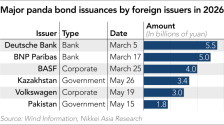
Both countries and banks are joining the onshore bond market in record volumes this year. Low interest rates are a key factor.

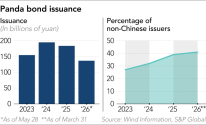
About 133 billion yuan-worth of panda bonds were issued through May 29 this year, according to data provider Wind. That is nearly double the amount in the same period last year and 68% of the full-year tally, putting issuances on track to surpass the record 195 billion yuan in 2024.

The ratio of foreign companies in panda bond issuances by value grew from 27% in 2023 to 41% in the first quarter of 2026, according to Lei Wang, head of research for S&P Global (China) Ratings. "We expect the share of non-Chinese issuers to keep rising and could become the main force in the market," he said.

Driving demand is a low interest rate environment that has remained intact even as the Iran war drives oil prices higher and raises the inflation outlook in other parts of the world. The yield on 10-year government bonds in China stood at 1.73% on May 28, having fallen about 0.8 percentage points since the Iran war started on Feb. 28. During the same period, yields have climbed in the U.S., Japan and Germany.

1780375611669.png

1780375705392.png

Please, Log in or Register to view URLs content!

Meanwhile over in Russia, yuan-denominated bonds are also having their moment on the Moscow Exchange.

LONDON -- Russia will issue yuan-denominated sovereign bonds worth 10 billion yuan ($1.47 billion) Wednesday, the Finance Ministry said, illustrating how Moscow increasingly raises money in China's currency in lieu of dollars to offset the toll of sanctions. The new bonds can be bought with the yuan or the ruble, and the maturity is set at 10 years with a coupon of 7.65%. U.S.-imposed sanctions on the Moscow Exchange, where the bonds will be available, make purchases by overseas buyers complicated.

This follows the first-ever issuance of yuan-denominated bonds by Russia's Finance Ministry in December. The two tranches of three-year and seven-year maturities totaled 20 billion yuan. The bonds being offered this week carry a longer maturity. The move appears intended to meet demand from Russian companies, which often settle payments in yuan, and domestic investors seeking long-term investments in foreign currencies.

Please, Log in or Register to view URLs content!
 
Last edited:

Wrought

Captain
Registered Member
Looks like Brazil will be joining the list of countries in the onshore market later this month.

BRASILIA, June 5 (Reuters) - Brazil plans to announce its first-ever sovereign bond issuance in China, denominated in yuan, during a trip by a large delegation of ‌government officials to the Asian country later this month, two people with direct knowledge of the matter told Reuters.

The official agenda in Shanghai and Beijing led by Brazilian Finance Minister Dario Durigan is expected to run from June 24 to 26.

Please, Log in or Register to view URLs content!
 

Wrought

Captain
Registered Member
Apparently mBridge is finally gearing up for commercial rollout. Certainly took them long enough.

The Beijing-led platform, known as mBridge, is backed by the central banks of mainland China, Hong Kong, Thailand, the United Arab Emirates and Saudi Arabia. A Hong Kong-based entity will be set up to oversee its operations, people familiar with the matter said. They did not reveal the exact date of the commercial launch but said preparations were advanced and that fees would be half those of conventional international payment systems. Smaller businesses that found international payment systems, such as Swift, expensive and difficult were expected to use mBridge, they said.

As a reminder, this is the the digital currency analogue to CIPS (though completely different technically speaking, blockchain blah blah).

China’s drive to widen global use of its currency has been boosted by the Iran war, with adoption of Beijing’s more conventional renminbi cross-border clearing and payments system (Cips) — its version of
Please, Log in or Register to view URLs content!
— surging since the conflict erupted. The mBridge platform is a separate and complementary system, designed to bolster the use of digital renminbi.

The mBridge platform, now led by Beijing, uses blockchain technology to transact directly between central banks using their own digital currencies — reducing the role of the dollar as an intermediary currency and cutting the time to make foreign exchange transactions down to seconds. Commercial banks could participate in mBridge transactions under the supervision of their central banks, people familiar with the project said. So far mBridge had processed about Rmb470bn ($69bn) in transactions to date, the people familiar with the matter said.

Please, Log in or Register to view URLs content!
 

Wrought

Captain
Registered Member
Low rates are drawing more folks into the onshore bond market.

Panda bond issuance has remained robust in recent years. The issuance volume hit a record 197.8 billion yuan in 2024 and totaled 183.1 billion yuan in 2025, according to Moody’s. Issuance exceeded 137.1 billion yuan by the second week of June, up 80.4% from a year earlier. Panda bond issuance totaled 26.64 billion yuan in May, the highest on record for the month, according to Fareast Credit Rating.

Analysts estimate many foreign issuers can raise yuan funding at coupons below 3%, significantly cheaper than comparable dollar borrowing. “We view the key driver as the interest rate gap: funding in RMB is much cheaper than in U.S. dollars,” Moody’s Ratings told CNBC in an email. According to the financial risk assessment group, foreign banks issuing panda bonds can borrow at roughly 1.7% to 2.2%, compared with 4.5% to 5.5% in dollar markets, generating interest savings of two to three percentage points.

Please, Log in or Register to view URLs content!
 
Top