Renminbi (RMB)/Yuan Appreciation & Internationalization

Wrought

Captain
Registered Member
Pakistan is scheduled to issue its first tranche of (onshore) yuan bonds in Q12026.

Buoyed by a return to macroeconomic stability, Pakistan is preparing to launch its first-ever Panda bonds, expected before the end of the current quarter, as it looks to deepen ties with China beyond a relationship long anchored in military cooperation. Analysts say the initial $250 million issuance, with an eventual target of $1 billion, could pave the way for Pakistan to tap China's bond market more regularly.
Please, Log in or Register to view URLs content!
 

Wrought

Captain
Registered Member
Kazakhstan is exploring yuan-denominated bond issuance this year, both offshore and onshore.

In a milestone for financial ties, Kazakhstan — the region’s biggest economy — is
Please, Log in or Register to view URLs content!
its debut yuan panda bonds as early as next month and may seek to raise the equivalent of $500 million.

Kazakhstan’s Baiterek National Investment Holding, a key driver of its development agenda,
Please, Log in or Register to view URLs content!
a potential dim sum bond sale in yuan, a top executive said in February. Retail brokerage Freedom Holding Corp. is
Please, Log in or Register to view URLs content!
a similar offering, billionaire Chairman Timur Turlov said in an interview earlier in the year.

“We expect the first renminbi deal from Central Asia in the first quarter,” said Alex Shupletsov, head of emerging markets coverage at TF International Securities Group Ltd., using the official name for the Chinese currency. The latest deals in the pipeline follow the growing issuance of bonds and loans in the Chinese currency over the past year. State-owned oil producer KazMunayGas National Co. raised
Please, Log in or Register to view URLs content!
, while private bank ForteBank JSC secured a 750 million-yuan loan that included a note saying its use of proceeds included a “particular emphasis on fostering business flows with China.” Shupletsov expects KazMunayGas and state-owned Development Bank of Kazakhstan to become “frequent issuers.”

Please, Log in or Register to view URLs content!
 

Wrought

Captain
Registered Member
A quick note on SWIFT vs CIPS accounting of transactions, as cross-border RMB transactions increasingly migrate from the former to the latter.

On one metric, however, the data, on the surface, seem anomalous. As shown by the red line in the graphic above, the RMB share of payments over SWIFT—the main messaging network for international financial transactions—has been in fairly steep decline since 2024, suggesting a lessening global role for the RMB. This, however, is not the case. As we show in the accompanying vertical green bars, there has, since 2023, been an offsetting rise in RMB transactions over CIPS—China’s system for interbank RMB payments and messaging.

Historically, CIPS payments have been accompanied by necessary SWIFT messages containing payment instructions. As recently as 2022, an
Please, Log in or Register to view URLs content!
of CIPS payments were accompanied by SWIFT messages. Since 2024, however, direct participants in CIPS—the only participants able to make payments accompanied by CIPS messages—have grown by nearly 40 percent: from 139 banks to 193. Direct participation has grown not only in absolute terms but as a proportion of total CIPS membership. This means that large volumes of payments messages that would in the past have gone through SWIFT now go through CIPS. It follows, then, that the decline in the share of RMB payments on SWIFT is not an indicator of a lessening global role for the RMB, but rather of RMB payments becoming less dependent, and therefore less visible, on the SWIFT messaging network.

Please, Log in or Register to view URLs content!
 

Wrought

Captain
Registered Member
Digital yuan operations are being expanded to 12 new banks, more doubling the current number. Long overdue in my opinion.

China is preparing to significantly expand the number of banks authorized to operate its digital yuan, with 12 additional lenders expected to join the program in a move to broaden the currency’s reach, according to people familiar with the matter. The newcomers will join 10 banks already designated as operating institutions for the e-CNY, China’s central bank digital currency (CBDC). The additions are expected to include seven national joint-stock banks and five regional city commercial banks.

Please, Log in or Register to view URLs content!

Also in related news, CIPS has been expanded to process non-yuan transactions.

Beijing recently undertook the first major update to the business rules governing the CIPS – which previously focused on yuan-denominated payments – in eight years, with the new version coming into effect in February. In the revised regulations, the system’s mandate has expanded from cross-border yuan transactions and financial operations to include the offshore yuan, as well as “other business approved by the People’s Bank of China”. The new rules also include a line explicitly mandating the creation of separate operational guidelines for “the processing of cross-border payments in foreign currencies such as Hong Kong dollars through the CIPS”.

The updated regulations have also eliminated a set of strict rules on which financial institutions can participate in the CIPS, instead authorising operating institutions to formulate their own management rules for participants. Ju noted that this flexibility reserved space for attracting more diverse and innovative participants in the future, “which is the foundation for the system to maintain its long-term vitality and competitiveness”. “[CIPS] is no longer limited to the cross-border flow of the renminbi, but has been endowed with the potential to become an infrastructure platform connecting multiple currencies and serving complex cross-border financial transactions,” he added.

Please, Log in or Register to view URLs content!
 

Wrought

Captain
Registered Member
Yuan bond issuance surged to a record high, serving as a financial safe harbour amid Middle East turmoil.

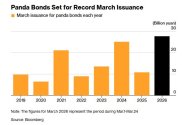
Yuan bond issuance by foreign borrowers has surged in mainland China this month, eclipsing the momentum of such fundraising offshore and highlighting the appeal of a vast local market less affected by the Iran war. So-called panda bonds issued by overseas entities in China’s onshore market have more than tripled on year to 27.8 billion yuan ($4 billion) in March, set for a record for the month, data compiled by Bloomberg show.

The sales boom contrasts with the much slower growth seen in the larger offshore yuan debt market, where issuance plans have been
Please, Log in or Register to view URLs content!
worldwide since the Middle East conflict began. The divergence is a reminder of the Chinese onshore bond market’s relative immunity at times of external uncertainties, when overseas financing using the country’s currency is heavily influenced by global conditions.

panda.JPG

Please, Log in or Register to view URLs content!
 

Serb

Senior Member
Registered Member


Please, Log in or Register to view URLs content!


China’s project mBridge rapidly scales after BIS steps away​

From pilot volumes in 2022 to multi-billion-dollar cross-border settlement by 2025​


ActivityOctober 2022 (Under BIS leadership)November 2025 (Under China and partner central banks’ leadership)
Total number of transactions1604,047
Total transaction volume$22 million$55.49 billion


China also could leverage
Please, Log in or Register to view URLs content!
, a cross‑border payments platform designed to enable direct settlement between central bank digital currencies (CBDCs), for purchases of Iranian oil. Originally incubated under the Bank for International Settlements (BIS) Innovation Hub, the project brings together the PBOC, the Hong Kong Monetary Authority, the Bank of Thailand, the Central Bank of the United Arab Emirates, and the Central Bank of Saudi Arabia. The project has
Please, Log in or Register to view URLs content!
more than 4,000 transactions worth $55.49 billion, with China’s digital yuan comprising 95.3 percent of the volume.


Please, Log in or Register to view URLs content!


Screenshot 2026-04-01 103001.png
 

Wrought

Captain
Registered Member
Short piece on the steady and deliberate liberalization of the capital account.

China’s approach focuses on building a ‘homegrown, risk-controllable cross-border renminbi payment system’. Rather than relying on Western financial infrastructure, China is developing the institutional capacity to support RMB settlement in an increasingly politicised global financial environment, where dollar-based systems have become instruments of geopolitical leverage.

All these developments suggest that China is not edging towards convergence with the liberal financial model, but refining an
Please, Log in or Register to view URLs content!
. Capital account opening is being carefully calibrated to support trade, investment and monetary autonomy without surrendering macroeconomic control. This may appear underwhelming if assessed through benchmarks of conventional liberalisation, but such yardsticks miss Beijing’s priorities. In a world of rising risk of economic sanctions, volatile capital flows and geopolitical fragmentation, China’s priority is stability and resilience rather than financial dominance.

Please, Log in or Register to view URLs content!
 
Top