New SSN (09X?) thread

plawolf

Lieutenant General
In that case, the question then becomes how China would be able to conduct massed and sustained standoff strikes against land and sea targets far beyond the reaches of the PLAAF H-6K/J and PLARF MRBMs into the CentPac and EastPac, let alone the West Coast and East Coast of CONUS, in order to degrade the US's war-making and war-waging capabilities, without having a substantial fleet of SSNs that are able to provide massed standoff hypersonic and/or ballistic firepower to the target?

Yes, we do know that there's the DF-27 - But the purported maximum strike range of ~8000 kilometers would only enable the coverage of Hawaii and the northwestern CONUS (e.g., Kitsap), leaving the rest of CONUS untouched. Developing intercontinental-range conventional strike missiles (somewhat similar in a sense to the Global Prompt Strike idea) would mean a lower cost-vs-benefit ratio, alongside an understandably lower number of missiles that can be procured and deployed.

As long as China doesn't have any footholds up to the 2IC (at least), I certainly don't see how PLAN CVs, CGs and DDGs would be freely sailing within the vicinity of Hawaii, Kitsap, San Diego, or even Norfolk and Newport News to launch strikes against the naval bases and shipyards there, in addition to Palmdale (B-21 production site) and Fort Worth (one of the three F-35 production sites), among other industrial and military sites dotting all across CONUS for the foreseeable future. This is in contrast to how China's eastern seaboard is well within range of the 1IC and 2IC (and that there were never any guarantees of 100% defendability against enemy strikes coming from these island chains and beyond).
This is getting off topic, but is somewhat pertinent in terms of the role and function of the 09X, so it’s with exploring briefly.

You are oversimplifying the strategic choice by not really taking into account current objective reality, what you are trying to achieve and obvious game theory responses of opfor to your moves.

Firstly, the object reality is that America never really seriously expected to be hit in its homeland so unlike Iran, China or Russia, it has not really hardened any of its major strategic industrial assets. And as countless examples of shown, modern America is just frankly terrible at major infrastructure work. That means America actually has a glass jaw when it comes to homeland strategic industrial infrastructure where a relatively small number of hits can achieve pretty disproportionately powerful results. Of all of the targets you reeled off, basically all of them would be irrevocably destroyed by just one round of strikes.

That is not necessarily to say you can dismantle America’s MIC with a few rounds of strikes, but rather than after you have taken out their big factories designed in a time when the idea of conventional strikes against targets deep inside CONUS was simply unthinkable, when they do rebuild, they are not going to make the same mistakes twice so soon again, so will actually be rebuilding with strike resistance in mind.

This means that while the initial salvo might be stupendously successful, subsequent strikes will drop off a cliff in terms of strike effectiveness as all of the low hanging fruit are picked and America naturally responds to the strikes by making their rebuilt MIC far more dispersed and resilient from inception. So the nice big juicy soft targets would be destroyed beyond America’s ability to rebuild, or for those industries they can regenerate, they will be idiots not to go with the Ukrainian model of distributed hidden cell based manufacturing.

All this means that after the first alpha strike, subsequent sustained strikes will carry exponentially greater costs in terms of required weapons numbers while also delivering vastly reduced bang for buck.

As such, the obvious question is, is sustainable fires required or worthwhile? Especially at such high cost? At tgus

If China and America are directly striking at each other’s homelands, then that’s a fight neither side can afford to back down from. While China might hope America will TACO after a short sharp fight, that’s not something they can afford to count on, which means they need to give serious thought to how they can end the fight. And in no realistic scenario is a small, persistent cruise missile strike regime going to force America to its knees in surrender.

It is this near certainty that makes SSGNs unattractive to the PLAN, because no realistically affordable number of SSGNs can allow them to achieve their strategic goal of winning the actual war against the Americans.

Also, history has not really been kind to nations who over invest in niche fields trying to make up for a lack of full spectrum dominance across the board. Better to do what China is already doing, building a comprehensively bigger and better navy, so it can do sustained fires against CONUS with a full spectrum air sea battle body blow after systematically winning the air and sea campaign in the pacific instead of keep hitting them with ineffective jabs at the expense of the rest of the navy.

China has a few 09IIIBs with decent VLS packages and other strike options for alpha strikes to shatter American MIC’s glass jaws early in any conflict, after that, there is minimal additional benefits to be had from follow on sustained strikes, so the kind of investment needed to allow such a sustained strike capability via SSGNs is frankly a poor use of resources.

Remember also, that offence is not the only game in town, and while China’s long range strike options against CONUS will be limited in war, the same can be said about American strike options against mainland China, as all American frontline regional forward bases can be expected to be wiped off the face of the earth in the opening hours or even minutes of commencement of combat. So SSGN/SSN is highly likely to become the primary means by which America will seek to strike at mainland Chinese targets. This is far more likely to be why the 09X’s higher top speed is desirable, so that they can hunt down and run down USN subs doing stand off cruise missile attacks against China. Rather than trying to shave a few days off of the round trip to plink at CONUS targets with their own cruise missiles.
 

bsdnf

Senior Member
Registered Member
It's not, with a 12.5m beam this submarine has a L/D ratio of around ~9.6 compared to 09V's ~9.1 depending on the exact diameter. While it is slightly on the higher side of things, any L/D ratio between 7-10 is still considered optimal for a generally teardrop shaped submarine hydrodynamically.

IMO, the thing is that 09V's propulsion design and architecture is allegedly already extremely advanced to the point that there isn't much to improve upon with current technology. Theoretically, it may be possible for 09X to use more exotic type of reactor like LMR, but I doubt it given tender info do vaguely point to a more standard two looped PWR or use sCO2 as working fluid for turbomachinery though there isn't any evidence of this being the case.

What I find more likely (and Xiyazhou also talked about this) is that 09X uses more advanced quieting technology than 09V. He speculated that 09V may use a similar type of hexagonal rafting as the Yasen class while 09X could possibly use more advanced concepts like magnetic assisted active isolation raft for better broad spectrum acoustic performance.
Changing the reactor type alone warrants building a new Long March as a test vessel; the risk is enormous. The sailless design is already radical enough; the Type 09X cannot afford to add another high-risk design.

SCO₂ generator is also impossible. The Chaotan-1 has only recently entered commercial operation, and the research institute has yet to produce any prototype of a marine MW-class generator; currently, it's only at the hundred-kilowatt level.

Its development path should be: land-based power plant units → surface civilian ship generator units → surface warship generator unit conversion → submarine generator units. We've only taken half a step; reaching the final step may take more than 10 years.
 
Last edited:

tphuang

General
Staff member
Super Moderator
VIP Professional
Registered Member
you need mini-reactors for submarines, so I think the transfer of 200MWt from Russia is likely the culprit here.

by the way, every big shrimps seems to talk about this sub as a total game changer. Very interesting development to see China essentially jump 3 generation in noise level in 4 yrs in terms of launched boats. 093A -> 093B -> 095 -> 09V.

Please, Log in or Register to view URLs content!

at least the intention here is for this sub to be at a different stealth level vs 09V. In terms of stealth vs passive and active + at higher speed.
Please, Log in or Register to view URLs content!

Dreadnought’s outer hull will be much lighter than the true ‘
Please, Log in or Register to view URLs content!
’ construction typical of Russian submarines. And its purpose is different. We know from the common missile compartment, which will be the same as is used on the
Please, Log in or Register to view URLs content!
, that the submarine hull remains the single-hull type. This means that it has its strengthening rings (called frames) on the inside. Russian boats have these frames on the outside, between the two hulls, and use the outer hull as part of their structure. On Dreadnought the outer hull is about stealth.


As well as being angled to deflect incoming active sonar, it will be coated with anechoic tiles. And it is a safe bet that the anechoic coatings will extend to the inside, in the flooded area between the inner and outer hulls.


Some other submarines are also adopting this new take on a double-hull submarine. The German designed Type-212CD will include an even more
Please, Log in or Register to view URLs content!
. There is no suggestion that the British design is borrowing from the German boat however. And the complex multi-layer anechoic treatment is likely unique.

being hybrid hull, like what Dreadnought is described here seems to make a lot of sense as a design with goal of diminishing active sonar return.

At transit speed, stealth vs passive sonar on 09V and 09X is unlikely to be much different, since they are likely very close already. So it seems to me the next step forward is how to return return vs active sonar and at much higher speed.

A lot of the material/rafting technology can be shared between 09V and 09X. There is no fundamental reason why 09V cannot use the same type of tiling material or rafting material as 09X. But what 09X can have is this extra space and external shape designed intentionally with stealth in high speed and against active ping of different band. It will also be expected to pick up these active ping & figure out where the threat comes from.

It seems having hybrid hull could also potentially introduce room for UUVs or other counter measures.

The outer hull will also present some advantages, creating more space under the casing. We can speculate that this could accommodate future sensors, uncrewed underwater vehicles (UUVs) and countermeasures. It also seems likely that the boat’s flank array sonars will be mounted flush with the outer hull. This will be a cleaner than the current British and American boats which have them added as patches.

if we think about this as a high low mix going forward, then there must be advantages for larger, high option that justifies the bigger size. What does it carry for offensive actions?
 

tphuang

General
Staff member
Super Moderator
VIP Professional
Registered Member
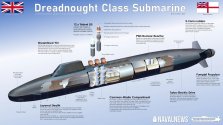
Royal-Navy-Dreadnought-Class-SSBN-Cutaway-scaled.jpg copy.jpg

If we look at this one. It's kind of what 09X could be:

Shaped to deflect active sonar pinging. Layered interior stealth to absorb active sonar. powerful flank array sonar that maybe has active on top of passive transmitter/receivers.

Uses Turbo-Electric drive so that it doesn't have noise mechanical propulsion at high speed.
Since 09X is an attack sub/sub hunter, it would be expected to go at much higher speed, so minimize the sail to reduce the second noisiest feature of sub at high speed.

I would also expect a larger battery pack so you can surge to higher speed to sprint away while having a reactor with full natural circulation.

You'd expect a sub like this to attack enemy naval assets very far away from your own shore, so it needs to be able to scamper away at high speed very quietly and have minimal return vs active & passive sonobuoys.

High power system allows for installation of AI server farm that compute the data from sensors to discover the quietest subs like Virginia, which are more designed to be quiet vs passive sonar (at least that's my impression).
 

mack8

Senior Member
View attachment 176304

If we look at this one. It's kind of what 09X could be:

Shaped to deflect active sonar pinging. Layered interior stealth to absorb active sonar. powerful flank array sonar that maybe has active on top of passive transmitter/receivers.

Uses Turbo-Electric drive so that it doesn't have noise mechanical propulsion at high speed.
Since 09X is an attack sub/sub hunter, it would be expected to go at much higher speed, so minimize the sail to reduce the second noisiest feature of sub at high speed.

I would also expect a larger battery pack so you can surge to higher speed to sprint away while having a reactor with full natural circulation.

You'd expect a sub like this to attack enemy naval assets very far away from your own shore, so it needs to be able to scamper away at high speed very quietly and have minimal return vs active & passive sonobuoys.

High power system allows for installation of AI server farm that compute the data from sensors to discover the quietest subs like Virginia, which are more designed to be quiet vs passive sonar (at least that's my impression).
I know we're probably drifting away, but can we dare hope the 096 SSBN would be at least something roughly like this (Dreadnought) as well, incorporating most/all the advanced tech found in 09X?
 

mister unknown

New Member
Registered Member
Basic clarifying question: what's the available info & consensus speculation (if any) about the 09X's VLS so far? Is it 0 VLS or minimal VLS? My layman's opinion is that even if this is meant to be a dedicated ASW SSN &/or UUV mother ship, it would still be convenient to have a minimal complement of VLS launched missiles, so as to fend off surface enemies at a standoff distance & conduct attacks of opportunity where possible.
 

tphuang

General
Staff member
Super Moderator
VIP Professional
Registered Member
I know we're probably drifting away, but can we dare hope the 096 SSBN would be at least something roughly like this (Dreadnought) as well, incorporating most/all the advanced tech found in 09X?
I'm just speculating based on what we've seen from satellite photos and big shrimp posts. This is still very early on. So, anything I write is just a wild guess at this point. A couple of days ago, I speculated this could carry a large mission module due to its size, but now I have turned completely from that based on new photos and prominent Weibo posts. So, I would not want to speculate 096 at this point.

I think it is kind of interesting to talk about what 095 and 09X might share (as in, similar tech) and where they differ, it seems like larger hull, possibly hybrid vs single? and sail size. You can continue to make 095 better over next 2 decades (just like what they did with 093 series), but you could never significantly change its sail or hull diameter/type.
 

hmmwv

Junior Member
The idea of completely excluding land-attack + anti-ship elements in favor of going 100% with anti-sub elements for the PLAN's subsurface fleet is plain and outright ridiculous.

In that case, then why did China start procuring the J-16s at about the same time as the J-20 began its production run, and that's also when pretty much the entirety of the PLAAF's fighter fleet was made up of 2nd-gen, 3rd-gen and early 4th-gen fighters?

And why did the CCTV announce that the J-35A is a multi-role fighter, instead of an air-superiority fighter like the J-20?
I think you're going a bit extreme, no one is suggesting 09X completely excluding land attack and anti shipping roles, just that its design will not sacrifice any anti-sub performance for multirole purposes, i.e. won't waste space on large VLS cells, but still retain the capabilities of launching YJ-18C and YJ-19 via tubes.

I don't want to going off topics, but to answer your PLAAF question, because J-16 is a very capable air superiority fighter, and used as such, in fact we've seen J10 series being used as multirole fighter more than J-16. This is also the analogy as 09IIIB, as it's available earlier on a mature platform, but will be outnumbered by J-20. Regarding J-35A you can see its design as foremost an air superiority fighter, strike functions are added later but it's not designed around it at all, kinda like 09X can be declared as multirole as well.
 

AndrewS

Brigadier
Registered Member
I think you're going a bit extreme, no one is suggesting 09X completely excluding land attack and anti shipping roles, just that its design will not sacrifice any anti-sub performance for multirole purposes, i.e. won't waste space on large VLS cells, but still retain the capabilities of launching YJ-18C and YJ-19 via tubes.

I don't want to going off topics, but to answer your PLAAF question, because J-16 is a very capable air superiority fighter, and used as such, in fact we've seen J10 series being used as multirole fighter more than J-16. This is also the analogy as 09IIIB, as it's available earlier on a mature platform, but will be outnumbered by J-20. Regarding J-35A you can see its design as foremost an air superiority fighter, strike functions are added later but it's not designed around it at all, kinda like 09X can be declared as multirole as well.

Bear in mind that there are indications that the 09X has 4-5 large payload tubes, which is part of the reason it is 10m longer than the Type-095.

But they may have wanted this increase in length anyway for increased stability due to the elimination of the sail and that those payload tubes could be used for other purposes like launching UUVs as well as missiles.
 

Lethe

Captain
I'm gonna pour some cold water here. What we're seeing is of course significant in many ways, the lack of a sail is not the only factor. There are still many areas of submarine tech where the PLA has not caught up to the latest US tech. I really do think the J-36 comparison (lack of a sail to lack of vertical stabilizers) creates blind spots in how China's submarine progress should be perceived.

And there is also the issue of underwater mapping. China has certainly been working on it, but it is still something that will take much more time.

Per Ayi: The PLA is still not in a position to scoff at the 885M.

The suitability of the J-36 analogy depends on what one means by that. For me, the emergence of J-36 did not so much suggest that China has matched or surpassed the United States across all or even most of the relevant technology domains. Rather, J-36 is significant in demonstrating that Chinese armed forces and industry are no longer content to "follow in the footsteps" of established players such as the United States, Europe, or the former Soviet Union/Russia, but are now forging ahead to embrace new frontiers in service of developing unique solutions addressed to Chinese requirements, heralding a new phase in China's broader military-industrial development. To be sure, a high level of technical accomplishment is bound up in that, but they are not precisely the same stories: a platform like KJ-600 may well be the most advanced and capable example of its type, but fundamentally it is just the latest iteration of a solution that was arrived at some sixty years earlier. J-36 is something different and altogether more intriguing.

From this perspective, 09X tells a similar story. As several posters including myself have noted, the idea of shrinking, streamlining or eliminating the sail is not a new one, but to date nobody had actually taken that final step, because the sail encapsulates a number of useful functions. That China has nonetheless gone ahead and done it, and not in a research paper or on a sub-scale model for hydrodynamic testing or somesuch, but in a full-scale, nuclear-powered submarine constructed at very considerable expense suggests that China's engineers have thought through the full range of implications of not having a sail and developed at least plausible alternative solutions to e.g. mast stowage and deployment, safe maneuvering in harbor, onboarding and offboarding of personnel, etc. As with J-36, 09X is no longer "following in the footsteps" of established players, but forging ahead to embrace new frontiers. And as with J-36, this narrative is entirely compatible with the notion that other nations may retain certain advantages in particular areas, and does not require unbounded assertions of comprehensive primacy. The known and unknown details are certainly fascinating in their own right but, from this perspective, they are not the real story.

I don't think anyone is in a position to scoff at 885M.
 
Last edited:
Top