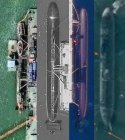
New sailless SSN (provisional)

enroger

Senior Member
Registered Member
How does a submarine prevent rolling without a sail? Esp when turning, it is easy to imagine that the submarine might roll without a rather heavy ballast or perhaps actively managed ballast (i.e. pumping between compartments to compensate) but that might be rather loud.

Possibly center of mass sits much lower than center of buoyancy to provide some static stability, combine with active control control surfaces to enhance vertical stability. It is of course very challenging, otherwise it would have been done before given the advantages in noise reduction and drag reduction.
 

latenlazy

Brigadier
Hmm, what if the Bohai mystery sub is a lengthened variant of the 09V. I'd suppose variations off a standard 09V for different mission specializations are not impossible.
 

tphuang

General
Staff member
Super Moderator
VIP Professional
Registered Member
the only reason I can think of having it so long is a very large mission module, whether it's large VLS farm or some kind of UUV section or both. Probably not used in an attack sub role. Maybe if it is a double hull sub, then it's close to the inner hull of 093B to reduce risks and allowing for earlier mass production. If it doesn't need to be quietest sub with high speed requirement, then using 093B sized pressure hull could be okay.
 

Blitzo

General
Staff member
Super Moderator
Registered Member
the only reason I can think of having it so long is a very large mission module, whether it's large VLS farm or some kind of UUV section or both. Probably not used in an attack sub role. Maybe if it is a double hull sub, then it's close to the inner hull of 093B to reduce risks and allowing for earlier mass production. If it doesn't need to be quietest sub with high speed requirement, then using 093B sized pressure hull could be okay.

I actually think a 120m long hull isn't that long.

A Virginia is 115m long, and it is only Block 5 Virginia that reaches 140m in length (given its hull plugs for additional VLS), or USS Jimmy Carter at 138m in length (given hull plugs for special mission/UUV deployment).


Of course, a 120m long hull could still be a special mission submarine in role (it depends on if the rest of the submarine has a similar weapons fitout to a standard SSN), but the length itself is one which could be within the bounds of a "normal SSN" as well.


If this submarine was 140m long, I would agree that a special mission role/mission module plug would definitely be something to more heavily consider.
 

Lethe

Captain
The problem here is why would "underwater missile trucks" i.e. SSGNs have a smaller hull diameter? Shouldn't they be having similar (if not larger) hull diameters than the "pure-blood" SSNs in order to fit missile tubes that would carry longer and larger-sized anti-ship and land-attack missiles instead? Using a smaller hull diameter could/would inevitably lead to the need for a turtleback design (which is an unavoidable feature on SSBNs, but rather unfavorable on SSNs/SSGNs).

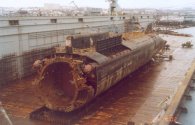
As described by @Tomboy, large missiles could be mounted outside a smaller pressure hull. The wreck of the ill-fated submarine Kursk (R.I.P.) illustrates:

03.jpg

I think an arsenal submarine makes sense. The payload fraction of ballistic/cruse missiles goes from roughly 20% -> 10% -> 5% for ranges of 1600km, 5000km, 10000km. A 5000km range missile on a moving platform is awkward as the total operational cost of a platform plus the munition for payload delivered at range would be similar cost for a 10000km range ballistic/cruise in a silo/TEL, which can hit anywhere relevant in the world from China. For a conventional warhead a moving platform with a shorter range missile makes sense.

A low cost nuclear submarine built to the 20/80 principal focusing on payload delivered to cost ratio with cheap sensors, low crew numbers and reasonable sound levels would be effective and also increase the effectiveness of the navy's other weapon platforms. The key Idea of an arsenal submarine compared to a SSGN is operating as a team. A carrier battle group with 1 aircraft carrier, 4 destroyers, 2 frigates, 2 attack submarines will have their individual capabilities improved by the addition of an arsenal submarine. The destroyers can remove any cruise/ballistic missiles from their VLS and focus entirely on air and missile defense, the attack submarines can likewise also remove their cruise/ballistic missiles they can also forgo VLS tubes and instead dedicate more internal volume to torpedoes. The attack submarines and frigates will keep the carrier battle group safe from other submarines and the aircraft carrier's fighters will keep the air clear from ASW, from this safe bubble sat 2000km from shore the arsenal submarine can move up 1000-1300 km to the shore and launch it's weapons.

From the rumors in this thread i sketched out a design of arsenal submarine based on the typhoon class submarine, at 1.5 billion dollars this should have lower cost per VLS than attritable unmanned small vessels:

If the task is simply to haul payload around, a nuclear-powered submarine is surely the most expensive means of doing it compared to any kind of surface ship. There's a reason the nuclear cargo submarine idea never went anywhere...

How does a submarine prevent rolling without a sail? Esp when turning, it is easy to imagine that the submarine might roll without a rather heavy ballast or perhaps actively managed ballast (i.e. pumping between compartments to compensate) but that might be rather loud.

My (very superficial) understanding is that an ongoing concern for U.S. submarine design is the tendency for a large, forward positioned sail, as American boats tend to have, to contribute to "snap roll" phenomenon whereby the submarine rolls into a rapid turn and, if the roll is not corrected, subsequently into a dive, and that this has prompted exploration of smaller submarine sails to attenuate the phenomenon.
 
Last edited:

Blitzo

General
Staff member
Super Moderator
Registered Member
As described by @Tomboy, large missiles could be mounted outside a smaller pressure hull. The wreck of the ill-fated submarine Kursk (R.I.P.) illustrates:

View attachment 176077

I think what he's asking about is why the reported 10-11m hull diameter could be reconciled as a missile truck/SSGN.
The premise being that the 10-11m hull diameter is the external/overall diameter, which will be the case regardless of whether the submarine is single or double hulled.


... But the question of course is what its actual overall hull diameter is, which we have some disagreement on per the satellite pictures.
 
Top