New Energy Vehicles (NEVs) in China

Lethe

Captain
BYD was Australia's #2 best-selling vehicle brand for the second month in a row, finishing with 8211 sales for the month of May, plus 498 sales for Denza. Even excluding Denza, this was BYD's highest selling month since launch in Australia, eclipsing previous record from June 2025.

This moves BYD into #3 position YTD in what is a tightly packed field beneath Toyota:

1. Toyota 76,017 sales, down 31% YTD
2. Kia 33,841 sales, down 2% YTD
3. BYD 33,454 sales, up 155% YTD
4. Mazda 33,224 sales, down 27% YTD
5. Ford 33,115 sales, down 15% YTD
6. Hyundai 32,110 sales, up 5% YTD

Numbers courtesy of
Please, Log in or Register to view URLs content!
.

With the much publicised recent arrival of BYD's Zhengzhou Ro-Ro ship carrying ~5,000 additional vehicles, it seems likely that BYD will carry forward its sales momentum from recent months to finish as Australia's #2 brand for H1 2026, which would be an astonishing achievement.

(I'll do a more detailed writeup for the quarterly results next month, but suffice to say that China Inc. is flying while Japan Inc. is collapsing before our eyes.)
 
Last edited:

Michael90

Senior Member
Registered Member
Because Koreans are very nationalistic.
That will make sense why. Since I can’t think of any other reason for such a situation . That’s why I always tell some naive people that they are lucky that China or Chinese are more open minded/welcoming. If Chinese were like Koreans , then I don’t think Japanese companies /brands will have much market share in China, even more so when Japanese leaders have taken the unprecedented step of saying Japan will get involved in Chinas core interests and sovereignty inn Taiwan conflict to stop any reunification . The last time the Japanese tried something far less aggressive against Korea a few years ago, almost all their brands in Korea irrevocably lost market share to this day. They still haven’t recovered and had to pull out of Korea.
Please, Log in or Register to view URLs content!

Japan should count itself lucky that Chinese are more tolerant/open minded.
BYD was Australia's #2 best-selling vehicle brand for the second month in a row, finishing with 8211 sales for the month of May, plus 498 sales for Denza. Even excluding Denza, this was BYD's highest selling month since launch in Australia, eclipsing previous record from June 2025.

This moves BYD into #3 position YTD in what is a tightly packed field beneath Toyota:

1. Toyota 76,017 sales, down 31% YTD
2. Kia 33,841 sales, down 2% YTD
3. BYD 33,454 sales, up 155% YTD
4. Mazda 33,224 sales, down 27% YTD
5. Ford 33,115 sales, down 15% YTD
6. Hyundai 32,110 sales, up 5% YTD

Numbers courtesy of
Please, Log in or Register to view URLs content!
.

With the much publicised recent arrival of BYD's Zhengzhou Ro-Ro ship carrying ~5,000 additional vehicles, it seems likely that BYD will carry forward its sales momentum from recent months to finish as Australia's #2 brand for H1 2026, which would be an astonishing achievement.

(I'll do a more detailed writeup for the quarterly results next month, but suffice to say that China Inc. is flying while Japan Inc. is collapsing before our eyes.)
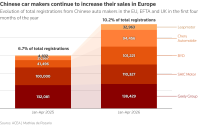
what position is Chery and other Chinese car makers? I think they will also be among the top 10 ?
 
Last edited:

Michael90

Senior Member
Registered Member

Chery will start local production of its models in UK in 2027 & also licensing its EV platform to Tata in India.
Yes , Chery has been the most international and sucesssul Chinese car company overseas, even more than BYD. Though BYD is now catching up fast to them and will probably soon overtake them as well. Chery is doing so well overseas in many markets , even outselling BYD in some markets to et compete overseas . I’m surprised people don’t really talks about them much compared to BYD . They don’t get much media attention despite their huge success. Seems their brand is not as inspirational as BYD.
 

henrik

Captain
Registered Member
Yes , Chery has been the most international and sucesssul Chinese car company overseas, even more than BYD. Though BYD is now catching up fast to them and will probably soon overtake them as well. Chery is doing so well overseas in many markets , even outselling BYD in some markets to et compete overseas . I’m surprised people don’t really talks about them much compared to BYD . They don’t get much media attention despite their huge success. Seems their brand is not as inspirational as BYD.

Chery gasoline engines are taking market share from the Japanese, more so than even BYD.
 

Michael90

Senior Member
Registered Member
Chery gasoline engines are taking market share from the Japanese, more so than even BYD.
Yes Chery's huge success is really undereported to be honest, for some weird reason I don’t understand. The hell, Jaecoo is the best selling brand in UK just last month(first ever for a chinese brand ) and their sales are increasing even more eaxh month.

I think many people dont even know much about them or at all, i think people even recogbise more JAECOO and OMODA brands globally than Chery. Lol
 

PopularScience

Senior Member
Registered Member
Yes , Chery has been the most international and sucesssul Chinese car company overseas, even more than BYD. Though BYD is now catching up fast to them and will probably soon overtake them as well. Chery is doing so well overseas in many markets , even outselling BYD in some markets to et compete overseas . I’m surprised people don’t really talks about them much compared to BYD . They don’t get much media attention despite their huge success. Seems their brand is not as inspirational as BYD.
 

Wrought

Captain
Registered Member
Smartphones on wheels as they say, but Western automakers seem to have missed the memo.

NEW YORK (April 8, 2026) – In the global race to develop software-defined vehicles (SDV), Western automakers and auto suppliers are falling behind where it matters most: software control points, reuse, and lifecycle economics, even as Chinese automakers and technology players accelerate their lead. That’s the key takeaway from an analysis informed by a multi-country survey of 1,000-plus senior SDV-oriented automaker, auto-supplier and technology-industry executives released today by AlixPartners, the global consulting firm.

“Software-defined vehicles are the very future of the global auto industry, and right now that future is being controlled by a much greater degree than many people know by Chinese automakers and by technology companies—and in many cases that control is being ceded to them by Western automakers and auto suppliers,” said
Please, Log in or Register to view URLs content!
, partner and managing director in the
Please, Log in or Register to view URLs content!
at AlixPartners. “Western automakers and auto suppliers are at risk of giving up too much influence at critical SDV control points. That does not just limit future flexibility—it can also weaken cost position, slow reuse, and make it more difficult to capture the full operational benefits of SDV across the vehicle lifecycle.”

The survey of 1,002 senior SDV executives (up to the CEO level) from automakers, Tier-1 auto suppliers and technology companies in North America, Europe, and Asia, found that Chinese automakers are the most focused on how they build and scale SDV capabilities while many Western automakers remain spread across legacy platforms, patched software stacks, and transitional architectures. This leaves Western players at greater risk of dependency on outside partners at key SDV control points and makes it harder to capture full returns from their SDV investments.

Pure technology matters, of course, but also organizational factors like in-house development vs outsourcing are also critical for integration.

  • Forty-one percent of Chinese automakers reported sourcing their SDV initiatives internally compared to just 27% of Western-based automakers – which means that Western players are at a higher risk of being hindered by break points in their tech stacks (e.g. updating CAN controllers that are being provided by some auto suppliers.)
  • In this era of geopolitical cyber concerns, 59% of Chinese automakers say they employ decoupled SDV tech stacks, while 70% of Western automakers are muddling through using single, “patched” stacks—which is a big strategic risk for them.
  • Thirty-nine percent of Chinese automakers rely on central/zonal SDV architectures, while 67% of Western automakers report using suboptimal hybrid architectures.
  • According to the survey, 94% of Western automakers report they currently monetize less than half of their SDV features, mostly due to technical constraints and customer resistance.

Please, Log in or Register to view URLs content!
 
Top