
You are using an out of date browser. It may not display this or other websites correctly.
You should upgrade or use an alternative browser.
You should upgrade or use an alternative browser.
New Energy Vehicles (NEVs) in China
- Thread starter supercat
- Start date

Tesla launches 55 V4 Supercharger stations across expressways in Chongqing on March 28. [Photo provided to chinadaily.com.cn]
US EV maker Tesla has put into operation its largest supercharger project on China's expressway network, with 55 charging stations simultaneously opening on Saturday across highways in Southwest China's Chongqing.
During a launch ceremony on Saturday at the Dazu Rock Carvings express service area, Huang Lei, general manager of Tesla Western China, explained that the newly opened stations use Tesla's V4 Supercharger technology.
These stations are strategically distributed across key transport corridors, covering 10 of China's national expressways. This network links urban Chongqing with districts and counties in its northeastern and southeastern regions, with charging stations appearing approximately every hour along these routes.
Huang noted that by connecting major highway nodes, this project is expected to improve interprovincial travel for electric vehicle users to facilitate journeys between Chongqing and neighboring provinces.
According to the company, as of March this year, Tesla has built over 2,500 supercharger stations with over 12,000 charging piles across the Chinese mainland. The company has also deployed more than 650 destination charging stations, bringing total coverage to all provincial-level regions and most prefecture-level cities.
Zhou Peng contributed to this story.

More than 100 robot taxis running Baidu autopilot stopped at the same time in Wuhan due to a fault, blocking traffic. I'm actually surprised they're centrally controlled, seems like a vulnerability that can be exploited to cause mass disruptions.
Last edited:

I’m disappointed that infotainment systems in China’s new energy vehicles haven’t yet reached the point of excess computing power. This year, BYD’s infotainment systems generally come with a 778G chip and 12GB RAM plus 128GB storage—a configuration that’s far too underpowered for an electric vehicle expected to last 8 to 12 years.
I believe that within the next two years, in-car infotainment systems must be upgraded to a performance level featuring an 8G3 chip with 12/16 GB of RAM and 256/512 GB of storage.
Mobile phone chips have, to some extent, become overpowered, while in-car systems are still struggling to keep up with demand—which is deeply disappointing.
I believe that within the next two years, in-car infotainment systems must be upgraded to a performance level featuring an 8G3 chip with 12/16 GB of RAM and 256/512 GB of storage.
Mobile phone chips have, to some extent, become overpowered, while in-car systems are still struggling to keep up with demand—which is deeply disappointing.
In a Price war, the AI bubble and the West's sanctions ahead of the node, the Chinese semiconductor ecosystem is still in the process of being built. I don't expect that will happen soon, at least 5 years to have an abundance of computing power.I’m disappointed that infotainment systems in China’s new energy vehicles haven’t yet reached the point of excess computing power. This year, BYD’s infotainment systems generally come with a 778G chip and 12GB RAM plus 128GB storage—a configuration that’s far too underpowered for an electric vehicle expected to last 8 to 12 years.
I believe that within the next two years, in-car infotainment systems must be upgraded to a performance level featuring an 8G3 chip with 12/16 GB of RAM and 256/512 GB of storage.
Mobile phone chips have, to some extent, become overpowered, while in-car systems are still struggling to keep up with demand—which is deeply disappointing.
As I suspected
New Energy Vehicles (NEVs) in China
has become a possibility
There is criticism that CKD is not manufacturing. To certain extent, it is true. However, you have to start somewhere. The factory's intertwined history can tell...
The Brampton (then Bramalea) plant was opened in the 80’s by one of the predecessor company’s of Stellantis (American Motors - AMC). AMC's next big project in the 80's was opening a plant in Beijing to build CKD Jeep Cherokees imported from America. The first western car company to do so...
New Energy Vehicles (NEVs) in China
has become a possibility
There is criticism that CKD is not manufacturing. To certain extent, it is true. However, you have to start somewhere. The factory's intertwined history can tell...
The Brampton (then Bramalea) plant was opened in the 80’s by one of the predecessor company’s of Stellantis (American Motors - AMC). AMC's next big project in the 80's was opening a plant in Beijing to build CKD Jeep Cherokees imported from America. The first western car company to do so...

EU tariffs have been largely ineffectual as Chinese sales continue to rise.
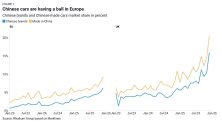
While sales at home are languishing, China-based carmakers are having a ball in Europe. In December, a record 9.3% of new cars sold in the EU were made in China, while in the UK the share surged to a striking 20.6%. For the full year, China-made vehicles accounted for 6.4% of EU sales and 12.1% in the UK (Figure 1). The success of Chinese car exports comes despite the EU’s countervailing duties on Chinese-made battery electric vehicles (BEVs), in place since October 2024 (Figure 2). While the measures briefly slowed exports in late 2024, shipments have since rebounded to pre-duty levels. At the same time, exports of internal combustion engine (ICE) and plug-in hybrid vehicles (PHEV) which are not subject to additional duties have risen rapidly. This has meant that overall passenger car exports from China reached 922,000 units, up 29% year-on-year. In early 2026, exports are accelerating even further, reaching 214,000 units in just the first two months, up 62% year-on-year.
Death, Taxes, and Baidu screwing up again. Three certainties of life.
More than 100 robot taxis running Baidu autopilot stopped at the same time in Wuhan due to a fault, blocking traffic. I'm actually surprised they're centrally controlled, seems like a vulnerability that can be exploited to cause mass disruptions.

Seems like a major security concern.
More than 100 robot taxis running Baidu autopilot stopped at the same time in Wuhan due to a fault, blocking traffic. I'm actually surprised they're centrally controlled, seems like a vulnerability that can be exploited to cause mass disruptions.
To do what exactly?I’m disappointed that infotainment systems in China’s new energy vehicles haven’t yet reached the point of excess computing power. This year, BYD’s infotainment systems generally come with a 778G chip and 12GB RAM plus 128GB storage—a configuration that’s far too underpowered for an electric vehicle expected to last 8 to 12 years.
I believe that within the next two years, in-car infotainment systems must be upgraded to a performance level featuring an 8G3 chip with 12/16 GB of RAM and 256/512 GB of storage.
Mobile phone chips have, to some extent, become overpowered, while in-car systems are still struggling to keep up with demand—which is deeply disappointing.