Mom, can we have a J-36? The J-36 at home:
Two F/A-18G Growlers attempted to combine into a single F-36 in an experimental mating ritual. It was unsuccessful. However, valuable data was collected. Win!

You are using an out of date browser. It may not display this or other websites correctly.
You should upgrade or use an alternative browser.
You should upgrade or use an alternative browser.
Miscellaneous News
- Thread starter bd popeye
- Start date

China didn't "fold" against Australia quietly after a while, the relationship between China and Australia recovered because the PM responsible for the period of heightened tension - Scott Morrison suffered a decisive defeat in 2022 general election. The new and current PM - Anthony Albanese has a much friendly attitude towards China, eg:I don’t think your previous analysis captured the reality of China’s economic strategy toward non-U.S. Western competitors. You described China as an “appeaser” that symbolically retaliates and then folds, resetting to “business as usual” with Australia, Canada, and the EU. But if that were truly the case, China’s economic ascent and deep inroads into high-value-chain industries would not have triggered such panic across the developed Western economies.
Take the very examples you mentioned. The reality is the inverse of the “folding” narrative. In high-value sectors — especially passenger vehicles/EVs, renewable energy components, batteries, and solar — China has not bent over and said “more please.” It has advanced aggressively. The data I researched (pre- and post-dispute) shows a decisive structural shift in China’s favor, despite tariffs, security warnings, and intense information campaigns.
Here is the before-vs-after picture:
Sector Pre-Dispute (2019–early 2020) Post-Reset / 2025–2026 Structural Shift Passenger Vehicles (incl. EVs) Chinese brands < 2% market share; almost no EVs China = #1 source of new vehicles (25–28% YTD 2026); Chinese-built cars = 20–25%+ of all new sales; Chinese brands supply ~77% of all BEVs sold in Australia Complete reversal. China went from marginal player to dominant supplier in the highest-value consumer durable (cars) EV-specific Negligible Chinese EVs dominate sales; BYD and others leading growth Despite security warnings and “information warfare” from Australian defence circles, consumer demand overrode policy pushback Renewable components (solar, batteries) Minor supplier Major supplier of panels, batteries, and related tech Strong re-engagement and growth
Europe & UK
Sector Pre-2022/2023 2025–early 2026 Structural Shift EVs & Hybrids Chinese brands < 1–2% of EV market Chinese-built vehicles = 19% of European EV market in 2025 → 22% in 2026; Chinese EV/hybrid exports to EU nearly doubled in early 2026 Rapid penetration despite EU countervailing tariffs (imposed 2024 onward) Batteries & Renewables Significant but not dominant China supplies vast majority of imported batteries and solar components; strong growth in high-value green-tech exports EU tariffs and “de-risking” rhetoric have slowed but not stopped the advance
Your framing captures an older, commodity-focused pattern that no longer describes the strategic reality. In the sectors that will define economic power for the next decades, China is not appeasing. In my view it is advancing, and Western (plus Japanese/South Korean) attempts to constrain it are proving far less effective than the rhetoric suggests. The structural trade picture has shifted decisively in China’s favour in precisely the high-value areas the West most wants to protect - hence the current EU strategy of borrowing and reversing China's playbook back when it opened up it's economy to western countries investments in exchange for technology transfer, educating its population for market access. The absurdity on this particular scenario is that the EU countries most vociferous in it's condemnation of China's economic "bullying" is that China set the condition when it was technologically backwards and dirt poor and underdeveloped, whereas these western countries are already highly developed economies. So the Europeans are quite sclerotic when it comes to their economic history.
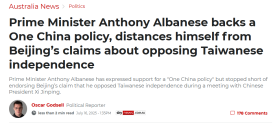
Under him many trade barriers erected by Scott Morrison were taken down. He also navigated geopolitical events with finesse. For example for the 80th anniversary of Victory over Japan military parade while he didn't attend himself (as Trump didn't get an invite), he tacitly allowed Former Victorian Premier Daniel Andrews (a politician who himself is notably friendly to China, signing up to BRI) to attend where Andrews was given a VIP seat with the other world leaders, right behind Kim Jong Un even.
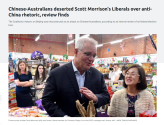
One of the factor in Scott Morrison's defeat in the 2022 election was his pro-US anti-China attitude, complete with running a sinophobic election campaign. It caused Australian Chinese diaspora to vote away from his party the Liberals in overwhelming fashion, to the degree that extremely safe seats with large Chinese diaspora populations like Kooyong that has always voted conservative since the formation of the nation changed colour and voted in an independent:
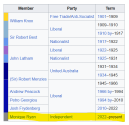
(In Australian politics Liberal = conservative, Labor = progressive)
After Trump became president, Liberal suffered a further decisive defeat in 2025 federal election where the Liberals campaigned on being US aligned, only to have Trump place tariff on Australia during his liberation day tariff war half way through the election campaign.
Last edited:
Yesthis was today?
I don’t think your previous analysis captured the reality of China’s economic strategy toward non-U.S. Western competitors. You described China as an “appeaser” that symbolically retaliates and then folds, resetting to “business as usual” with Australia, Canada, and the EU. But if that were truly the case, China’s economic ascent and deep inroads into high-value-chain industries would not have triggered such panic across the developed Western economies.
Take the very examples you mentioned. The reality is the inverse of the “folding” narrative. In high-value sectors — especially passenger vehicles/EVs, renewable energy components, batteries, and solar — China has not bent over and said “more please.” It has advanced aggressively. The data I researched (pre- and post-dispute) shows a decisive structural shift in China’s favor, despite tariffs, security warnings, and intense information campaigns.
Here is the before-vs-after picture:
Sector Pre-Dispute (2019–early 2020) Post-Reset / 2025–2026 Structural Shift Passenger Vehicles (incl. EVs) Chinese brands < 2% market share; almost no EVs China = #1 source of new vehicles (25–28% YTD 2026); Chinese-built cars = 20–25%+ of all new sales; Chinese brands supply ~77% of all BEVs sold in Australia Complete reversal. China went from marginal player to dominant supplier in the highest-value consumer durable (cars) EV-specific Negligible Chinese EVs dominate sales; BYD and others leading growth Despite security warnings and “information warfare” from Australian defence circles, consumer demand overrode policy pushback Renewable components (solar, batteries) Minor supplier Major supplier of panels, batteries, and related tech Strong re-engagement and growth
Europe & UK
Sector Pre-2022/2023 2025–early 2026 Structural Shift EVs & Hybrids Chinese brands < 1–2% of EV market Chinese-built vehicles = 19% of European EV market in 2025 → 22% in 2026; Chinese EV/hybrid exports to EU nearly doubled in early 2026 Rapid penetration despite EU countervailing tariffs (imposed 2024 onward) Batteries & Renewables Significant but not dominant China supplies vast majority of imported batteries and solar components; strong growth in high-value green-tech exports EU tariffs and “de-risking” rhetoric have slowed but not stopped the advance
Your framing captures an older, commodity-focused pattern that no longer describes the strategic reality. In the sectors that will define economic power for the next decades, China is not appeasing. In my view it is advancing, and Western (plus Japanese/South Korean) attempts to constrain it are proving far less effective than the rhetoric suggests. The structural trade picture has shifted decisively in China’s favour in precisely the high-value areas the West most wants to protect - hence the current EU strategy of borrowing and reversing China's playbook back when it opened up it's economy to western countries investments in exchange for technology transfer, educating its population for market access. The absurdity on this particular scenario is that the EU countries most vociferous in it's condemnation of China's economic "bullying" is that China set the condition when it was technologically backwards and dirt poor and underdeveloped, whereas these western countries are already highly developed economies. So the Europeans are quite sclerotic when it comes to their economic history.
Here is the problem with your analysis. You are equating Chinese industrial success with actual Chinese government showing toughness when they get attacked by the EU or any other western country. Are they in any way comparable?
China's industry is successful because of many factors including its much lower GDP per capita and this lower cost of engineers and factory workers, huge population of STEM grads, massive govt investment, infra and so on.
That has nothing to do with how tough Chinese government is when they attacked by the west.
If EU attacks China with tariff on EVs, which is a new and high tech industry, and China only hits back by putting tariff on some EU farm goods, are they in any shape or form equal actions?
No, its China doing a much lower level attack on a good they don't need and that has no strategic significance.
If EU bans Huawei and ZTE using national security and China does nothing, Is China being tough?
EU nationalizes Nexperia and Italy takes back a few companies Chinese companies bought. When was the last time China took control of a European company in China?
What has China done to make Australia walk back on the massive anti-China attacks under Morisson? Huawei ban, national security legislation veto power, foreign interference law....the list goes on. Has Australia walked back any of those things? No. But China walked backed on its hidden trade restrictions on coal and iron imports. Again, chickening out.
Let's face it. China is a pragmatic, successful and slowly getting powerful country. But its completely timid against the west. That is the fact. Maybe because China keeps its head down that EU still allows Chinese cars, perhaps they would have banned them completely by now if China showed some spine. But the fact is, China still is too timid.
Successful without dignity, that is China.
Last edited:

manqiangrexue
Brigadier
You say China is timid, but actually we already did these things to them before they did it to us. They wanna ban tiktok? We already banned Facebook, Google, Yahoo, etc... They want us to share our EV tech to enter their markets? We already demanded that of them for ICE cars. There are many things we never allowed the West or Western companies to do in China that China can do in the West but since they wanted to change course now rather than 30 years ago, it seems they attacked us. The result is indeed our success, as I pointed out here: Miscellaneous News And the dignity is not that we always find zingers to hit them with at negotiations, but that in the end, trade always prevails to our favor and that the leader of the free world bows to China while kicking the EU like a bunch of miserable alley mutts.Here is the problem with your analysis. You are equating Chinese industrial success with actual Chinese government showing toughness when they get attacked by the EU or any other western country. Are they in any way comparable?
China's industry is successful because of many factors including its much lower GDP per capita and this lower cost of engineers and factory workers, huge population of STEM grads, massive govt investment, infra and so on.
That has nothing to do with how tough Chinese government is when they attacked by the west.
If EU attacks China with tariff on EVs, which is a new industry, and China only hits back by putting tariff on some EU farm goods, are they in any shape or form equal actions?
No, its China doing a much lower level attack on a good they don't need and that has no strategic significance.
If EU bans Huawei and ZTE using national security and China does nothing, Is China being tough?
EU nationalizes Nexperia and Italy takes back a few companies Chinese companies bought. When was the last time China took control of a European company in China?
What has China done to make Australia walk back on the massive anti-China attacks under Morisson? Huawei ban, national security legislation veto power, foreign interference law....the list goes on. Has Australia walked back any of those things? No. But China walked backed on its hidden trade restrictions. Again, chickening out.
Let's face it. China is a pragmatic, successful and slowly getting powerful country. But its completely timid against the west. That is the fact. Maybe because China keeps its head down that EU still allows Chinese cars, perhaps they would have banned them completely by now if China showed some spine. But the fact is, China still is too timid.
Successful without dignity, that is China.
If you ban this and ban that, all you do is create lazy monopolies. Chinese EV and telecoms success was forged by the competition against the European companies.I didnt know China nationalized German car brands in China. But EU did takeover Chinese companies. EU banned huawei and many other chinese companies from various sectors. What has China banned that explicitly that is from the EU?
Hence the think in the west that,If you ban this and ban that, all you do is create lazy monopolies. Chinese EV and telecoms success was forged by the competition against the European companies.
"if we keep hitting China, they won't hit back because they are too money hungry".
"If we ban this from China, they won't do anything cause their economy will lose all vitality without western companies, so they can't hit back"
China is seen as too pragmatic, too money hungry and thus easily hittable.

AssassinsMace
Lieutenant General
Pay money to apply for a visa and then you lose it when they reject you? It sounds like an another European scam like how they wanted to tax the world’s airliners for pollution even for ones that didn’t travel to or across Europe. Really, was the money going to go solve the world’s pollution problem? No, it was just to generate a new revenue scheme for EU economies. It shows you how desperate they are over there where they know how everyone is going to protest so they hide it under fighting for the environment. True democracies are suppose to disclose what the money is specifically going to be used for. They didn’t.
Europe doesn’t like how Trump thinks the world including Europe owes so much to the US that he expects them to hand over billions of dollars to him for nothing. Well what is it when Europe thinks China is suppose to just handover its best EV technology to them and get literally nothing from it? They don’t think that’s the cost of paying tribute to them for nothing like it’s owed to them?
manqiangrexue
Brigadier
China's seen as winning too hard so in desperation, they're trying to hit to gain an advantage but China always counters it so that the advantage either remains or increases. China has already hit them a lot decades ago protecting the Chinese economy and that's when China saw them as capitalists that will sell the rope they are hung with. If it took a person with a room temperature IQ to be stupid enough to believe that China is easily hittable, that room is now in the arctic after watching Trump;s begging tour in China. But still, they must struggle because they feel China eating even the crumbs of thier lunch as this rate.Hence the think in the west that,
"if we keep hitting China, they won't hit back because they are too money hungry".
"If we ban this from China, they won't do anything cause their economy will lose all vitality without western companies, so they can't hit back"
China is seen as too pragmatic, too money hungry and thus easily hittable.
After Trump became president, Liberal suffered a further decisive defeat in 2025 federal election where the Liberals campaigned on being US aligned, only to have Trump place tariff on Australia during his liberation day tariff war half way through the election campaign.
To be fair, even if Trump didn't start tariffing Australia on Liberation Day, Dutton's buffoonery did a lot of heavy lifting and doomed that campaign before it even began.
Leaving aside the usual anti-Chinese rhetoric from his lackeys like Well Done Angus, Dutton's + "" + dodging questions about helping first homebuyers ("see? I'm just like the rest of you!") were just some of the own goals that the Liberals scored. Trump ironically didn't play much of a part in the election outcome compared to everything else.