
You are using an out of date browser. It may not display this or other websites correctly.
You should upgrade or use an alternative browser.
You should upgrade or use an alternative browser.
J-35A fighter (PLAAF) + FC-31
- Thread starter ACuriousPLAFan
- Start date

I've always found it strange how WS-19 could be so expedited compared to WS-15 and doubted that J-35A uses WS-19 from the get go. Sure it benefits immensely from WS-15 experience and technology being directly available to the WS-19, cutting down the development cycle time and cost.
WS-21 being used for introduction block J-35 and J-35A makes sense. It is an engine below the tech level of WS-19 and is basically equivalent in tech to WS-10B/C/X.
WS-19 should reach maturity readiness after WS-15 and WS-15 has barely reached maturity readiness for mass production and application yet.
The confusion with J-35A already using WS-19 probably stems from the alleged news that J-35A has been tested with WS-19. That's not the same as maturity to apply on all production fighters.
WS-10A reached maturity readiness in the early 2010s for widespread adoption on J-11B and onwards land based Sino-Flankers. WS-10B only reached maturity for J-10C application in the mid to late 2010s.
We should expect WS-19 to be on later block J-35s.
On the question of carrier J-35, WS-21 has had years and years of head start vs WS-19 for navalised version and saline environment modification, testing and evaluation over those years.
WS-21 being used for introduction block J-35 and J-35A makes sense. It is an engine below the tech level of WS-19 and is basically equivalent in tech to WS-10B/C/X.
WS-19 should reach maturity readiness after WS-15 and WS-15 has barely reached maturity readiness for mass production and application yet.
The confusion with J-35A already using WS-19 probably stems from the alleged news that J-35A has been tested with WS-19. That's not the same as maturity to apply on all production fighters.
WS-10A reached maturity readiness in the early 2010s for widespread adoption on J-11B and onwards land based Sino-Flankers. WS-10B only reached maturity for J-10C application in the mid to late 2010s.
We should expect WS-19 to be on later block J-35s.
On the question of carrier J-35, WS-21 has had years and years of head start vs WS-19 for navalised version and saline environment modification, testing and evaluation over those years.

The confusion comes from Yankee specifically claiming J-35A is using WS-19 on Chahuahui. Hard to know who to believe right now.The confusion with J-35A already using WS-19 probably stems from the alleged news that J-35A has been tested with WS-19. That's not the same as maturity to apply on all production fighters.
Huitong is an aggregator, not a primary source. He’s gotten things wrong before.The confusion comes from Yankee specifically claiming J-35A is using WS-19 on Chahuahui. Hard to know who to believe right now.


Did not see this posted

欧阳振我86468 hints at, and 鹰眼军视 says the WS-19 is in service with the J-35A
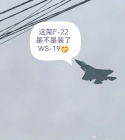
I thought it's already in service??
The discrepancy in development and testing times is simply because of differing levels of ambition. The current WS15 is simply gigantic in terms of airflow, with 35kg/s of equivalent core airflow, around 20% more than f119 and f135. Theoretically the design allows up to 200kn of thrust but is limited to 175 or 180kn for much better turbine life, fuel efficiency and electricity generation. Meanwhile WS19 has around 20kg/s of equivalent core airflow which is still within the normal range.
Eh that’s not what the head of the WS-19’s program said.The discrepancy in development and testing times is simply because of differing levels of ambition.