Future PLAAF fleet procurement and composition

AndrewS

Brigadier
Registered Member
View attachment 170268

Interesting video! Thanks for sharing. :)

According to the speaker, retired USN Commander
Please, Log in or Register to view URLs content!
, who had previously served as the Assistant US Naval Attache in Beijing (
Please, Log in or Register to view URLs content!
):

- AVIC will be producing 250 to 300 4th and 5th generation fighters annually by 2027 (he probably actually meant 4.5 and 5th generation fighters).

- Under the "worst case numbers" scenario for the US, the PLAAF and PLANAF will have as many fighters as the USAF, USN and USMC combined by 2028.

- "By 2029, China will have the largest fighter force on the planet and will continue to grow."

He's talking about the rationale being that China wants a huge Air Force and aircraft carriers for expeditionary operations, but that doesn't make sense and is a case of projection.

1. What possible expeditionary operations is he talking about, given that China prefers to trade, rather than use military force like the USA? What implacable enemies does China have? What "allies" does China have? And even if that is the case, China won't have many aircraft carriers by 2030.

2. There's a much simpler answer. In a Taiwan scenario, the USA has said it has the option of going to war with China, which potentially means a long protracted war. In order to win this, at the bare minimum, China would need to have a larger Air Force and also outproduce the USA in military aircraft.
 

Tomboy

Captain
Registered Member
IMO an average production rate closer to 200 per year for 5th generation fighters is more realistic over the next 5 years. 4th generation should be limited to only special mission and naval aircraft from this year on while older J-10As, J-11As and Su-30s would likely be fully retired from active combat units to training and reserve as even the newest of these aircraft would be nearing/over 20 years old by 2030, leaving the least capable active fighter in PLAAF roster by 2030 being a few J-11BGs and JH-7As probably only in a few backwater units.

Fighter fleet composition by 2030 would likely consists of roughly 50 percent 5th generation fighters while the other half being advanced 4.5th generation like J-10C/B and J-16s and a small amount of legacy fighters. I foresee that the manned fleet will only grow moderately but will be thoroughly modernised while the unmanned fleet will see major growths to fill numerical requirements for future combat.

PLANAF will probably retire most if not all of the original J-15s to go for a fully modernised fleet in the next 5 years.
 

Blitzo

General
Staff member
Super Moderator
Registered Member
Overall some of the estimates by think tanks (RUSI, Mitchell Institute etc) in terms of future fleet procurement are indeed a bit behind the times by extrapolating past 4.5th gen production as continuing.

Of course, we have the benefit of the grapevine telling us that vanilla J-16 production is winding down/already stopped, and knowledge that PLA has ceased J-10C procurement for a while.


Taking that with knowledge of J-20 family and J-35/A production scale, and estimating the maximal demand that exists for J-15T/DT and J-16D, means it's pretty reasonable to predict the PLA will sunset 4.5th gen airframe procurement by the end of this decade, or perhaps later/earlier depending on if they scale down or up annual production rates.


In terms of manned tactical fighters (not including CCA/USAF), it is very reasonable to argue that most new PLA fighter procurement between now and 2030 is likely to be 5th gen (J-20A/S, and J-35/A), with only a minority being 4.5th gen (J-16D, J-15T/DT), and in the immediate post 2030 environment, procurement likely will be overwhelmingly 5th gen with maybe small numbers of 6th gen types starting to trickle in.
 

Wrought

Captain
Registered Member
If—as the diagram purportedly suggests—PLAAF is indeed on track to field a fleet of ~3500 manned aircraft by 2030, then there are verifiable secondary indicators which should readily corroborate that trajectory. 3500 planes demands (at least) 3500 pilots, who in turn demand commensurate support staff and facilities. That means we should see barracks, hangars, new bases, new units, a dramatic expansion of topline headcount and budget; all of which is quite impossible to conceal at the required scale and none of which happens overnight. Where are the thousands of new pilots making their journey through the training pipeline? Where are the dozens of new facilities under construction? Where is the billions in procurement and personnel funding?

Strange as it sounds, this claim fails for the exact same reasons as every conspiracy theory. It only makes sense in its own myopic context of pure production, without any of the necessary followthrough to make said production useful. The math just doesn't math.
 

sunnymaxi

Colonel
Registered Member
If—as the diagram purportedly suggests—PLAAF is indeed on track to field a fleet of ~3500 manned aircraft by 2030, then there are verifiable secondary indicators which should readily corroborate that trajectory. 3500 planes demands (at least) 3500 pilots, who in turn demand commensurate support staff and facilities. That means we should see barracks, hangars, new bases, new units, a dramatic expansion of topline headcount and budget; all of which is quite impossible to conceal at the required scale and none of which happens overnight. Where are the thousands of new pilots making their journey through the training pipeline? Where are the dozens of new facilities under construction? Where is the billions in procurement and personnel funding?

Strange as it sounds, this claim fails for the exact same reasons as every conspiracy theory. It only makes sense in its own myopic context of pure production, without any of the necessary followthrough to make said production useful. The math just doesn't math.

''hOw pLaAf wILL tRaIn 3000+ piLoTs'' This is just the cope from western experts.

all training infrastructure does available and their budget doesn't count in overall PLA annual budget. its civil-military fusion.

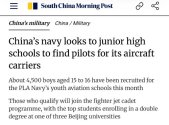
The PLAAF operates a competitive "3+1" dual-enrollment cadet program with top Three Beijing universities to train elite fighter pilots.

here is the one example of PLAN. they have already recruited 4500 young cadets for naval aviation.

PLAN aviation.jpeg


PLAAF still have large number of older flanker series , J-10A, JH-7.. this new J-20/J-35 production is to replace older already existed PLAAF aircrafts.
 

Wrought

Captain
Registered Member
''hOw pLaAf wILL tRaIn 3000+ piLoTs'' This is just the cope from western experts.

all training infrastructure does available and their budget doesn't count in overall PLA annual budget. its civil-military fusion.

The PLAAF operates a competitive "3+1" dual-enrollment cadet program with top Three Beijing universities to train elite fighter pilots.

here is the one example of PLAN. they have already recruited 4500 young cadets for naval aviation.

View attachment 170285


PLAAF still have large number of older flanker series , J-10A, JH-7.. this new J-20/J-35 production is to replace older already existed PLAAF aircrafts.

Uh no, you should reread what I wrote more carefully. The Western experts did not address pilots at all, and apparently assume they all just spawn out of the aether. Nor did I say that PLAAF is incapable of expanding their training pipeline to accomodate a huge new cohort of pilots; what I did say is that we have not seen indications of them doing so. And the same goes for infrastructure expansion, etc. In other words, I'm saying the logical underpinnings of said Western experts is faulty because it clashes with empirical observations. If someone tells you it's raining, but the road is dry, then a hefty dose of skepticism is warranted.

And 4,500 students who will be screened for university entrance is very much not the same as 4,500 uniformed pilots-in-training.
 

sunnymaxi

Colonel
Registered Member
Uh no, you should reread what I wrote more carefully. The Western experts did not address pilots at all, and apparently assume they all just spawn out of the aether. Nor did I say that PLAAF is incapable of expanding their training pipeline to accomodate a huge new cohort of pilots; what I did say is that we have not seen verifiable indications of them doing so. And the same goes for infrastructure expansion, etc.

And 4,500 students who will be screened for university entrance is very much not the same as 4,500 uniformed pilots-in-training.
sir my point is, all AVIC subsidiaries massively expanding their production. look at SAC largest integrated manufacturing plant for J-35/J-XD. it means they know what they are doing. this thing indicate the PLAAF fleet size in coming years.

and i agreed with you. 4,500 students are not the same as trained pilot but PLAN has already started their preparation for future carrier operations.
 

Wrought

Captain
Registered Member
sir my point is, all AVIC subsidiaries massively expanding their production. look at SAC largest integrated manufacturing plant for J-35/J-XD. it means they know what they are doing. this thing indicate the PLAAF fleet size in coming years.

and i agreed with you. 4,500 students are not the same as trained pilot but PLAN has already started their preparation for future carrier operations.

The expansion in production is what we are all here talking about right now. It is a confirmed fact. What is neither confirmed nor factual is the proposition that PLAAF is going to use said production to massively expand its manned fleet between now and 2030. Because if that were true we would—and don't—see all sorts of other expansions going on simultaneously to support it.

Production capacity is of course an important factor, but it's also important to avoid overindexing on it. Take Bohai, with its 20 submarine bays. Does it logically follow that it is currently producing 20 submarines at once?
 
Last edited:

Blitzo

General
Staff member
Super Moderator
Registered Member
If—as the diagram purportedly suggests—PLAAF is indeed on track to field a fleet of ~3500 manned aircraft by 2030, then there are verifiable secondary indicators which should readily corroborate that trajectory. 3500 planes demands (at least) 3500 pilots, who in turn demand commensurate support staff and facilities. That means we should see barracks, hangars, new bases, new units, a dramatic expansion of topline headcount and budget; all of which is quite impossible to conceal at the required scale and none of which happens overnight. Where are the thousands of new pilots making their journey through the training pipeline? Where are the dozens of new facilities under construction? Where is the billions in procurement and personnel funding?

Strange as it sounds, this claim fails for the exact same reasons as every conspiracy theory. It only makes sense in its own myopic context of pure production, without any of the necessary followthrough to make said production useful. The math just doesn't math.

As various people have pointed out, the diagram/projection of annual aircraft procurement is likely an overestimate, with particular over-exaggerarion of how many 4.5th gen aircraft the PLA will be procuring going forwards.

The diagram/graph isn't set in stone, it's just their own estimate which we should be viewing critically rather than accepting at face value.

"If—as the diagram purportedly suggests—PLAAF is indeed on track to field a fleet of ~3500 manned aircraft by 2030" shouldn't be on the cards to begin with, instead we should be just saying "the diagram's projection is likely incorrect in a couple of key ways".
 

tamsen_ikard

Captain
Registered Member
''hOw pLaAf wILL tRaIn 3000+ piLoTs'' This is just the cope from western experts.

all training infrastructure does available and their budget doesn't count in overall PLA annual budget. its civil-military fusion.

The PLAAF operates a competitive "3+1" dual-enrollment cadet program with top Three Beijing universities to train elite fighter pilots.

here is the one example of PLAN. they have already recruited 4500 young cadets for naval aviation.

View attachment 170285


PLAAF still have large number of older flanker series , J-10A, JH-7.. this new J-20/J-35 production is to replace older already existed PLAAF aircrafts.
These 4th gen J-10As,Bs J-11 are actually very new, only produced after 2005-2012 time frame. Even Jh-7A is quite new in terms age of the airframes only starting induction in 2004. Knowing how PLA doesn't like to retire assets before they are actually old, I feel like China will not retire those planes early. They will likely expand the air force with these older airframes now, prepare the training, pilots and facilities for the real Dominance of the PLA Air force, which is 3000+ 5th and 6th gen fighters in service along with 6k+ CCA. This should happen in maybe 20 years.

China with its population, location and future GDP potential of 50+ trillion USD should easily be able to afford 3000+ fighter jets. They also need it because most of China's adversaries are very close by and can be covered by land based Air Force.

I expect China's land air force to be twice as big as the US over time in terms of fighter jets.
 
Top