Climate Change and Renewable Energy News and Discussion

Wrought

Senior Member
Registered Member
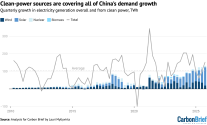
CO2 emissions were flat in the past 18 months despite surging power demand. Record renewable installations have stepped up to fill the gap.
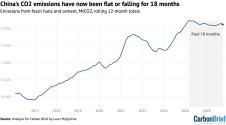
China’s carbon dioxide (CO2) emissions were unchanged from a year earlier in the third quarter of 2025, extending a flat or
Please, Log in or Register to view URLs content!
trend that
Please, Log in or Register to view URLs content!
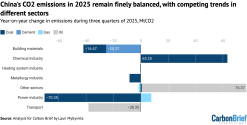
in March 2024. The rapid adoption of electric vehicles (EVs) saw CO2 emissions from transport fuel drop by 5% year-on-year, while there were also declines from cement and steel production.
  • Power-sector CO2 emissions were flat in the third quarter, even as electricity demand growth accelerated to 6.1%, from 3.7% in the first half of the year.
  • This was achieved thanks to electricity generation from solar growing by 46% and wind by 11% year-on-year in the third quarter of 2025.
  • In the first nine months of the year, China completed 240 gigawatts (GW) of solar and 61GW of wind capacity, putting it on track for a new renewable record in 2025.
  • Oil demand and emissions in the transport sector fell by 5% in the third quarter, but grew elsewhere by 10%, as the production of plastics and other chemicals surged.

1762881576277.png

1762881799807.png

1762881814305.png

Please, Log in or Register to view URLs content!
 

Wrought

Senior Member
Registered Member

Wrought

Senior Member
Registered Member
Wind and solar installations in 2025 are expected to remain world-leading.

In 2025, Ember forecasts that China will install 66% of global solar capacity and 69% of global wind capacity. As recently as 2022, China made up less than half of global solar and wind additions (46% and 47% respectively). This remarkable growth means China has been the largest contributor by far to the growth in global renewable deployment.


1763692707858.png

Please, Log in or Register to view URLs content!
 

Wrought

Senior Member
Registered Member
Turns out that giving your central bank a political mandate means it can then drive political goals, i.e. green investment. Not a terribly surprising conclusion, really.

In comparing climate policies, we first find that PBoC is the only central bank that conducts meaningful monetary policy that supports the green transition, such as through targeted green lending, green bonds in collateral frameworks, and differing interest rates on reserve requirements. Second, in comparing independence dynamics, we find that the initiative for green action originates in higher government bodies, which directly command the PBoC to act, while the PBoC retains a high degree of operational independence when executing these policies. On the other hand, legal independence, mandates, and other restricted avenues of government influence restrict the green action of the other central banks. As the literature on central banking develops, it has demonstrated that consensus on monetary policy moves in cycles, notably from a period of non-independence during the Great Inflationary period of the 1970s to the present state of independence following the Great Moderation (Best, 2025; Downey, 2024; Moschella, 2024).

Indeed, before contemporary views of independence were commonplace, non-independent central banking was common in the post-war years across both democratic and undemocratic countries (Best, 2025; Moschella, 2024). From this, we argue that the climate era requires revisiting central bank independence. As a first step in this effort, the insights from the PBoC suggest that central banks can address the climate crisis through a setup that embraces what we term ‘government directing with operational independence.’ This suggests that future research on the topic needs to both place greater emphasis on the case of PBoC and explore how nonindependence might work across the world.

Please, Log in or Register to view URLs content!
 
Top