Pop Mart makes really good products. I own a few. They make great gifts for children, teens, young women in their early to mid 20s, old grandmas, etc.Labubu strike again..
Samsung Electronics' Executive Chairman Lee Jae-Yong was spotted buying Labubu products at JD Mall in Beijing's Shuangjing subdistrict. Lee attended the China-South Korea Business Forum yesterday as a supporting activity for South Korean President Lee Jae-Myung's state visit to China from Jan. 4 to tomorrow

You are using an out of date browser. It may not display this or other websites correctly.
You should upgrade or use an alternative browser.
You should upgrade or use an alternative browser.
Chinese Soft Power and Media Discussion and Updates
- Thread starter tankphobia
- Start date

You know you're cool when they use a clip of Chinese carrier operations to illustrate American firepower:

Account based inYou know you're cool when they use a clip of Chinese carrier operations to illustrate American firepower:
South Asia

Trying to doxx someone from Central Party School? Really?
Apparently some Chinese shit libs are resorting to their favorite tactic — doxxing the author of the article and cyberbullying him or her…
View attachment 167649
View attachment 167650
View attachment 167651


Once again, people like you if you can help them in meaningful material ways. Soft power is downstream of hard capabilities.
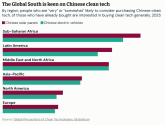
Working with the insights and advisory firm GlobeScan, we looked into global attitudes towards clean tech, whether built in China or not. Surveying 32,000 people in 33 countries from July to September 2025, we that solar panels and electric vehicles are extremely appealing, with more than eight in ten people expressing an interest in these technologies or having already bought them. Affordability remains a consistent barrier to purchase among those who are interested, but with prices still falling, many of those who are clean-tech curious may soon become adopters and advocates.
There is overwhelming interest in sub-Saharan Africa, for instance, where 87% of people across Kenya, Nigeria and South Africa say they are likely to consider buying Chinese-made solar panels. The same goes for 69% of people in Latin America and 67% in the Middle East and North Africa. Meanwhile, across Europe, on average 35% express interest. In the US and Canada, it’s only slightly higher, at 38%.
Yet another example of persuading people by delivering material outcomes.
Not just about what you do either, but how you do it.
Even skeptics can be won over if you improve their lives.
The professor in Australia says it's hard to tell who is winning. The citizen on the ground?
At a church hall on the outskirts of Honiara, dozens of community leaders gathered for a training session organised by the Chinese police, alongside local officers. Among them is Ben Angoa, who has enthusiastically embraced the training, as well as other things has provided: solar lighting, sewing machines, soccer balls, and even noodle-making lessons. “We really love China,” he says.
The sessions – along with the provision of blue uniforms, flashlights and fleets of police cars – are among the many ways Beijing supports Solomon Islands policing. They’re also a powerful reminder of the battle for influence, taking place across this strategically important nation; what Australian foreign affairs minister Penny Wong has characterised as the “permanent contest” to be the “partner of choice” in the Pacific.
For Angoa, the choice is simple. China has “impact in the community,” he tells the Guardian at the training session in late 2025, “and that’s something we don’t have from our other partners.”
In recent years, Australia has concentrated on the police while China focused more on the communities the police are meant to serve. “Australia’s approach is through formal partnerships and that excludes the involvement of community leaders. This approach obscures the fact that most disputes are managed by community leaders and not the formal police.”
Not just about what you do either, but how you do it.
In Solomon Islands, much of what China and Australia offer is the same: both provide advisers who rotate in and out of police stations. Both have also donated so many police cars that the Honiara police headquarters resembles a dusty used car lot. Australia and China have provided weapons, and officers from Solomon Islands travel regularly to both countries for training.
But there are also differences. Australia has focused on building the capability of the 1,100 strong police and ensuring it is fully equipped, with their programme budgeted at more than $170m, according to the Australian Federal Police. Solomon Islands government has recently requested even further support from Canberra, with Anthony Albanese’s government announcing an additional $190m in commitments in 2024. That initiative has reportedly now stalled.
Beijing provides far fewer staff – there are approximately a dozen Chinese police trainers in Honiara, three times fewer than the number of Australians – but their training sessions which have been rolled out across the capital, demonstrate the different approach China is taking in its engagements.
Even skeptics can be won over if you improve their lives.
Felix Bosokuru, a former politician from Malaita province now in the property sector, believes China’s efforts are working.
“Australia needs to remix the record and stop playing the same song,” Bosokuru says. He was sceptical about Chinese efforts before attending a community leader training session, but his attitude is shifting.
The professor in Australia says it's hard to tell who is winning. The citizen on the ground?
Still, he worries about the ramifications of the geopolitical jostling. It creates rifts within the police, he says, with senior figures perceived as pro-Beijing or pro-Canberra.
“There is a battle for hearts and minds going on” he says, noting how Australia recently erected large billboards around Honiara trumpeting its partnership with the police. And who is succeeding? “China is, definitely’, he replies.


Quality shitposting.