Chinese Soft Power and Media Discussion and Updates

Matcher6130

New Member
Registered Member
I wonder if it would be like the auto industry. China had silently developed the world's largest car market AND the world's dominant reservoir for auto parts. No one knew this until five years ago and then in a period of just four years it shot to the top of the world:

If the underpinnings are there then things could happen very quickly once the ball gets rolling. Like autos, China has the world's largest gaming, animation and drama industries. The largest short film and other new age media beginning with Douyin/Tik Tok.

As well as the 2nd largest traditional film markets for good measure.

I see it as bubbling volcano that can explode at any time.
I'll push back on this a little.

Li Qiang saw the potential in China's auto market. That's why he bet his career on supporting Elon Musk in building Gigafactory Shanghai. He realized the Chinese EV industry, which started in 2009, was reaching a critical milestone and tapping into Tesla's expertises would be a key step towards to global dominance. His ascension to Premier of China combined with the might of the Chinese EV industry is clear evidence this wasn't luck, but the results from a highly skilled and knowledgable politician.

I'm not seeing anyone remotely similar to Li Qiang in regards to culture and media. At best you have Xi Jinping repeatedly saying he'd like to see more Chinese culture by Chinese people, but this sentiment isn't echoed beyond "yeah I think that'd be nice too". Granted I'm not an insider nor a poliburo watcher so if someone wants to fact-check me, please do.

For transparency, this subject really hits close to home for me because whenever the subject of "Chinese culture" comes up, it's always about old things: hanfu, gongfu cha, etc. Even Xi Jinping's sentiments are about reviving old customs, which is fine but art and culture are living expression of society. They should always advance forward and unapologietic in creating something new.

I'll even give you some examples.
My personal favorite is China's tattoo industry where caligraphy and ink wash art are not only alive and well, but
Please, Log in or Register to view URLs content!
.
There's Chinese fashion where designers are going to the roots of Chinese fashion and modernizing it
Please, Log in or Register to view URLs content!
, AKA the same path the French took to create Art Deco.
In modern Chinese architecture, there
Please, Log in or Register to view URLs content!
. The designer I linked is Liu Jiakun winner of the 2025 Pritzer Prize AKA "The Nobel Prize of Architecture".
Even more stereotypically "old" culture is chugging along, with Yue Opera paving a rennisance
Please, Log in or Register to view URLs content!
.

At the risk of being inflamitory, this is absolutely to be blamed on the central government considering all of European, American, Japanese, and even Korean culture are prominent internationally because their respective governments devoted considerable resources in promoting it. Yet here we are, having a discussion about Chinese culture and media that most Chinese people don't even realize exists.
 

meedicx

New Member
Registered Member
At the risk of being inflamitory, this is absolutely to be blamed on the central government considering all of European, American, Japanese, and even Korean culture are prominent internationally because their respective governments devoted considerable resources in promoting it. Yet here we are, having a discussion about Chinese culture and media that most Chinese people don't even realize exists.

It's frustrating to discuss the success or failures of China cultural exports because it's 100% vibe based. Any datapoint gets played up or played down depending on personal preferences. People may also have different interpretations of the concepts of cultural exports and soft power and that also sometimes derails the conversation.

Someone should try to make an objective index, otherwise it devolves into arguments like "Genshin is too Japanese or mobile games don't count as soft power"

I wonder if it would be like the auto industry. China had silently developed the world's largest car market AND the world's dominant reservoir for auto parts. No one knew this until five years ago and then in a period of just four years it shot to the top of the world:

If the underpinnings are there then things could happen very quickly once the ball gets rolling. Like autos, China has the world's largest gaming, animation and drama industries. The largest short film and other new age media beginning with Douyin/Tik Tok.

As well as the 2nd largest traditional film markets for good measure.

I see it as bubbling volcano that can explode at any time.

I'll list some Chinese video game industry data that may surprise people.

1) At 287k employees (
Please, Log in or Register to view URLs content!
), China has more people working in the video game studios than the 4 next biggest countries combined: US (
Please, Log in or Register to view URLs content!
), Japan (
Please, Log in or Register to view URLs content!
), Korea (
Please, Log in or Register to view URLs content!
) and Canada (
Please, Log in or Register to view URLs content!
).

2) Due to exposure bias, millennials may think Japan and Korea are more successful exporting video games than China to the west. This is not necessarily true - just look at the
Please, Log in or Register to view URLs content!
in what the industry calls the "Tier-1 West" (US, CA, AU, UK, DE, FR) markets for 2025: There are 30 Chinese publishers in the top 100 (Funfly and FunPlus use tax HQ but development happens in China) Compare that to only 4 Japanese publishers and 4 Korea publishers

You also use the same tool to discover that Chinese game publishers are much more successful than Korean publishers in the Japanese market. And vice versa, Chinese game publishers are much more successful than Japanese publishers in the Korean market

3) China is the biggest video game exporter already, with Chinese game studios based in China earning $18.6B overseas in 2024. This does not count overseas subsidiaries owned by Chinese companies.

4) I'm going to emphasize the scale of Tencent's gaming business. In China alone, Tencent employs 43k employees in it's gaming division which is more than the entirety of Canada and also more than the Japan-based game division employees of all of the 6 major Japanese publishers - Bandai Namco, Konami, Sega Sammy, Square Enix, Capcom, Koei Tecmo - combined. You can even add Nintendo and all it's subsidiaries and it won't surpass Tencent's employee count

Counting Tencent's international studios,
Please, Log in or Register to view URLs content!
that Tencent's overseas gaming business (exclude domestic revenues) by itself earned more than the entire revenue of top US peers in the last quarter
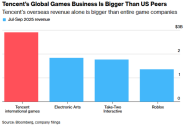
1765726752857.png

In 2024, Tencent's overseas gaming business by itself earned $8.0B in revenue, which is more than all of Nintendo ($7.5B incl. hardware, $4.5B for software only) including both it's international and domestic businesses.
 
Last edited:

TPenglake

Junior Member
Registered Member
At the risk of being inflamitory, this is absolutely to be blamed on the central government considering all of European, American, Japanese, and even Korean culture are prominent internationally because their respective governments devoted considerable resources in promoting it. Yet here we are, having a discussion about Chinese culture and media that most Chinese people don't even realize exists.
Not inflammatory since Chinese cultural exports are now at an inflection point and its helpful to talk about how they could improve. When it comes to the domestic front's attitudes, I would say perhaps 4 years ago the government may have been 100% to blame with the cultural crackdowns. But today, ever since Genshin and WuKong made it big, they're constantly praising IP's that make it big globally and promoting it more. Most notably the drama industry where they removed many restrictions they imposed in the past and stated they would do more to support that sector. Currently anybody who's watched Chinese content in the past few years knows that in many ways, the government's okay with just about anything nowadays. Their main redlines remains politically sensitive stuff, BL, and excessive wealth worship, the former two are regrettable but it is what it is and as the for the last one tbh it wouldn't hurt considering our modern world.

Rather I think Chinese people's attitudes towards their own media are interesting to say the least. It's a paradox that consumption of foreign media is declining in China, but large sections of the Chinese populace are still pretty condescending towards the quality of their own domestic IPs. I already mentioned before how unlike foreign audiences Chinese thought TBHX sucked. Also with Zootopia 2's recent success in China, many people were saying how domestic animation is hopeless and that you were an ultranationalist if you thought Nezha 2 can even hold a candle to Disney. Meanwhile others chimed in and said, so what if they think that since Zootopia 2 was just another generic Disney sequel and reviews in the West would say as much.

All in all, I think these are trivialities. The talent is clearly there and the momentum is building. The future is never certain, but I would gander to say the growth of Chinese cultural exports is a winning bet.
 
Last edited:
Top