Chinese semiconductor thread II

tokenanalyst

Lieutenant General
Registered Member

Tianyi Crystal Energy achieves breakthrough in 6-inch 3C-SiC wafer technology, ushering in a new era for the application of domestically produced third-generation semiconductors.​

Silicon carbide (SiC) wafers, as the core cornerstone of the third-generation semiconductor industry, directly influence the performance ceiling of high-end semiconductor devices and the height of industrial development through their growth process and crystal form selection. Currently, while 4H-SiC dominates the industry, its application limitations are gradually becoming apparent. Meanwhile, 3C-SiC, with its unique crystal structure, has become a key direction for breakthroughs in high-end applications. 3C-SiC growth is extremely difficult, prone to phase transitions, and struggles to achieve stable growth of a single crystal form. Globally, there is no mature, large-scale growth technology, and its liquid-phase growth method is still in the early stages of exploration, becoming a common problem plaguing the entire industry. For over three years, the Tianyi Crystal Energy R&D team has focused on liquid-phase growth technology, ultimately achieving successful growth of 6-inch 3C-SiC wafers. The liquid-phase growth technology has resulted in wafer purity and crystal quality far exceeding traditional processes, and has solved the industry pain point of 3C-SiC's difficulty in large-scale production.

Dr. Lin Hongfeng, founder of Tianyi Crystal Energy, conducted postdoctoral research on "Growth Process and Defect Control of Large-Diameter Czochralski Single Crystal Silicon" under the guidance of Professor Yang Deren (Academician of the Chinese Academy of Sciences) at Zhejiang University in 2008, accumulating profound theoretical foundation and practical experience in liquid-phase crystal growth technology. He subsequently served as R&D leader at industry leaders such as Tianwei New Energy Holdings Co., Ltd. and LONGi Green Energy Technology Co., Ltd., continuously cultivating liquid-phase crystal growth technology for approximately fifteen years, accumulating rich industrial resources and technological expertise. Chengdu Tianyi Crystal Energy Semiconductor Co., Ltd. was established in 2022. The company is committed to industrializing the most advanced international liquid-phase silicon carbide crystal growth technology to accelerate the large-scale application of silicon carbide in new energy vehicles, charging piles, inverters, 5G communications, rail transit, energy storage, and other fields, achieving independent control of core technologies in China's third-generation semiconductor-related fields. Since its establishment, the company has obtained numerous national-level enterprise certifications, including: National High-tech Enterprise, Sichuan Provincial Science and Technology-based SME, Sichuan Provincial Innovative SME, Chengdu High-tech Zone High-level "Four Talents" Enterprise, and Chengdu High-tech Zone Leading Science and Technology Park "Seed-stage Young Eagle Enterprise." Simultaneously, the company has obtained 10 national authorized patents and 7 national software copyright registrations, with over 20 invention patents pending. This series of authoritative certifications and intellectual property achievements fully demonstrates the company's technological innovation capabilities, R&D strength, and strong development potential in the field of liquid-phase silicon carbide.
Please, Log in or Register to view URLs content!
 

tokenanalyst

Lieutenant General
Registered Member

Hua Hong Semiconductor, latest performance results announced​

Hua Hong Semiconductor announced on the Hong Kong Stock Exchange that its fourth-quarter sales revenue reached a new record high of US$659.9 million, representing a year-on-year increase of 22.4% and a quarter-on-quarter increase of 3.9%. Gross margin was 13.0%, up 1.6 percentage points year-on-year and down 0.5 percentage points quarter-on-quarter. Profit attributable to owners of the parent company was US$17.5 million, compared to a loss of US$25.2 million in the same period last year and a profit of US$25.7 million in the previous quarter. Hua Hong Semiconductor expects its first-quarter sales revenue for 2026 to be between US$650 million and US$660 million, with a gross margin of approximately 13% to 15%.​

Please, Log in or Register to view URLs content!
 

tokenanalyst

Lieutenant General
Registered Member

Toujing Technology: Continuously driving breakthroughs in thin film deposition and 3D integration equipment​


The company continues to improve its thin-film deposition equipment product portfolio and promote breakthroughs in high-end products. In the field of thin film deposition equipment, the company has built an equipment matrix covering a full range of thin film materials, including PECVD, ALD, SACVD, HDPCVD, and Flowable CVD, deeply covering the needs of diverse application scenarios such as logic chips, memory chips, and advanced packaging. By the end of 2025, the company's products had entered more than 70 chip manufacturing plant production lines. Cumulative shipments of reaction chambers exceeded 3,000 units, with the proportion of high-performance reaction chambers used in advanced processes continuously increasing; the cumulative wafer fabrication volume on client production lines exceeded 396 million wafers; and the average stable operating time of client equipment exceeded 90%, reaching the international mainstream level.

The company is actively developing 3D integration equipment, and product progress is smooth. The application scenarios of 3D integration equipment continue to expand with the evolution of semiconductor technology. In multiple fields such as 3D NAND, HBM, and CIS, high-density integration of chips with different functions can be achieved through advanced bonding technology, breaking the physical limitations of single-chip process evolution. The company continues to expand semiconductor equipment applied in the field of 3D integration, launching advanced bonding products such as wafer-to-wafer high-precision hybrid bonding and supporting quantity inspection products. Currently, the company has shipped multiple 3D IC series devices to customers, and verification is progressing smoothly.

Please, Log in or Register to view URLs content!
 

tokenanalyst

Lieutenant General
Registered Member

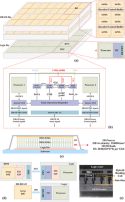
A scalable 1L2D multi-core near-DRAM computing architecture leveraging 3D hybrid bonding for high-performance data-intensive applications​

Abstract​

The rapid growth in AI computational demands has exposed memory bandwidth and energy efficiency bottlenecks in traditional Von Neumann architectures. To overcome these, we propose a scalable one-logic-two-DRAM multi-core near-DRAM computing architecture using 3D hybrid bonding technology. Our design integrates RISC-V processor arrays and DDR4 controllers with DRAM, enabling high-density interconnects and low-energy data transfer. Key innovations include a 1L2D multi-core architecture with 3 μm hybrid bonding, a co-optimized memory access scheme, and a RISC-V scalar-vector heterogeneous design with efficiency hybrid bonding interconnect, enabling scalable bandwidth, near-linear performance scaling, and balanced programmability-energy efficiency. Experimental results demonstrate a 3.07 × improvement in bandwidth and a 76 % reduction in energy consumption compared to existing HBM2-PIM architectures. When benchmarked against a high-performance Intel Xeon-6230 CPU and the state-of-the-art UPMEM-PIM system, our architecture achieves 3.4 × and 2.1 × computational efficiency gains for large-scale matrix-vector multiplication, respectively. These advancements establish the architecture's capability to address data-intensive workloads, offering a highly efficient and scalable solution for modern computing challenges.​

1770927885292.png

Please, Log in or Register to view URLs content!
 

tokenanalyst

Lieutenant General
Registered Member

Parasitics-Aware Quantum Transport Simulation of Stacked Si Nanosheet LGAA-nFETs for Sub-2 nm Node RF Applications.​

Abstract​

This work presents a comprehensive quantum transport modeling and simulation framework to evaluate parasitic effects and radio frequency (RF) performance in stacked silicon (Si) nanosheet (NS) lateral gate-all-around (LGAA) nFETs targeting the sub-2 nm technology node. Leveraging the non-equilibrium Green’s function (NEGF) method, the proposed framework integrates detailed modeling of parasitic resistances (Rpara) and capacitances (Cpara) to enable a holistic analysis of both intrinsic and extrinsic figures-of-merit, including transconductance (gm), output conductance (gd), cutoff frequency (fT), and maximum oscillation frequency (fmax). The effects of nanosheet geometry, crystal orientations, and dual-k spacers on high-frequency performance are systematically investigated. The analysis reveals key design trade-offs, with optimized device configurations yielding fT exceeding 400 GHz and fmax approaching 1.2 THz. These findings highlight the potential of stacked NS LGAA-nFETs for future millimeter-wave and terahertz applications, providing critical insights into parasitics management and quantum-transport-aware design strategies at advanced CMOS nodes.​

1770928128628.png

Please, Log in or Register to view URLs content!
 

tphuang

General
Staff member
Super Moderator
VIP Professional
Registered Member
Please, Log in or Register to view URLs content!
lol, keep pushing the Chinese chipmakers to buy domestic product. Great move here.

Chosun Biz reports CXMT 1a yield at 50%, limiting production currently.

According to Counterpoint Research, a market research company, the yield of 1x (10-nanometer 1st generation) DRAM, CXMT's main process, is 42% lower than that of 3 memory companies such as Samsung Electronics and SK Hynix. In the case of Samsung Electronics and SK Hynix, the yield of 1a process is classified as a mature process, but in the case of CXMT, it is still around 50%.

Please, Log in or Register to view URLs content!
wait, are they saying CXMT is on D1a now? That's news to me. Their 16nm process is considered to be D1z. I had speculated they might be on D1a due to the new DDR5 and LPDDR5x product, but this is good to confirm. D1a is important process since Samsung's first HBM3E was using D1a node.
 

Hitomi

Junior Member
Registered Member
Wait, are they saying CXMT is on D1a now? That's news to me. Their 16nm process is considered to be D1z. I had speculated they might be on D1a due to the new DDR5 and LPDDR5x product, but this is good to confirm. D1a is important process since Samsung's first HBM3E was using D1a node.
Honestly, the grammar of that translation is confusing. Maybe it sounds better in Korean but whatever Google Translate is saying is confusing because they were talking about D1x yield then suddenly jumps to D1a.

From what I understand, they are comparing the mature processes of CXMT versus their Korean counterparts and stating that the yield of mature process of CXMT (D1x) is 42% below mature process (D1a) of Korean companies and around 50%.
 
Last edited:

tokenanalyst

Lieutenant General
Registered Member

Jinhaitong: Plans to invest 400 million yuan in the Shanghai Lanbo Semiconductor Equipment Manufacturing Center project.​


On February 11, Jinhaitong announced that it plans to invest in the construction of the "Shanghai Lanbo Semiconductor Equipment Manufacturing Center Project" in Huaxin Town, Qingpu District, Shanghai, with a total investment of no more than 400 million yuan.

The investment in the construction of the Shanghai Lanbo Semiconductor Equipment Manufacturing Center is a prudent decision made by the company based on its own development strategy and business layout. The project plans to build a production and operation center of no more than 55,000 square meters, integrating production, R&D and comprehensive office space, including production workshops, comprehensive office buildings and supporting buildings, and purchase advanced production and R&D equipment, and ultimately establish the company's semiconductor equipment production and operation center.

Please, Log in or Register to view URLs content!
 
Top