Chinese Economics Thread

fishrubber99

Junior Member
Registered Member
For the people getting 8500/month, yes its a joke to call it 'weak'.

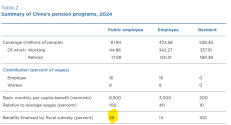
But for the 180mln people getting 200 rmb/month, I'd love for anyone to come up with a thesis as to how it is sufficient.
180 mln people basically get this unconditionally as it requires no contributions and it's stackable with other local welfare and social service provisions like 低保. It has an income replacement rate of about 10% which is fairly low.

So if you were to compare this to programs in other countries, the OAS in Canada is probably a close equivalent (with up to $750 CAD being paid per month) that applies to low income individuals. Doing napkin math, the Canadian program has a replacement rate of roughly 30% if the person made a pre-retirement income of $27k (although this is means tested and payments are reduced based on how high your income is). So China isn't that far off of the basic old age living allowance of poor seniors in a relatively developed country like Canada if they just triple the payout (scaled with income growth) of the basic pension plan over the course of the next few years.
 

abenomics12345

Junior Member
Registered Member
180 mln people basically get this unconditionally as it requires no contributions and it's stackable with other local welfare and social service provisions like 低保. It has an income replacement rate of about 10% which is fairly low.

So if you were to compare this to programs in other countries, the OAS in Canada is probably a close equivalent (with up to $750 CAD being paid per month) that applies to low income individuals. Doing napkin math, the Canadian program has a replacement rate of roughly 30% if the person made a pre-retirement income of $27k (although this is means tested and payments are reduced based on how high your income is). So China isn't that far off of the basic old age living allowance of poor seniors in a relatively developed country like Canada if they just triple the payout (scaled with income growth) of the basic pension plan over the course of the next few years.
Technically, the 180mln include rural residents, many of whom were farmers and these people were taxed agricultural tax until its removal in 2006 and they also technically sold agricultural products at below-market prices to the government so its not entirely accurate to suggest they 'didn't contribute' anything. Their in-kind contribution to building the country has been quite substantial.

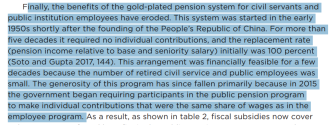
If we used the Canadian example you outlined, OAS is clawed back above a certain income. Additionally, the 8500/month received by the government workers in China is actually above the maximum CPP payout (and this is just nominal, if you apply the purchasing power equivalent it would be significantly higher). Also, prior to 2015 government workers in China didn't even need to contribute to the program.

So the issue here, as you can tell, is the inequality.
 
Last edited:

Michael90

Senior Member
Registered Member
. I mean every other east asian country managed to make it into high income. Its harder and will take longer since China is so big and has a lot of catchup but there's no structural reason it cannot achieve something like that.
Agree, I think this is the most important part. All East Asian countries are developed countries and they are the only ones outside the West who have really achieved that so far. So i don’t think it’s rational to expect China not to be able to do so. China will be an abnormally if they can’t achieve the same thing as their East Asian peers. So even a pessimistic person should expect China to achieve a similar level of development to her East Asian peers regardless of what kind of politics China follows. After all, Chinas peers in east Asia are not smarter or special than China . So no reason they can’t also achieve that. So China will
Definitely overcome the middle income trap and be a developed country as a whole this coming decades.
 
Top