Any guess when they will retire the J-11?

You are using an out of date browser. It may not display this or other websites correctly.
You should upgrade or use an alternative browser.
You should upgrade or use an alternative browser.
China Flanker Thread III (land based, exclude J-15)
- Thread starter Blitzo
- Start date
I've heard rumors that J-11BG is not a comprehensive upgrade but just an antenna upgrade (Not even a full radar upgrade), which means it still uses the old backend paired with a new antenna like the APG-63(V)2 and possibly a software update to allow it to probably carry the PL-15 (?, as no evidence of it has emerged). Engines are upgraded but I doubt it's on purpose as it is more likely that the original AL-31F were worn out and were just replaced by WS-10As to simplify logistics neither was the avionic suite overhauled.
It's difficult to claim it's Su-35S level when Su-35S has a much newer avionics suite, much better engines, TVC for supersonic trim and it's PESA radar is extremely powerful due to raw average output power and probably a more modern backend.
That would be a little disappointing if it's just an antenna upgrade. I thought it was a full radar and software upgrade.
Then again, it could actually be what you're suggesting/heard. To save a fortune, they could simply upgrade the J-11B's networking so it can CEC and with PL-15/16 and PL-17 compatibility, it becomes close to an equal carrier and shooter as J-16. If it is fed target data via another platform, that's more than half way a mini J-16 and saves them the trouble of developing an entirely new line of AESA and software package.
Wrt PLAAF's Su-35S, it has proven to be a weak player compared to other 4.5 gens with longer ranged weapons because I don't believe PLAAF ever got the R-37M with the Su-35S purchase since the purchase was done well before R-37M became available for export.
China has over 200 J-11B it can slowly convert to J-11BG. Giving them access to PL-15/16 and PL-17 even if via CEC dependent on other platforms is still a huge boost to combat capability for PLAAF. That's picking up an additional 200 units with 4.5 gen BVR capability with a relatively simple and inexpensive midlife upgrade. The J-11B was previously limited to PL-12 range with easily detected RF emission from its pulse doppler, making it only as good as a 3rd gen in most situations against any 4.5 or 5th gens. Now it can hold its own.
In a world where most second tier airforces barely have a handful of serviceable 4.5 gens that represent the absolute top tier of their fighter force, China is in the process of upgrading ~200 to closely match that performance level (actually exceed if it gets PL-16 and PL-17).
Any guess when they will retire the J-11?
J-11s are being retired and might be completely retired by now? Some J-11A units have reached retirement airframe life for the ones that were assembled in the 1990s and had more use put through.
J-11Bs are reaching mid life upgrade since they were introduced in 2005-2007 so even the oldest frames are only around 20 years old.
J-11A were sent to exercise with the Royal Thai Airforce Gripen Cs on at least two occasions. No comment on the level of pilot the PLAAF sent but J-11As dominated in WVR dogfighting against RTAF but got dominated in BVR. The J-11A is not really even capable of BVR in the modern sense of the word. But then again J-11A for China and PLAAF was a bit of a stepping stone. It's essentially Chinese assembled Su-27SK. Unless those exercises were just trying J-11A with radars switched off and entirely directed using datalink against the Thai Gripen Cs, there would be no point testing J-11A in BVR because it's like pitting a 1990s Soviet-Russian fighter against a 2000s Swedish fighter. Only chance J-11A has in BVR against Gripen C is with radars off, passive sensor (IRST) on, fly low and use terrain masking to sneak attack with the aid and vectoring of AWACs datalink. But the exercise results made no mention of any AWAC or gave details so it's quite useless to speculate much on the results. If it's any indication of how important radar, missile and modernity in avionics is, J-10B/C dominated in BVR against Thai Gripen Cs in other exercises and the dominance was like 1:5 ratio exchange.
J-11B is where the industry started internalising and upgrading the Flanker. It's the second step in Sino-Flanker development and the first time they integrated Chinese avionics and weapons onto the Flanker. They are currently being upgraded to J-11BG with some radar upgrades (some have mentioned entire AESA unit and software package and others have mentioned like above how it's just antenna upgrade). Other known upgrade is switching the Russian Al-31 engine to Chinese WS-10A/X that are being used for Sino-Flankers. Because the newest J-11B that were produced in the 2010s were already using WS-10A. The older Al-31 powered J-11B need engine replacements by now anyway.
J-11B could hold its own in a 4th gen BVR fight, radar is 1990s -2000s level, PL-12s are every bit as good as AIM-120C, modern MICA, R-77M. All the Flankers are great a WVR provided the pilots are equally capable with their machines compared to their opposition. Such are the Flanker's OG kinematic attributes. What else do you do with 200+ J-11Bs with between 10-20 years of airframe life left? CEC them with the rest of the PLAAF so it's performing BVR at least to J-10B/C and original J-16 block level.
Last edited:

IMO, it would simply be easier to replace all of the J-11s, there are only 400 of them built and probably ~300 or so left in service, with J-20's production rate it is possible to replace most of the J-11 fleet with J-20As (or hand-me-down J-20s from units upgrading to J-20As) by the end of this 5YP. PLAAF is seemingly going to be accepting many manned aircraft in the coming years which makes sense for them to retire their older fleet (Newer aircraft would probably be given to training units and aviation colleges) unless they want to significantly upsize their combat fleet. Though I'm not sure how upsizing makes more sense considering the trend these days with drones taking the lower end tasks and possibly even taking up higher end air combat with UADFs.China has over 200 J-11B it can slowly convert to J-11BG. Giving them access to PL-15/16 and PL-17 even if via CEC dependent on other platforms is still a huge boost to combat capability for PLAAF. That's picking up an additional 200 units with 4.5 gen BVR capability with a relatively simple and inexpensive midlife upgrade. The J-11B was previously limited to PL-12 range with easily detected RF emission from its pulse doppler, making it only as good as a 3rd gen in most situations against any 4.5 or 5th gens. Now it can hold its own.
In a world where most second tier airforces barely have a handful of serviceable 4.5 gens that represent the absolute top tier of their fighter force, China is in the process of upgrading ~200 to closely match that performance level (actually exceed if it gets PL-16 and PL-17).
J-11BG conversions also haven't been very frequent AFAIK as very little were ever spotted in the last few years and most of the spotted ones were apparently the last two batches of J-11Bs that were factory built to the BG standard.
iirc there are still active J-11A unitsJ-11s are being retired and might be completely retired by now? Some J-11A units have reached retirement airframe life for the ones that were assembled in the 1990s and had more use put through.
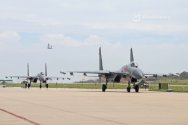
Photo from last year
India's desire to upgrade the Su-30MKI to "Super 30" or whatever the nickname is is basically similar to what China's already been doing with the J-11B.
The Su-30MKI is a more flexible multirole fighter compared to the air superiority focused J-11B but for air superiority alone, the J-11B would hold its own against MKI. The MKI as it is cannot hope to touch a 4.5 gen in most circumstances. IAF's support network (ground air and space based ISR, comms and EW) is also atrocious - low in numbers, backwards in modernity and a hodgepodge of Israeli, French, Russian and Indian hardware and software.
With BG upgrade for J-11B, it's giving PLAAF ~200 units of 4.5 gen level fighters on the cheap and doesn't really take away much operational availability while the upgrade is being performed.
The Su-30MKI is a more flexible multirole fighter compared to the air superiority focused J-11B but for air superiority alone, the J-11B would hold its own against MKI. The MKI as it is cannot hope to touch a 4.5 gen in most circumstances. IAF's support network (ground air and space based ISR, comms and EW) is also atrocious - low in numbers, backwards in modernity and a hodgepodge of Israeli, French, Russian and Indian hardware and software.
With BG upgrade for J-11B, it's giving PLAAF ~200 units of 4.5 gen level fighters on the cheap and doesn't really take away much operational availability while the upgrade is being performed.
IMO, it would simply be easier to replace all of the J-11s, there are only 400 of them built and probably ~300 or so left in service, with J-20's production rate it is possible to replace most of the J-11 fleet with J-20As (or hand-me-down J-20s from units upgrading to J-20As) by the end of this 5YP. PLAAF is seemingly going to be accepting many manned aircraft in the coming years which makes sense for them to retire their older fleet (Newer aircraft would probably be given to training units and aviation colleges) unless they want to significantly upsize their combat fleet. Though I'm not sure how upsizing makes more sense considering the trend these days with drones taking the lower end tasks and possibly even taking up higher end air combat with UADFs.
The J-11 and J-11A are near useless and they are simply being replaced. There are approx 200 J-11B and J-11BS in service. They have a decade to two more in the airframe and against basically every airforce except the USAF, these are decent fighters even without upgrade and just using PL-12. In China's region and those that are antagonistic, only India, Taiwan, Japan, South Korea operate fighters that are definitely above the J-11B in capability (Rafale for India, F-16V for Taiwan, F-2 for Japan, F-15K for SK and F-35s for both SK and Japan). Upgrading J-11B/S to BG more or less equal all those except the F-35s. I'm not counting Russian Su-35 or Su-57. With PL-17, the J-11BG can be an additional PL-17 shooting platform for PLAAF. This missile far outranges the weapons available for Rafale, F-16V, F-2, F-15K. Even PL-15/16 outranges the AIM-120D and is roughly equal to Meteor.
I don't see why PLAAF should simply retire all J-11 series when the J-11B has so much useful life in the airframes and 5th gen PLAAF fighters cannot carry the PL-17 internally. If you network your J-11BG appropriately, you instantly get 200+ additional PL-17 shooters. Each J-16 can comfortably carry 4x PL-17 and 6x PL-15/16. That's 10 long range to ultra long range A2A missiles on each modernised Sino-Flanker. Okay suppose you want to fly faster, higher and longer for those platforms, 2x PL-17 and 2x or 4x PL-15/16. No fighter outside of the F-15EX can do real world and effective air superiority/CAP beast mode as well as the Flanker. J-11BG could potentially be a second fleet of modernised Sino-Flankers capable of pushing PL-17s alongside the hundreds of J-16 fighters performing this role. Would rather install a new radar package which is now already developed and done or would you rather design and produce a whole new line of super heavy UADFs that can carry PL-17s. I'm sure there are going to be heavy UADFs precisely tasked with carrying and shooting PL-17 and PL-17 successor but that's a separate addition to the PLAAF force.
China has an absolute beast of a fighter platform in the Flanker. The Russians just couldn't modernise and digitise their fighters as quickly as the Western and Chinese electronics, computing and software industries move.
The fact that China continues to modernise and produce the Sino-Flanker branches is telling despite having 5th gen proliferation and 6th gen on the horizon. One factor is because China has so much excess productive capacity and resources but if these fighters don't have a place, they would simply retool for 5th gen production. J-16 new blocks, J-16D, J-15T, J-15DT. That's four continuous development and production streams for PLAAF and PLANAF.
My theory on the main utility of modern Sino-Flankers is their ability to carry the larger air to air and air to ground weapons that 5th gens cannot carry internally. Until the J-36 is available in large enough numbers, Sino-Flankers are staying in business.
J-11BG conversions also haven't been very frequent AFAIK as very little were ever spotted in the last few years and most of the spotted ones were apparently the last two batches of J-11Bs that were factory built to the BG standard.
Yeah it's a really low priority for PLAAF and China but it's being done precisely because it's making an existing tool you already have so much more effective. Yes China has many far superior fighters than the J-11B and even J-11BG but why neglect a perfectly functioning and still far from retirement age fighter? If India had the means and resources, they would absolutely upgrade the Su-30MKI and older Su-30 with AESA, R-37M, Meteor (if possible of course this is unrealistic since no access to Meteor codes) and Astra at least.
China did something very impressive with J-11A and Su-30MK (Russian made) in the past and that was despite not having access to the Russian sourced/ made Flankers' source codes, Chinese engineers were able to crack it and make PL-12 compatible with Russian fighters and radars. India isn't able to do this on their own and require source codes. IIRC some Chinese mathematician was the one responsible for cracking it for the J-11A (Su-27SK kits) and Su-30MK/MKK.
Yeah there are still active J-11A units that haven't reached airframe limits. Only some J-11A have been retired. Most if not all J-11 originals are retired.
Last edited:
What else do you do with 200+ J-11Bs with between 10-20 years of airframe life left? CEC them with the rest of the PLAAF so it's performing BVR at least to J-10B/C and original J-16 block level.
They can also operate as trucks for glide bombs. In such a role, they would need only minimal upgrades.
They can also operate as trucks for glide bombs. In such a role, they would need only minimal upgrades.
Yep I suspect PLAAF is doing the minimum to upgrade J-11BG so that it at least manages to shoot PL-15/16 and PL-17 like the J-16. Even if it can't do so on its own radar, it can now be integrated with the modern PLAAF fleet. Any platform can be eyes, brains and fists. It's all networked but under network disruption, it's better to have resilience and redundancies. All the other PLAAF fighters have eyes that can take PL-17 to its limits. I'm sure any modernising of J-11BG can already do the PL-15 justice even with J-11BG on its own since we know they're doing some upgrade to the radar rather than simply giving the J-11B a CEC equipment upgrade.
They are definitely going for the optimal balance between cost, time taken for upgrades and performance increase squeezed from upgrades. PL-15/16 and PL-17 is more than 100% increase in air to air capability for J-11B.
There's no guarantee that J-11BG is capable of even carrying the PL-15 much less the PL-17. Upgrading old J-11Bs to be able to fully network with the rest of the fleet is going to take some major changes considering the original avionics were never designed with it in mind.I don't see why PLAAF should simply retire all J-11 series when the J-11B has so much useful life in the airframes and 5th gen PLAAF fighters cannot carry the PL-17 internally. If you network your J-11BG appropriately, you instantly get 200+ additional PL-17 shooters. Each J-16 can comfortably carry 4x PL-17 and 6x PL-15/16. That's 10 long range to ultra long range A2A missiles on each modernised Sino-Flanker. Okay suppose you want to fly faster, higher and longer for those platforms, 2x PL-17 and 2x or 4x PL-15/16. No fighter outside of the F-15EX can do real world and effective air superiority/CAP beast mode as well as the Flanker.
China has an absolute beast of a fighter platform in the Flanker. The Russians just couldn't modernise and digitise their fighters as quickly as the Western and Chinese electronics, computing and software industries move.
The fact that China continues to modernise and produce the Sino-Flanker branches is telling despite having 5th gen proliferation and 6th gen on the horizon. One factor is because China has so much excess productive capacity and resources but if these fighters don't have a place, they would simply retool for 5th gen production. J-16 new blocks, J-16D, J-15T, J-15DT. That's four continuous development and production streams for PLAAF and PLANAF.
My theory on the main utility of modern Sino-Flankers is their ability to carry the larger air to air and air to ground weapons that 5th gens cannot carry internally. Until the J-36 is available in large enough numbers, Sino-Flankers are staying in business.
As for PL-17 carriers, there are already many J-16s in service, possibly more than all other flankers in service with the PLAAF combined by now and given the situation right now, combat with the US and their allies with 5th generation fighters should be the main priority. Main issue is that there is a limited amount of experienced pilots, if you keep more legacy aircraft in service you are taking up valuable pilots which could be in much more advanced aircraft like J-20s. It's not like there is a production bottleneck for 5th generation aircraft as they have more than enough capacity to replace 1-1 all legacy J-11 units and probably more by the end of this 5YP. Also, iirc China has more fighter aircraft than the USAF (Excluding the national guard), upsizing even more would make little sense.
J-16s are still kept in production is likely due to the PLAAF wanting to replace all the multirole/strike twin seaters (Though there are not much of Su-30s and JH-7s left in service which IMO means J-16 production will likely start winding down soon) with them and makes sense considering their system architecture was designed much later and in a time where the PLAAF was already sitting up a modern networking system making them much more effective. J-15Ts are procured simply as the navy lacks a strike aircraft and probably will stay in production for much longer than the J-16.
J-11Bs once retired from the active fleet could service useful life in aviation colleges and training or reserve units like retired Su-27Ks, J-11As and J-10As while the older ones would be put into storage.
Have there been many new fighter units recently?