New Energy Vehicles (NEVs) in China

Nevermore

Junior Member
Registered Member
Having driven many cars, I find these are the features that are most interesting.

You can talk about interior quality all day, but with the exception of the objectively terrible Stellantis brand cars, I find luxury car interiors a case of diminishing returns relative to price.

See that nice dual wireless charger so conveniently placed? Let me tell you about the premium German car which has one wireless charger that is placed inside the glove compartment that only fits an iPhone Max on a good day because of awful placement that requires clever maneuvering to fit inside a pocket, completely defeating the convenience of wireless charging! Let me also tell you about the convenience features like remote accessing the car cameras… sorry did I say remote access? I meant no access at all because the cameras didn’t work 3 days out of 7 in a week all of last summer. This year, only happened once so that’s progress. (In case it wasn't clear, there is no access from outside the car period). Any kind of self navigation feature? Only lane keeping and adaptive cruise, so 2010's level tech. And granted I'm not sure there is any utility for myself at this point in time, nor is my car suitable for it, but I think the Zeekr 009 has that crazy 4K 42" Dolby Vision/7.14 Dolby Atmos system in the back? It is a better home theatre setup than most people's actual home theatre set ups.

This German car though has great driving dynamics, but I'm not Schumacher/Hamilton/Verstappen (I'm old, so the great drivers have changed over time), I only have limited opportunity to enjoy that.
Some of the longtime car enthusiasts I know often praise the chassis and handling of German cars; that was an era when mechanical excellence was a source of immense pride.
A few years ago, the sudden emergence of large infotainment screens, high-end audio systems, refrigerators, electric massage seats, and smart connected infotainment systems in Chinese cars was viewed by automotive critics as a form of “unorthodox practice” designed to sidestep Western scrutiny—that is, to avoid discussing the mechanical qualities of chassis handling and instead focus on ride comfort, the enjoyment derived from various features, and convenience in daily use.
As the industry scales up and the shift toward electric vehicles gradually frees cars from constraints on size, performance, and in-car features, more and more people are beginning to rethink the definition of a car. A car may no longer be merely a means of transportation; a modern car could be a one-person office, a personal spaceship, a spacious bedroom for two, or a mobile castle for the whole family.
By now, Chinese cars are gradually catching up in terms of chassis engineering, while powertrain performance, smart features, and high-comfort amenities are their strong suits. We have entered a new era of automotive technology.

It feels a little weird—why does it seem like what I’m writing is starting to sound more and more like something an AI would write! Ah, well, let’s talk about interiors some more. These days, Chinese car interiors are also moving toward differentiation: there’s the sporty, race-car style of the Zeekr 007GT; the luxurious, indulgent style of the Zeekr 8X; NIO’s “spaceship” style; and BYD’s “suburban” style—haha. Some people say Chinese cars have entered a boring era of homogenization, but I believe that once technological competition reaches its peak, more diverse automotive aesthetic styles will be explored to achieve differentiation, and new design variations will emerge. This is a truly wonderful era for car enthusiasts and tech fans alike.
 

supersnoop

Colonel
Registered Member
I don't get why Chinese automakers can't get this part sorted out when all of their tech (including chassis and suspension) is at a world leading level. Dream cars that drive like Mario Kart.
The reality is that the majority of Chinese consumers don't want that kind of ride. Many reviews complain about the same thing when it comes to Chinese cars, overly soft suspensions that prioritize comfort over handling. What I think might change is the rapid adoption of full MEMS by wire steering/braking and full MEMS suspensions. By dispensing with hydraulics, in theory (and I am not a mechanical engineer), you should be able to have greater software control over the chassis, which means you can have better comfort/sport tuning profiles.

Chinese automakers can certainly do better handling if they try, you look at the Xiaomi reviews, and they haven't even made cars for very long. On top of that it's not even just the high end trims that are praised, even the base model is considered very good.

I believe the BYD is the most disappointing in this respect. Despite Z9's technological advancement, it had widely panned driving dynamics. The regular BYD cars are often criticized the same way. Somehow they seem to do better with their trucks, maybe expectations are lower...

Some of the longtime car enthusiasts I know often praise the chassis and handling of German cars; that was an era when mechanical excellence was a source of immense pride.
A few years ago, the sudden emergence of large infotainment screens, high-end audio systems, refrigerators, electric massage seats, and smart connected infotainment systems in Chinese cars was viewed by automotive critics as a form of “unorthodox practice” designed to sidestep Western scrutiny—that is, to avoid discussing the mechanical qualities of chassis handling and instead focus on ride comfort, the enjoyment derived from various features, and convenience in daily use.
As the industry scales up and the shift toward electric vehicles gradually frees cars from constraints on size, performance, and in-car features, more and more people are beginning to rethink the definition of a car. A car may no longer be merely a means of transportation; a modern car could be a one-person office, a personal spaceship, a spacious bedroom for two, or a mobile castle for the whole family.
By now, Chinese cars are gradually catching up in terms of chassis engineering, while powertrain performance, smart features, and high-comfort amenities are their strong suits. We have entered a new era of automotive technology.

It feels a little weird—why does it seem like what I’m writing is starting to sound more and more like something an AI would write! Ah, well, let’s talk about interiors some more. These days, Chinese car interiors are also moving toward differentiation: there’s the sporty, race-car style of the Zeekr 007GT; the luxurious, indulgent style of the Zeekr 8X; NIO’s “spaceship” style; and BYD’s “suburban” style—haha. Some people say Chinese cars have entered a boring era of homogenization, but I believe that once technological competition reaches its peak, more diverse automotive aesthetic styles will be explored to achieve differentiation, and new design variations will emerge. This is a truly wonderful era for car enthusiasts and tech fans alike.
Definitely some of the initial development of these features was to deflect attention, but you hit the nail on the head with the bolded part. Basically reflecting the changes in working patterns that happened before covid (coworking spaces) and accelerated after. If we reach a level of autonomy, driver engagement is no longer a priority. Being stuck in traffic, features like taking a nap in, watching a movie, or working will be better received. A good example is the Zeekr Mix/Waymo Ojai, purpose built for cab duty, not converted from any other car.
 

ansy1968

Brigadier
Registered Member
The reality is that the majority of Chinese consumers don't want that kind of ride. Many reviews complain about the same thing when it comes to Chinese cars, overly soft suspensions that prioritize comfort over handling. What I think might change is the rapid adoption of full MEMS by wire steering/braking and full MEMS suspensions. By dispensing with hydraulics, in theory (and I am not a mechanical engineer), you should be able to have greater software control over the chassis, which means you can have better comfort/sport tuning profiles.

Chinese automakers can certainly do better handling if they try, you look at the Xiaomi reviews, and they haven't even made cars for very long. On top of that it's not even just the high end trims that are praised, even the base model is considered very good.

I believe the BYD is the most disappointing in this respect. Despite Z9's technological advancement, it had widely panned driving dynamics. The regular BYD cars are often criticized the same way. Somehow they seem to do better with their trucks, maybe expectations are lower...


Definitely some of the initial development of these features was to deflect attention, but you hit the nail on the head with the bolded part. Basically reflecting the changes in working patterns that happened before covid (coworking spaces) and accelerated after. If we reach a level of autonomy, driver engagement is no longer a priority. Being stuck in traffic, features like taking a nap in, watching a movie, or working will be better received. A good example is the Zeekr Mix/Waymo Ojai, purpose built for cab duty, not converted from any other car.
No complain, having owned and experienced both BYD TANG AND SHARK, I will never go back to ICE vehicle ever, the only issued I have with TANG is the cargo space, I can fit 2 luggage and 2 hand carry only unlike my Toyota Fortuner and Prado where the maximum is 5 large luggages and 2 hand carry. The reason why I can't dispose my TOYOTA.
 

Wrought

Captain
Registered Member
Adam Tooze, on the grave missteps made by European automakers at exactly the wrong moment. Of course, it's easier to just blame China.

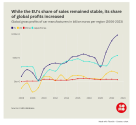
As recently as 2023, the European automotive industry stood out, relative to its peers, for the huge profits it was earning. In 2023 European firms earned 40.6 percent of all profits earned in the global automobile industry, up from a share of 27.9 percent in 2006. In 2023 the major producers collectively earned €98.1 billion in profits, versus a mere €10.9 billion in 2006. The Europeans reduced their US competitors - who a century before bestrode the world as the leaders of a new era of “Fordism” - to an also-ran in third place, behind Japan and South Korea. Not just in total volume, but as a percentage of sales, the profitability of the European industry was second to none.
1784782996280.png
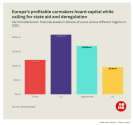
1784783015281.png
As Pardi shows, the European industry was deliberately opting for a high-price strategy that narrowed its own market. From early 2021, prices surged by more than 20 index points. The entry level price for basic European cars

Unfortunately for them, the European car producers embarked on this strategy precisely as the Chinese industry was entering a phase of dramatic capacity expansion and price-cutting. Were the European car producers to “give back” the wedge of € 5000 in upgrades and “pricing power” they have inserted into the average car price since 2020, if they focused their attention on offering attractive models in the € 10-20,000 price band - the kind of affordable mobility European households need - perhaps their competitive position would be better.

1784783137793.png
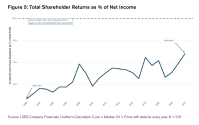
So what where the European car firms doing with their outsized profits? One thing they were doing was paying out generous dividends. I highlighted this in an earlier post. In the early 2020s, at what ought to have been a critical juncture for the competition with China, VW made huge payouts to its shareholders.
Please, Log in or Register to view URLs content!

At the critical moment in the 2020s when the Chinese competitors burst onto the scene, the European car industry was in a singularly introverted - one might even say involuted - mode. It was was not expanding demand through competitive pricing. Europe’s producers were milking the market with high-priced vehicles, generating large profits that were returned to investors or stashed in reserves rather than being poured into strategic investment.

1784783160780.png

Please, Log in or Register to view URLs content!
 

supercat

Colonel
Good.

China rare earth export curbs have opened up a huge price gap​

Dysprosium, used in EV motors, up 700% from pre-restriction level in Europe
Please, Log in or Register to view URLs content!

China has just begun.
Please, Log in or Register to view URLs content!

In the first half of 2026, BYD and Tesla has the same market share of 2.4% in Europe, while Geely beat both at 3.1%.
Q35lmkr.jpg

Please, Log in or Register to view URLs content!
 

Michael90

Senior Member
Registered Member
Good.

Please, Log in or Register to view URLs content!

China has just begun.
Please, Log in or Register to view URLs content!

In the first half of 2026, BYD and Tesla has the same market share of 2.4% in Europe, while Geely beat both at 3.1%.
Q35lmkr.jpg

Please, Log in or Register to view URLs content!
Geely beat BYD and Tesla ? That’s surprising , since I’ve barely seen Geely brands here, mostly BYD , Teslas obviously and Chery Jaecoo.
 

Lethe

Captain
Adam Tooze, on the grave missteps made by European automakers at exactly the wrong moment. Of course, it's easier to just blame China.

Please, Log in or Register to view URLs content!

Good read, fits with local experience too. Throughout the 2010s Volkswagen was a Top 10 brand here (typically #7 or #8) with a 4.5-5% market share. In the 2020s it has been all downhill, and they are currently at #16 YTD with 2% market share (just behind BMW!), down 17% YTD. First the prices went up, then COVID arrived and supply evaporated; over time supply gradually returned but prices did not, and all the while they were trying to pretend that unresponsive haptic sliders that you couldn't even see in the dark were something other than a usability catastrophe. Meanwhile, China arrived.

The two-tone ID. Buzz is very cute, though.
 

siegecrossbow

Field Marshall
Staff member
Super Moderator
Some of the longtime car enthusiasts I know often praise the chassis and handling of German cars; that was an era when mechanical excellence was a source of immense pride.
A few years ago, the sudden emergence of large infotainment screens, high-end audio systems, refrigerators, electric massage seats, and smart connected infotainment systems in Chinese cars was viewed by automotive critics as a form of “unorthodox practice” designed to sidestep Western scrutiny—that is, to avoid discussing the mechanical qualities of chassis handling and instead focus on ride comfort, the enjoyment derived from various features, and convenience in daily use.
As the industry scales up and the shift toward electric vehicles gradually frees cars from constraints on size, performance, and in-car features, more and more people are beginning to rethink the definition of a car. A car may no longer be merely a means of transportation; a modern car could be a one-person office, a personal spaceship, a spacious bedroom for two, or a mobile castle for the whole family.
By now, Chinese cars are gradually catching up in terms of chassis engineering, while powertrain performance, smart features, and high-comfort amenities are their strong suits. We have entered a new era of automotive technology.

It feels a little weird—why does it seem like what I’m writing is starting to sound more and more like something an AI would write! Ah, well, let’s talk about interiors some more. These days, Chinese car interiors are also moving toward differentiation: there’s the sporty, race-car style of the Zeekr 007GT; the luxurious, indulgent style of the Zeekr 8X; NIO’s “spaceship” style; and BYD’s “suburban” style—haha. Some people say Chinese cars have entered a boring era of homogenization, but I believe that once technological competition reaches its peak, more diverse automotive aesthetic styles will be explored to achieve differentiation, and new design variations will emerge. This is a truly wonderful era for car enthusiasts and tech fans alike.
This actually got me thinking — maybe China should get into the battery powered motor home business? A big issue with trailers is that they need to stay at dedicated camps where you have access to electricity and running water. Having stable power supply onboard will solve half of the equation. Since it is almost impossible for young people to buy homes in the states this can end up being a big market. Imagine if you can just pull up to some deserted parking lot and have heat, power, and internet…
 
Top