News on China's scientific and technological development.

tokenanalyst

Lieutenant General
Registered Member
This has to be China first nuclear fusion technology company.

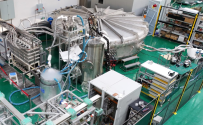
StarRing Energy Achieves World’s First Full-Scale HTS Magnet Test for Spherical Tokamak


StarRing Energy has successfully completed cryogenic excitation testing (at 20 K / -253°C) of the world’s first full-scale high-temperature superconducting (HTS) toroidal field magnet designed specifically for spherical tokamak fusion reactors. This marks a critical milestone in engineering fusion-grade magnets and lays the groundwork for their next-generation device, CTRFR-1 (StarRing One).

Achievements:
  • Record-Breaking Current Density: The magnet achieves an engineering current density exceeding 40 A/mm² (compared to ~10 A/mm² for ITER) and a winding current density of 375 A/mm² (approx. 2.4x higher than Commonwealth Fusion Systems’ SPARC model at similar temperatures).​
  • Performance: Successfully energized to 4.5 kA with stable performance, achieving a central magnetic field of 3.06 T and a maximum field of 11.1 T.​
  • Design Philosophy: Unlike conventional tokamaks that pursue extreme magnetic fields, this spherical tokamak design prioritizes extreme current density to enable compactness, lower energy storage, and enhanced safety margins against quenching.​
1784561308542.png

StarRing Energy demonstrated full supply chain control, independently developing:

HTS tape acceptance, coil winding machines, and key components like insulation terminals and connectors. Custom cryogenic systems (including a 360 W/20 K cold helium system), full-size Dewars, and magnetic shielding. An AI-native control system and the proprietary EPIC test instrument for comprehensive signal acquisition. They also deployed an OFDR distributed sensing system for millimeter-level strain/temperature monitoring to prepare for future quench detection.

The fully automated test validated the entire technical route from design to cryogenic operation, proving the reliability of StarRing’s approach. This achievement accelerates the transition of fusion energy from scientific verification to engineering realization, positioning StarRing as a leader in compact, high-efficiency fusion technology.​

Please, Log in or Register to view URLs content!
 

Michael90

Senior Member
Registered Member
Surprised biomedical graduates is still so low in China, with Chinas rise in biomedical field as among the worlds leader, and the industry now generating huge profits and revenue/deals(over $110billion just this first half and rising fast) for Chinese biomedical companies unlike say the auto industry where profits are at record low and demand is kind of stagnating/declining.

So im surprised more youths are not also going into the field and it’s not even among the top 10 in China. I actually believe it has as much potential or maybe even more potential to match auto industry this coming years as Chinas medical industry and needs will only keep growing. So I expect more people to get into this field in future .
 

subotai1

Junior Member
Registered Member
Surprised biomedical graduates is still so low in China, with Chinas rise in biomedical field as among the worlds leader, and the industry now generating huge profits and revenue/deals(over $110billion just this first half and rising fast) for Chinese biomedical companies unlike say the auto industry where profits are at record low and demand is kind of stagnating/declining.

So im surprised more youths are not also going into the field and it’s not even among the top 10 in China. I actually believe it has as much potential or maybe even more potential to match auto industry this coming years as Chinas medical industry and needs will only keep growing. So I expect more people to get into this field in future .
This will change.

And I see dynamics in this space that it is. There a large number of medical device companies now setting up shop in China, for both R&D work and go to market. The R&D side is that they are realizing there are very good engineers in China. And those engineers are not coming to the US. They are also cheaper than in the US (which already did not have enough MedTech related engineers). What is also changing is that companies want to design/re-engineer products for the China market, in China. You can see this in the number of MedTech companies that are starting up R&D centers in China.

On the Go To Market side, companies have now realized if they want to sell in to China they need to be in China and are establishing a presence to do so.

I think, though, that what will most affect BioMed graduates in China, is the Chinese market for products. Right now, in the West, GLP-1 is destroying entire markets by solving one of the major root causes for sleep, diabetes and cardio problems, which is obesity. So many MedTech companies are suffering as their customer base dwindles. The other products that have done well is connected products. There is a huge amount of potential here for new and varied types of smart devices that help you monitor and improve your health. If Chinese MedTech companies can solve/improve this (and they should be able to) and make it cheap enough that it sells affordably in China, it will absolutely destroy other companies in this space.
 

Wrought

Captain
Registered Member
Surprised biomedical graduates is still so low in China, with Chinas rise in biomedical field as among the worlds leader, and the industry now generating huge profits and revenue/deals(over $110billion just this first half and rising fast) for Chinese biomedical companies unlike say the auto industry where profits are at record low and demand is kind of stagnating/declining.

So im surprised more youths are not also going into the field and it’s not even among the top 10 in China. I actually believe it has as much potential or maybe even more potential to match auto industry this coming years as Chinas medical industry and needs will only keep growing. So I expect more people to get into this field in future .

My understanding—as someone who originally started in that field before switching—is that the biomedical track is looked down on as one of those "mile wide, inch deep" fields of study. Serious people go for chemical engineering and then specialize in biochem or organic chem or what have you. Alternatively, they go into the electrical engineering/materials science side if they're focused on medical devices.

Then again, I'm old. So it's possible things have changed dramatically since my day.
 
Last edited:
Top