Indian Military News, Reports, Data, etc.

bsdnf

Senior Member
Registered Member
Fourth-generation fighter jets will always remain in service. Fifth-generation fighters will eventually be phased out, but fourth-generation jets will still be flying. U.S. Air Force is a good example, production of the F-22 Raptor has already ended, and it is now nearing retirement, while the more than 50-year-old F-16 is still in production, with new variants continuing to be developed.

Similarly, Rafale, Eurofighter Typhoon, and Gripen are all fourth-generation fighter jets that are still in production, with new iterations being introduced every 10–15 years.
Fourth-generation heavy fighter jets can be used as bomb/missile trucks to extend their service life.

Does Tejas have this capability?
 

Mt1701d

Junior Member
Registered Member
Fourth-generation fighter jets will always remain in service. Fifth-generation fighters will eventually be phased out, but fourth-generation jets will still be flying. U.S. Air Force is a good example, production of the F-22 Raptor has already ended, and it is now nearing retirement, while the more than 50-year-old F-16 is still in production, with new variants continuing to be developed.

Similarly, Rafale, Eurofighter Typhoon, and Gripen are all fourth-generation fighter jets that are still in production, with new iterations being introduced every 10–15 years.
What are you talking about? Considering that the f-35 was intended to replace the f-16 to begin with. Further many countries at the time didn’t have 5th gen programs because the f-35 was supposed to be the end all and be all for fighters in NATO.

It was only because the Americans promised too much and under delivered that Europeans have no choice but to focus on their own 4th gen since they didn’t initiate any 5th gen programs. Considering the 5th gen programs, tho the outlook doesn’t seem too bright, was the Europeans saying we want 5th gen and were tired of waiting for the f-35.

And your example of f-22 is ridiculous. The f-22 was way ahead of its time, it also costed too much which was why the production stopped, the only reason the f-22 are being phased out is because their design never accounted for modern upgrades and they are now reaching their limits electrically and electronically.
 

Gloire_bb

Colonel
Registered Member
Fourth-generation heavy fighter jets can be used as bomb/missile trucks to extend their service life.

Does Tejas have this capability?
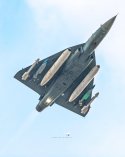
Ugh. Of course?
1000029229.jpg
It's a single F404 after all; provided you have got your engine, your short range package delivery will be as cheap as it gets.
Probably best actual use of mk.1s by the way.
 

bsdnf

Senior Member
Registered Member
Ugh. Of course?
View attachment 177828
It's a single F404 after all; provided you have got your engine, your short range package delivery will be as cheap as it gets.
Probably best actual use of mk.1s by the way.
Calling to a MK.1 carrying two fuel tanks, two SRAAMs, and two JDAM-ERs as a bomb truck.

LCA=Light Combat Aircraft

OK, done. Ignore
 
Last edited:

Puss in Boots

Junior Member
Registered Member
Fourth-generation fighter jets will always remain in service. Fifth-generation fighters will eventually be phased out, but fourth-generation jets will still be flying. U.S. Air Force is a good example, production of the F-22 Raptor has already ended, and it is now nearing retirement, while the more than 50-year-old F-16 is still in production, with new variants continuing to be developed.

Similarly, Rafale, Eurofighter Typhoon, and Gripen are all fourth-generation fighter jets that are still in production, with new iterations being introduced every 10–15 years.
The ability to carry a large weapons payload with few size constraints is an advantage that prevents fourth-generation aircraft from being phased out for now; the Tejas holds no unique or irreplaceable advantage in this regard.
Most countries choose to upgrade fourth-generation aircraft simply because they lack the capability to develop fifth-generation ones, not because their existing fourth-generation aircraft are sufficiently capable.
 

Gloire_bb

Colonel
Registered Member
Calling to a MK.1 carrying two fuel tanks, two SRAAMs, and two JDAM-ERs as a bomb truck.

LCA=Light Combat Aircraft

OK, done. Ignore
Half the normal weapon load of a Su-34 for ~1/5 maintenance time, flight hour cost, and fuel burn, usable from small HAS available at Indian border bases.

If you thought that the bomb truck mission refers solely or predominantly to oversized bomb bushes, well, you were wrong.
 

Blitzo

General
Staff member
Super Moderator
Registered Member
Half the normal weapon load of a Su-34 for ~1/5 maintenance time, flight hour cost, and fuel burn, usable from small HAS available at Indian border bases.

If you thought that the bomb truck mission refers solely or predominantly to oversized bomb bushes, well, you were wrong.

To be fair, the term "bomb truck" tends to refer to being able to accommodate a decent number of normal sized bombs.

In the case of Tejas, calling it an aircraft capable of light strike is reasonable, but in context of the variety of bomb weights that we'd usually consider "normal" for tactical fighter aircraft (250kg-500kg), the quantity of such weapons that Tejas (or any other fighter in its weight class) can carry doesn't really qualify it as a "bomb truck".

And that's fine, it isn't a heavy fighter, it's a light fighter. Most light fighters are not expected reasonably to be "bomb trucks" in the way that heavier fighters can be.
 

supersnoop

Colonel
Registered Member
Failure is a bit too harsh - they're now operational, and with IOC aircraft brought to partial FOC standard, there'll be at least some numbers and operational use out of them.
Yes, it isn't much of a combat aircraft (barely/if better than MiG-21 Bison, provided everything works); it's still a monumental achievement in that India has managed a broadly modern fighter, after all.
Remember how China got to J-7D/J-8-II back in the 1980s. It was also a long and really painful story.

Or, I don't know... since KF-21 isn't at IOC yet, right now India is still *notionally* ahead of Korea, for example. Operational FA-50s are equal mix of international components, but FA-50 is a simpler plane, done with much broader and basic foreign assistance.
Mk1’s failure is not my determination, but rather the Indian armed forces assessment by not procuring it further. Like they don’t even feel it can credibly replace a MiG-21 as is? It’s not a glowing endorsement.

I’m not saying it’s a total failure, but without certainty on the engines, the program is effectively at a dead end. Put those resources into AMCA instead, or create a face-saving “Mk3” (in reality a new plane) based around M88 or something. Also (I know this is impossible), but restrain against demanding too much for the engine like full and complete tech transfer and the keys to Versailles Palace.

I think a more relevant lesson is not that of J-8II, but of the cancelled J-9. An overly ambitious design for the industrial capability of China of that time, so it was cancelled. You could also say the same about Super-7 vs. JF-17.

TL;DR India needs to take a realistic assessment and approach to indigenous development.

Being ahead of Korea is no great accolade, despite the level of Korea’s current industry. India had already produced the Marut fighter, so it had already hit this mark on the achievements board.
 

Gloire_bb

Colonel
Registered Member
Mk1’s failure is not my determination, but rather the Indian armed forces assessment by not procuring it further. Like they don’t even feel it can credibly replace a MiG-21 as is? It’s not a glowing endorsement.
Well, because it's true. At a face value, Tejas mk1 has better(but not crucially) radar, ~similar intercept profile.
Mk1 doesn't get EL/L-8222 and twin ASRAAM(in fact it doesn't get ASRAAM at all apparently), so it's effectively similar or even weaker armament(i-derby v rvv-ae) and less protection (though with modern RWR).
But it is not the same as development failure, as old warhorse is obviously just more reliable and better understood.
All planes early on in their career are bitch to work with. But you can make tejas mk1a out of tejas mk1. Mig-21bis was really on its last legs.
I’m not saying it’s a total failure, but without certainty on the engines, the program is effectively at a dead end. Put those resources into AMCA instead, or create a face-saving “Mk3” (in reality a new plane) based around M88 or something. Also (I know this is impossible), but restrain against demanding too much for the engine like full and complete tech transfer and the keys to Versailles Palace.
Tejas mk1 is a live plane, which can be used operationally; at least, when you have engines(1a). Tejas MK2 is a 2030s plane; it's a new plane, sure, but at least it's a Tejas. I.e. it is low risk.
AMCA is a 2040s high risk dream. And speaking flatly, french never share core know-how, i.e. if indians will believe this - idk, they should check allegiance (and visa) of their negotiators.
I think a more relevant lesson is not that of J-8II, but of the cancelled J-9. An overly ambitious design for the industrial capability of China of that time, so it was cancelled. You could also say the same about Super-7 vs. JF-17.
I disagree. Tejas has 1 operational squadron, and Tejas mk1a are now ultimately restricted by engines; i.e. otherwise, problematic development now delivered a proper fruit.
Yes, Tejas mk1 is a 3rd rate plane(mostly courtesy of it's armament and decision to skip on derby-er and overall just be done with them). But Tejas mk1a is roughly comparable with JF-17 III, only a few years later. Which is, mildly speaking, a decent plane.
Yes, Tejas 1a is flatly weaker in air superiority, but in it's core role (GCI intercept, light strike) - it's excellent.

Engine be damned, but should they solve at least indian radar, this is a solid point. Remember that for all our laughs at air forces, as a product, JF-17 is Chengdu through and thorough, with Chinese armament, radar and Russian engine. Tejas on mk1a at least got astra, and maybe second batch will get Uttam.
Industrially, it's certainly an achievement.

Operationally, Tejas will for the first time in a decade may contain the general trend of PAF gaining and gaining strength v IAF. This is significant as well.

Overall, we laugh at India for buying their way out of trouble. But that's ultimately how growing something looks like. Through persistence, pain and laughs.

 
Last edited:

Anhad

New Member
Registered Member
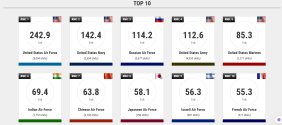
The WDMMA Air Power Ranking for 2026 has once again ranked the Indian Air Force above the Chinese Air Force. The top five air forces in the ranking are:
  1. U.S. Air Force
  2. Russian Air Force
  3. Indian Air Force
  4. Chinese Air Force
  5. Japanese Air Force
According to WDMMA, air power is not assessed solely on the number of aircraft. It also takes into account the quality of the aircraft and the overall composition and balance of an air force's inventory.
Please, Log in or Register to view URLs content!
1783538888983.png
 
Top