
Food & Resource Security

Wrought

Captain
Registered Member
A simple and plausible explanation for how oil imports dropped so precipitously without touching stockpiles.
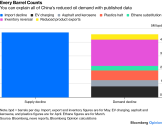
A close look at the reams of official data available suggests a more humdrum explanation. Public information and signs of a demand peak that analysts have been
Please, Log in or Register to view URLs content!
can explain almost all the loss of nearly five million barrels a day in May.

1781820465131.png

Please, Log in or Register to view URLs content!
 

Wrought

Captain
Registered Member
Allegely, China has put an additional 55% tariff on Aus Beef starting june 20 midnight, since allegedly, 100% of required imported beef has already been purchased.
Please, Log in or Register to view URLs content!

That's not an additional tariff being imposed; it's just the annual beef quota has been used up. That is to say, it's not singling out Australia for punitive measures.

Australian beef exports to China will face an additional 55% tariff starting this weekend after hitting Beijing’s annual
Please, Log in or Register to view URLs content!
, which could impact trade flows and prompt producers to seek new markets for red meat. The Chinese government
Please, Log in or Register to view URLs content!
imposed a quota of 205,000 tons on beef imports from Australia as part of a range of trade limits on major red meat-producing nations, including Brazil and Argentina, in a push to protect local farmers.

Please, Log in or Register to view URLs content!
 

Wrought

Captain
Registered Member
Russian paper on whole-of-society stockpiling and resilience efforts in recent years.

This article examines China’s comprehensive mobilization policies undertaken since the early 2020s. Analysis reveals that they span multiple domains. First, China is developing a protected inland reserve of critical industrial capacity. Second, it is strengthening emergency supply mechanisms and accelerating the accumulation of food and raw-material reserves. Third, it is enhancing civil defense and urban infrastructure resilience, including the expansion of the ‘people’s air defense’ system. Fourth, recently amended legislation now regulates military service and the government’s obligations towards fallen servicemen’s families. The scope and pace of these measures indicate that Beijing anticipates a severe military-political crisis in the coming decade. This partly explains Chinese foreign policy’s apparent contradictions, with stated global ambitions coexisting alongside strategic caution and risk aversion.

Please, Log in or Register to view URLs content!
 

Wrought

Captain
Registered Member
why do they see this as "contradictions"?

Idealistic rhetoric + worst-case preparations.

The measures’ extreme cost indicates that, although the Chinese leadership advances optimistic conceptions like the Community of Common Destiny for Mankind and a “universally beneficial, inclusive economic globalization,” the leadership actually adheres to an extremely bleak outlook for the world in the 21st century. It is preparing—at the very least—for a severe military and political crisis, including the disruption of all normal economic ties and a slide to the brink of war. At worst, it is preparing for even more nightmarish scenarios.
 

Michael90

Senior Member
Registered Member
Idealistic rhetoric + worst-case preparations.
“Prepare for the worse hope for the best” policy I guess. That’s a good way of running a country, especially one who is facing the worlds current most powerful/advanced power and her ally Japan who seems to be as hostile to Chinas rise or even more, for obvious reasons. So it’s normal they should be preparing for the worse. Hopefully it will never come to that, but I’m not so sure, since who could have imagined just 6 years ago that there will be a major war in Europe with Russia launching a full scale invasion ? So one thing we should never say in this life is never. Anything is possible.
 
Top