Its
paywalled got achieved version?
Trump’s Iran war has propelled China’s cleantech industry
Disruption to global energy supplies sparks surge in demand for alternatives
Executives at Yadea, which produces battery-powered scooters and motorcycles, said overseas demand was tracking about 70% higher than a year ago © Yadea
in Shanghai
At the start of 2026 there was an air of uncertainty about China’s clean technology industry.
Companies such as electric vehicle maker BYD and battery giant CATL had enjoyed years of strong growth as China stole a march on the global transition to electrified transport. But they now face considerable challenges both at home and abroad.
In China, the sector’s growth was being affected by the phaseout of subsidies as well as crackdowns on companies’ poor treatment of suppliers, unsustainable price competition and
.
Overseas, many Chinese companies saw a landscape of rising tariff walls and increased scrutiny from Brussels and Washington over whether their products posed a national security risk.
And then, in late February, came President Donald Trump’s decision to attack Iran, leading to the closure of the Strait of Hormuz, a key energy trade artery. This led not only to higher prices in many parts of the world but also to genuine fears about oil and gas shortages. The shock has sparked a surge in demand for Chinese cleantech.
According to customs data, exports of Chinese-made solar cells hit 1.7bn units in March, a record high for a single month. Demand in March and April was led by south-east Asia and Africa, highlighting how swaths of the oil-dependent developing world have emerged as key markets for low-cost Chinese renewable energy technologies.
Battery-powered vehicles, from two-wheelers and cars to buses and trucks, have also benefited. When the FT visited Yadea, the world’s largest producer of battery-powered scooters and motorcycles, at its headquarters in Wuxi, executives said overseas demand was tracking about
than a year ago.
At Sany, one of China’s top producers of electric trucks, executives also pointed to a more than 70 per cent year-on-year increase in industry-wide sales since the war started. The company said that with diesel prices high, electric trucks can recoup their extra purchase cost within 12 to 14 months.
“We have to thank Trump. He created an opportunity for us,” Huang Tie, deputy general manager of the group’s truck manufacturing unit, told the FT.
The Sany factory in Hunan © Wang Xueqiao
For
’s EV producers, the boost to foreign demand from higher oil prices has been nothing short of a saviour from domestic weakness. Data from Automobility, a Shanghai consultancy, shows that auto exports in April hit a record high of 900,000 units, up from about 500,000 in the same month in 2025.
Dealers say the sharp increase in fuel prices has changed the way many people think about cars. In Australia, for example, nearly half of all vehicles sold in May were either battery-only, hybrid or plug-in hybrid.
There is an open debate about how and when the Iran war will be resolved. However, many analysts believe it will ultimately reinforce the world’s long-term direction of travel towards cleaner transport and energy. This, in turn, will almost certainly increase the world’s dependence on Chinese supply chains and exacerbate trade tensions.
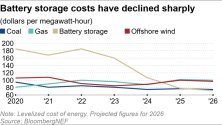
Neil Beveridge, a veteran energy analyst at Bernstein in Hong Kong, has raised his long-term growth target for battery demand. Bernstein forecasts that battery demand will grow at a compound annual rate of 9 per cent over the next 25 years, or from 1.8 terawatt hours last year to 5.7 TWh by 2030 and 16.6 TWh by 2050.
While much near-term demand growth is being fuelled by power for AI, Beveridge pointed out that “China is driving electrification across all major industry verticals”. He noted that in shipping, for example, more than 70 per cent of new vessel orders in China are dual-fuel — with batteries as backup.
Another sign of longer-term effects can be seen in the sharp rise in heavy industry decarbonisation projects reaching final investment decisions.
Data from Mission Possible Partnership, an international non-profit, showed that 19 clean industry projects globally reached final investment decisions in the past six months, more than double the rate recorded a year earlier.
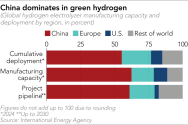
Of these projects — which span clean fuels, chemicals, fertilisers and metals and account for about $43bn of investment — more than two-thirds are in China.
“Clean industry is rising because the world has changed,” said Faustine Delasalle, CEO of Mission Possible Partnership.
Ye Lin, an Asia oil market analyst at Rystad Energy, believes there are signs that, for China at least, the shift from oil to electricity will be permanent.
“Confidence built in a disruption tends to outlast the disruption itself,” she said.
Additional reporting by William Langley, Xueqiao Wang and Haohsiang Ko