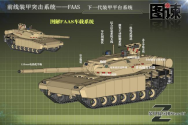
I'm not sure if we've ever had any PLA big ticket projects actually commission competing products that have reached the prototype stage in the modern era -- and more importantly,
That’s always the risk with regression based analysis and predictions. Past trends are never guaranteed to always continue into the future. And one of the most often times when big paradigm shifts occur to totally throw off past trend lines is at times if inflection. The Type100 and this new design represents uncharted waters for the PLA, where for the first time in its history it’s not the one playing catch up to the world.
if a program was meant to have competing products, they should be competing for the same set of requirements rather than field such different requirements/CONOPs (of course there will be some degree in overlap of capability and characteristics, but the areas where they differ are very stark as well).
Which neatly brings us up to one of the fundamental challenges the PLA would have faced in this contest as de facto world leader - just what are the requirements and CONOPs of future armoured warfare? It no longer has the luxury of being able to copy everyone else’s homework in terms of detailed performance requirements and instead needed to also work out what the grand vision of how future armoured warfare should work.
If you do not have a clear and well defined vision of what future armoured combat might look like, the obvious solution is to pose that question to the field in the first instance and see what the troops and market comes back with. A truly blank sheet design again reminiscent of how the PLAAF 6th gen development was rumoured to have went.
So while it's an interesting idea, I don't think it makes much sense for Type 100 and this heavier MBT to have been competitors, but rather it is more likely they were intended to be complementary from the outset.
The PLA 6th generation effort is a good parallel in the sense that J-36 and J-XDS are obviously such wildly different aircraft of different weight classes and meant to do different mission sets, that the idea of them competing for the same mission set and CONOPs is out of the scope of imagination IMO, and it is far more likely that they were intended from the outset to be complementary as part of a unified CONOPs.
I guess this shows the fundamental difference in how we view the PLAAF 6th gen competition. While you seem to think the PLAAF went to both SAC and CAC with separate, radically different yet fully detailed design specifications to meet predetermined CONOPs, I think the PLAAF started with a far more open scope of asking both teams how they think future air combat will evolve and produce a design to dominate in that envisaged future combat doctrine.
The wildly divergent weight class and intended performance priorities are from underlying philosophical differences in how the two teams expect future air combat is expected to evolve instead of them being aimed at different niches in a well defined combat environment.
That in turn was why CAC was so ecstatic about the the outcome of the May 7th air battle, as it validated their overall vision, which was far more important and consequential than just the J10 proving its own intrinsic capabilities.
The suggestion that Type 100 and this heavier MBT were "competitors" would only work if the PLA had somehow signed off on a competition of CONOPs and requirements.... which just seems so beyond the pale and not really how product development tends to work. Usually, the parameters of the CONOPs and requirements are set to begin with, and different designs are then proposed and/or developed to see which fits best within said parameters.
I think this is a common problem people have with China watching in general where they mistake discipline for a lack of ability, ambition and vision, with a hint of the old classic trope of China being a hyper-controlled state where decisions always flow top-down.
Modern China would not exist as it is today if that was the case.
Also, this fundamental different philosophy is not as unprecedented as you seem to think. Just look at the Chinese UAV industry as an example of the frankly bewildering diversity and often apparent significant overlaps between various designs.
As with the UAV industry, China owns the overwhelming majority of the high value capital stocks of development and production of tanks and armoured vehicles, so it can make those capital stocks available to promising private sector pitches to make sure barriers to entry do not allow the market to stagnate. How else do you think they managed to get so much innovation from just one proper tank making factory in the whole country?
Another common mistake to make is in thinking all procurement processes work the same way for the PLA. There will be procurements where the PLA knows exactly what it was and will issue detailed design specs that need to be met, and in such cases they generally want that need met ASAP, which is the kind of tenders we are most exposed to. But there will also be other, more open (both in terms of timeframe and design specifications) routes where a particularly interesting and/or promising design and/or designer emerges from the frankly ridiculous number of competitions and contests that takes place annually in China, and resources are made available to see what might come if it. Often, the most interesting and revolutionary designs comes out of this second route, and these also tend to be the ones most kept under wraps by the PLA.