Looks like rehashed old footage?

You are using an out of date browser. It may not display this or other websites correctly.
You should upgrade or use an alternative browser.
You should upgrade or use an alternative browser.
2026 Israel-US vs. Iran conflict [Military updates/News Only]
- Thread starter Phead128
- Start date

This is def older video,
The fire lasted for 30 hours.The fire in the Ford wasnt as small as initially implied. Losing 13% of your berthing on an extended deployment thats already taxing on the crew?
The fact that they haven't sent the ship back to port speaks volumes
I would have assumed a carrier would have pretty impressive fire suppression system or something, must be some scary fire
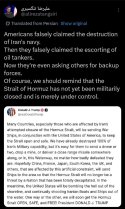
Meanwhile:
IRGC Navy Commander Rear Admiral Alireza Tangsiri

SM-2 uses a semi-active radar seeker which requires a fire control radar like AN/SPG-62 to illuminate the target. AN/SPG-62 is mechanically steered... So if there are ~100 incoming drones it'll need to illuminate them one by one for the entire terminal phase duration. Cold War tech.
I am aware of the limitations, these missiles are only interesting because they constitute the bulk of the USN stockpile of SM's.
They are so short on missiles that even with that bulk of SM-2 they can barely fill every VLS cell on every ship, if you strip these SM-2 away then a lot of VLS cells would be empty.
So I presume that SM-2 are on board of most if not all ships and are used over the rare SM-3 and SM-6 whenever possible.
There is an extended capability SM-2 but it uses an SM-6 seeker which is production rate limited, so it doesn't really fix any of the ammunition shortage issues. Seems merely a capability extension.
I found some speculation and rumours and some very flimsy math on those SM-2 numbers which do not add up.
Apparently the 8,500-8,800 stockpile number is calculated from the baseline of 12,000 total produced SM-2 in some old report, minus all the expenditures which happened.
But it is questionable if these 8,500-8,800 missiles actually exist. A lot of "procurement" was actually modernisation of existing missiles, and they did a lot of seeker swaps and the like, it is not straightforward to tell.
Also the older Block I and Block II and even some Block III were build for arm launchers, not VLS cells and it is unknown how many got converted.
But I found no reliable citable source for this and you have to pull together many sources and do some flimsy math to get there.
Would explain the 2,500 number from the FPRI report though. It seems likely that SM-2 stockpiles are much lower than the big numbers which are floating around.
If anyone has more solid numbers, I would be interested.
Ironically we have pretty good numbers on SM-3 and SM-6 but this bulk of SM-2 has been a ghostly mystery to me.
Last edited:

Summary
- Gulf states now urge Washington not to stop short, sources say
- US presses Gulf states to join war, according to diplomats
- Gulf anger hardened after Iran struck oil hubs, ports, cities
- Quick end might let Iran threaten oil lifeline again in future
- Gulf leaders see degrading Iran’s power as long-term priority
Just to add, we need to see how many are actually within the vicinity to replenish those empty launchers. Also, with the major bases in and around Iran being legitimate targets and within reach of Iran, USN needs to go further out into safer harbours to reload.I am aware of the limitations, these missiles are only interesting because they constitute the bulk of the USN stockpile of SM's.
They are so short on missiles that even with that bulk of SM-2 they can barely fill every VLS cell on every ship, if you strip these SM-2 away then a lot of VLS cells would be empty.
So I presume that SM-2 are on board of most if not all ships and are used over the rare SM-3 and SM-6 whenever possible.
There is an extended capability SM-2 but it uses an SM-6 seeker which is production rate limited, so it doesn't really fix any of the ammunition shortage issues. Seems merely a capability extension.
I found some speculation and rumours and some very flimsy math on those SM-2 numbers which do not add up.
Apparently the 8,500-8,800 stockpile number is calculated from the baseline of 12,000 total produced SM-2 in some old report, minus all the expenditures which happened.
But it is questionable if these 8,500-8,800 missiles actually exist. A lot of "procurement" was actually modernisation of existing missiles, and they did a lot of seeker swaps and the like, it is not straightforward to tell.
Also the older Block I and Block II and even some Block III were build for arm launchers, not VLS cells and it is unknown how many got converted.
But I found no reliable citable source for this and you have to pull together many sources and do some flimsy math to get there.
Would explain the 2,500 number from the FPRI report though. It seems likely that SM-2 stockpiles are much lower than the big numbers which are floating around.
If anyone has more solid numbers, I would be interested.
Ironically we have pretty good numbers on SM-3 and SM-6 but this bulk of SM-2 has been a ghostly mystery to me.
Same thing for land based interceptors. Its Ukraine-Russia all over again....targeting resupply dumps and logistics nodes.

40 years ago, Trump openly discuss attacking and seizing Kharg island. In 1988, Trump mulled a hypothetical conquest of Kharg island.
In fact, Kharg island handle nearly 90% of its crude oil exports and functioning as a vital economic lifeline. The entirety of the Iranian oil export infrastructure and therefore income/revenue centers around Kharg Island's facilities.
Based on the content of the Newsweek article, it is essentially saying is the main thing stopping Trump from seizing Kharg is the possibility of Iranians turning the Gulf regional oil infrastructure into ruins, thus skyrocketing oil price. Mutually assured destruction (MAD) but in terms of oil infrastructure. Therefore, now US may be trying to reduce Iran's offensive capabilities , reducing drone and missile stockpiles, with the goal to to minimizing allied collateral damage in event Kharg is seized, and preservation of allied Gulf oil infrastructure, this oil price market... Now, this sounds like a game of chicken in escalatory ladder, unless one side sues for peace or suddenly declare mission accomplished.
While promoting his book The Art of the Deal in the United Kingdom in 1988, Trump discussed U.S.-Iran relations following the 1979 Iranian Revolution and hostage crisis. Mulling hypothetical military actions, Trump told The Guardian at the time, “They’ve been beating us psychologically, making us look a bunch of fools. One bullet shot at one of our men or ships, and I’d do a number on Kharg Island. I’d go in and take it.”
Why It Matters
Kharg Island, a small coral island about 21 miles off Iran’s coast, is not just any target—it’s the symbolic economic artery for Iran, the primary terminal through which its oil exports pass.
In fact, Kharg island handle nearly 90% of its crude oil exports and functioning as a vital economic lifeline. The entirety of the Iranian oil export infrastructure and therefore income/revenue centers around Kharg Island's facilities.
While military targets were struck on Friday, Trump warned the island’s oil facilities could be next if Iran continues curbing ship traffic in the strait, writing on Truth Social, “I have chosen NOT to wipe out the Oil Infrastructure on the Island. However, should Iran, or anyone else, do anything to interfere with the Free and Safe Passage of Ships through the Strait of Hormuz, I will immediately reconsider this decision.”
Kharg Island was also targeted in the eight-year Iran-Iraq War due to its critical role in Iran’s economy. With a strategic location in the Persian Gulf, it hosts massive storage tanks and pipelines. Large tankers dock there to transport oil from Iran’s vast reserves to global markets, particularly East Asia.
But Iran’s new leader vowed on Thursday to continue obstructing the strait, with the nation warning the U.S. against hitting its oil infrastructure after the Kharg Island bombing.
“In the event of an attack on the oil, economic and energy infrastructure of the Islamic Republic of Iran … all oil, economic and energy infrastructure belonging to oil companies throughout the region that own American stocks or cooperate with the United States will be immediately destroyed,” a spokesperson for Iran's Khatam al-Anbiya Central Headquarters said, according to a report by Iran's Fars news agency. “They will be destroyed and turned into a pile of ashes.”
Meanwhile, some Republican lawmakers have expressed concern elevated gas prices could hurt the party’s chances in the midterm election later this year. The conflict has also left many Trump supporters disenchanted after he promised to not get the U.S. entangled in unnecessary foreign wars.
The Importance of Kharg Island
Iran has exported 13.7 million barrels from the island since the war started, with multiple tankers seen on satellite imagery Wednesday loading at Kharg, according to TankerTrackers.com, a maritime intelligence company, the Associated Press reported.
Iran gets a significant share of its revenue from oil, with shipments flowing to places like China. A strike on Kharg would damage Iran’s current government but also could undermine the viability of a replacement, according to the AP.
The island has storage tanks in the south and also houses thousands of workers.
Petras Katinas, an energy researcher at the Royal United Services Institute, told the AP the island is critical to funding Iran’s government and military, adding if Iran loses Kharg, it would be difficult for the country to function, even though the island isn’t a military or nuclear target.
“It doesn’t matter which regime is in power—new or old,” Katinas said, adding that a takeover would give the U.S. leverage over negotiations with Tehran because the island is “the main node” of its economy.
This week, JPMorgan’s global commodity research team warned in an investment note a strike on the island would have major economic implications.
What People Are Saying
White House press secretary Karoline Leavitt wrote on X on Friday: "President Trump has been remarkably consistent his entire life on Iran. Anyone who says otherwise has not been paying attention."
Senator Lindsey Graham, a South Carolina Republican, wrote on X on Saturday: "Iran’s attempt to close the Strait of Hormuz is done at its own peril. President Trump’s decision to take the war to Kharg Island - the crown jewel of Iran’s oil and gas economy - was necessary, bold and in my view, highly effective. This will help shorten the war. Seldom in warfare does an enemy provide you a single target like Kharg Island that could dramatically alter the outcome of the conflict. If Iran loses control or the ability to operate its oil infrastructure from Kharg Island, its economy is annihilated. He who controls Kharg Island, controls the destiny of this war. Semper Fi."
President Donald Trump told Fox News’ Brian Kilmeade earlier this week: “These ships should go through the Strait of Hormuz and show some guts, there’s nothing to be afraid of...They [Iran] have no Navy, we sunk all their ships.”
Defense Secretary Pete Hegseth on Friday about Iran: “As the world is seeing, they are exercising sheer desperation in the Straits [sic] of Hormuz, something we’re dealing with. We have been dealing with it and don’t need to worry about it. We’re on plan to defeat, destroy, disable all of their meaningful military capabilities at a pace the world has never seen before.”
Based on the content of the Newsweek article, it is essentially saying is the main thing stopping Trump from seizing Kharg is the possibility of Iranians turning the Gulf regional oil infrastructure into ruins, thus skyrocketing oil price. Mutually assured destruction (MAD) but in terms of oil infrastructure. Therefore, now US may be trying to reduce Iran's offensive capabilities , reducing drone and missile stockpiles, with the goal to to minimizing allied collateral damage in event Kharg is seized, and preservation of allied Gulf oil infrastructure, this oil price market... Now, this sounds like a game of chicken in escalatory ladder, unless one side sues for peace or suddenly declare mission accomplished.
Summary
- The shutdown of the Strait of Hormuz has stranded about 15 million barrels/day of Gulf oil exports, giving Gulf Cooperation Council producers major leverage in the Middle East conflict.
- Gulf states could deploy an energy “nuclear option” by halting exports entirely, removing up to 20% of global oil supply.
- Doing so, they could potentially force the United States and Israel to reconsider military operations against Iran.
Will Trump Still Visit China?
Talks in Paris Monday between U.S. Treasury Secretary and Chinese officials were meant to prepare for the president's visit.“We had a very good two days here,” Bessent said, adding that a statement “reaffirming the stability” between the two countries would be issued “in the next few days.”
If Trump's request to delay the face-to-face visit with Chinese President is granted, it could spark major economic consequences. Over the past year, relations between Washington and Beijing have been fraught, with both sides threatening steep tariffs.
In Beijing, a foreign ministry official said only that the two countries had maintained communication about Trump's visit.
“Head-of-state diplomacy plays an irreplaceable strategic guiding role in China-U.S. relations,” Lin Jian said at a daily briefing.
Bessent urged investors not to react negatively if Trump puts off the trip.
Speaking in the Oval Office Monday afternoon, the president said the U.S. and China had a very good relationship, but that the war in Iran took priority.
The U.S. national average price of diesel surpassed $5 a gallon on Monday, GasBuddy data showed. The only other time diesel retailed above that mark was in December 2022, when global oil markets were still reeling from Russia's invasion of Ukraine earlier that year.
The U.S.-Israeli war on Iran, now in its third week, has severely disrupted global diesel supply chains because the Middle East is a major supplier of both the fuel and the type of crude oil most suitable for its production.
Iran's near-complete blockade of the Strait of Hormuz impacts between 10% to 20% of total global seaborne diesel supplies. Moreover, the slump in Middle Eastern crude oil flow to Asian refineries has pushed many of them to cut production, further hitting global diesel availability.
A string of measures announced by Trump and other world leaders, including a by industrialized nations, has to tame surging fuel prices.
U.S. national average gasoline prices stood at $3.76 a gallon as of 6:10 p.m. EDT, the highest since October 2023, GasBuddy data showed.