

You are using an out of date browser. It may not display this or other websites correctly.
You should upgrade or use an alternative browser.
You should upgrade or use an alternative browser.
North Korea Military News, Reports, Data, etc.
- Thread starter FORBIN
- Start date
-
- Tags
- north korea
Unfortunately, no equipment shown.DPRK held military parade.
Probably in 24 hours KCNA releases images, KCTV recording.
Nothing new besides reel of having underwater handgun SPP-1M.Unfortunately, no equipment shown.
I guess we will have to wait for 2028/2030.
Flying a single range-extension maneuver and using some of the lift to turn allows the missile to reach a target that is 580 km down-range and displaced by 175 km in the cross-range (horizontal) direction (i.e. to the side of the ballistic trajectory). If the missile uses most of its lift to turn, it can even turn back (hitting a target at cross-range distance of 100 km). While such maneuvers cause the missile to lose velocity, an interceptor may not be able to match them. Furthermore, based on the KN-23’s initial ballistic trajectory, an air-defense unit, such as a Patriot unit, may expect the missile to land outside of its defended area and therefore not attempt an interception, to preserve scarce and expensive interceptors. However, by maneuvering, the KN-23 may fly into the defended area and pose a threat after all, but too late for the air defense unit to react.
Choe Hyon is almost ready for service, sailed under own power and did demonstration of its arsenal.
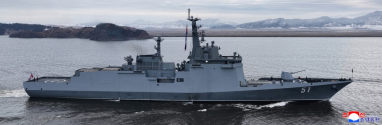
Kim Jong Un visited the destroyer "Choe Hyon 51" on March 3 and 4 during its navigation tests and also attended cruise missile launch exercises, and photo's confirmed that the engines are on boardChoe Hyon is almost ready for service, sailed under own power and did demonstration of its arsenal.
View attachment 170738

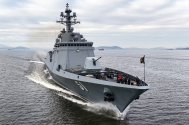
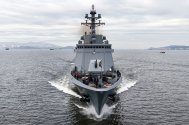
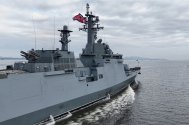
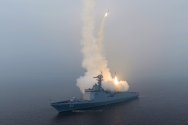
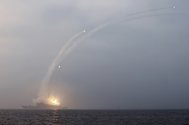
Does North Korea really have no intention of equipping it with a better surface-search radar?
Choe Hyun is a good looking ship.
Well, isn't that the point of the AESA arrays, they could do everything, surface search, targeting etc.?Does North Korea really have no intention of equipping it with a better surface-search radar?
I'm primarily referring to its Type 362-like radar, positioned directly below her maritime navigation radar. If I'm not mistaken, it's a surface search radar, right?
For a ship of this top-tier class (seriously), she should be equipped with the Mineral-ME/Type 366 – or anything that more advanced – instead of a radar that's somewhat dated.
For a ship of this top-tier class (seriously), she should be equipped with the Mineral-ME/Type 366 – or anything that more advanced – instead of a radar that's somewhat dated.