Chinese Economics Thread

tphuang

General
Staff member
Super Moderator
VIP Professional
Registered Member

I do think the current labor force changes will force the continued shift away from labor intensive, low margin business and into higher margin services trade. And even if they replace those labor intensive work with robots (which is actually hard for many of the toy work), those trade will still be low margin and not worth it for an economy where 70% of people entering work force are looking for white collar work.
 

Nevermore

Junior Member
Registered Member

I do think the current labor force changes will force the continued shift away from labor intensive, low margin business and into higher margin services trade. And even if they replace those labor intensive work with robots (which is actually hard for many of the toy work), those trade will still be low margin and not worth it for an economy where 70% of people entering work force are looking for white collar work.
Will this shift the economy from physical manufacturing toward services? The relative decline in manufacturing makes me worry that China might follow the path of recession taken by the United States and the United Kingdom.
 

siegecrossbow

Field Marshall
Staff member
Super Moderator
Will this shift the economy from physical manufacturing toward services? The relative decline in manufacturing makes me worry that China might follow the path of recession taken by the United States and the United Kingdom.
If China has a redline for farming/food production, you can be assured that there is one for low end but necessary manufacturing. Don’t forget that the party, not the shareholders have the final say in China.
 

tphuang

General
Staff member
Super Moderator
VIP Professional
Registered Member
Will this shift the economy from physical manufacturing toward services? The relative decline in manufacturing makes me worry that China might follow the path of recession taken by the United States and the United Kingdom.
people need to chill about this. There is a huge gap between where US/UK is vs where China is. China is already shifting low end manufacturing to ASEAN countries & this will continue. Sure, you can fully automate w/ robots to compete on cost, but after a while, ppl just don't want to do the work. What's important is to continue to dominate the high value added part of supply chain & do less of the low margin assembly work that any poorer country can do. They will have Chinese ownership, Chinese supply chain & machines, but use local labor and electricity.

And there is a long way between where they are now vs not having any. They will still have some low end manufacturing but the mass export to Western countries will be from other global south countries.
 
Will this shift the economy from physical manufacturing toward services? The relative decline in manufacturing makes me worry that China might follow the path of recession taken by the United States and the United Kingdom.
I forsee China moving to a, "manufacturing as a service," model. Actual manufacturing may take place outside of China, but China will provide the core services, components, and infrastructure necessary. Imagine mostly automated smart factories, using Chinese machines/robotics connected to Chinese cloud/AI services running on Chinese provided digital and network infrastructure and using critical materials/components sourced from China producing products primarily designed in China and relying on Chinese IP.
 

siegecrossbow

Field Marshall
Staff member
Super Moderator
I forsee China moving to a, "manufacturing as a service," model. Actual manufacturing may take place outside of China, but China will provide the core services, components, and infrastructure necessary. Imagine mostly automated smart factories, using Chinese machines/robotics connected to Chinese cloud/AI services running on Chinese provided digital and network infrastructure and using critical materials/components sourced from China producing products primarily designed in China and relying on Chinese IP.
One example of this would be plastic toys manufactured in India. While the product is technically made there, the mold for the parts and pellets for the plastic are both from China since it is not economical for them to do those themselves.
 

Wrought

Captain
Registered Member
India has relaxed curbs on Chinese equipment in the public sector following shortages and delays.

NEW DELHI, Feb 18 (Reuters) - India has begun easing its restrictions on buying Chinese equipment after a
Please, Log in or Register to view URLs content!
, allowing state-run power and coal companies to start limited imports as shortages and project delays mount, two government officials told Reuters. This is the first significant easing of five-year-old curbs that have largely shut Chinese firms out of India's $700 billion-$750 billion government contract market.

India has now allowed state-run entities to procure a power-transmission component from China without government approval. It is weighing a similar, time-bound exemption for key coal-sector equipment, the two officials said. The exemption was granted in the "national interest," as blocking Chinese imports would hurt India's manufacturing capability, one of the officials said. A panel of top bureaucrats has approved the waiver, with a formal order expected soon, the two sources said. The easing follows repeated requests from government departments facing shortages and project delays under the 2020 restrictions, both officials said.

Please, Log in or Register to view URLs content!
 

Wrought

Captain
Registered Member
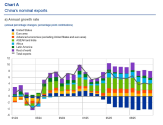
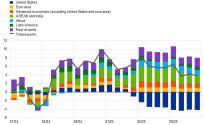
The European Central Bank published a report on the impact of Trump's tariffs last year w.r.t. Chinese export flows.

Global trade flows were reshaped in 2025 following the introduction of new US tariffs. US import growth weakened sharply, reflecting a strong decline in imports from China. Meanwhile, Chinese exports have surprised to the upside overall, with broad-based growth across destinations outside the United States. A key question is whether this resilience reflects trade diversion in response to the US tariffs, i.e. the reallocation of exports originally destined for one market towards alternative markets, or other adjustment mechanisms, such as rerouting through intermediary countries. However, it may still be too early to assess the full extent of tariff-induced trade redirection, as anticipatory behaviour, implementation lags at customs, shipping delays and other factors can all affect how long it takes for tariff changes to be reflected in observed trade flows. This box reviews developments in Chinese exports in 2025 and provides initial empirical evidence on whether US tariffs have triggered trade diversion.

It concluded that tariff impacts were limited compared to longstanding structural factors.

Overall, trade diversion accounts for only a limited role in recent Chinese export dynamics, with other factors playing a more prominent role. While part of the decline in Chinese exports to the United States can be attributed to the new tariffs, thus far there is little evidence that these measures have led to substantial trade diversion towards other markets. Any tariff-related diversion appears modest and confined to a narrow set of products, indicating limited spillovers from US tariffs to third destinations. Instead, the recent strength of Chinese exports to other markets seems to have been driven by trends that predate the latest tariff measures, as evidenced by broad-based export growth across major regions.

1771457430915.png

1771457384510.png

Please, Log in or Register to view URLs content!
 

Attachments

  • 1771457327577.png
    1771457327577.png
    36.3 KB · Views: 5
Top