Chinese Economics Thread

Blitzo

General
Staff member
Super Moderator
Registered Member
Various posts deleted

Six months warning ban for gadgetcool5 for starting the conversation about demographics again, and 1 month ban jli88 and michael90 for responding to it.
My patience for this topic which we've specifically ruled out a thread for, is growing thin.
 

abenomics12345

Junior Member
Registered Member
I think its more that they've taken share from other players in the industry.

KFC for example has an algorithmic promotion/coupon generator that will step up the coupons on products that have been sitting in the warmer too long. I.E if fried chicken has been out for 20 min (and close to the 30 min throw-away-point) they will discount it to get it sold.

The technology is simply not comparable to your mom and pop.
 

tphuang

General
Staff member
Super Moderator
VIP Professional
Registered Member

There does appear to be an increasing surplus in China's digital services sector. Although, China is still running a deficit in services industry overall.


longer term, China has to significantly appreciate it's currency as it moves up value chain, which would entail buying less USD assets (or selling them off) and putting them in domestic markets and gold.

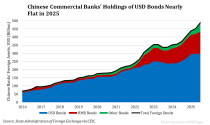
Chinese+Banks_Holding+Breakdown_2016-2025.png
This is a pretty good photo by Gerard DiPippo of Chinese commercial Bank holding on different Asse them holding. You can see USD bond holdings have been flat for all of 2025. That would make sense given the news that Chinese govt is telling them that RMB is appreciating and holding USD assets mean losses in RMB. Which is leading to greater RMB Bond & stock holdings over time and obviously Gold and silver.
 

Wrought

Captain
Registered Member
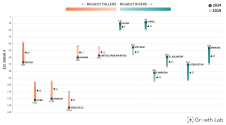
Harvard economists predict that Vietnam (#1) and China (#2) will be the leading sources of global growth per capita for the next decade, thanks to their well-developed industrial bases.

Cambridge, MA—New projections from the Growth Lab at Harvard University suggest that Vietnam and China are positioned to lead global growth in the decade ahead, driven by their sophisticated and diverse manufacturing capabilities. The findings, released today in the latest Atlas of Economic Complexity using 2024 data, forecast that economies that have built complex productive capabilities will drive the world's economic expansion for the coming decade, even as rising trade tensions threaten to disrupt their growth trajectories.

Vietnam is projected to lead all nations in GDP per capita growth, followed closely by China, a remarkable forecast for the world's second-largest economy. "Vietnam and China remain more complex than expected for their income level, so they will continue to lead global growth in the coming decade," said Ricardo Hausmann, director of the Growth Lab, professor at the Harvard Kennedy School, and the leading researcher of The Atlas of Economic Complexity. "Countries that have diversified their production into more complex sectors are those that will lead global growth."

1770829416065.png
Please, Log in or Register to view URLs content!
 

ENTED64

Junior Member
Registered Member
1770829416065.png
This chart confuses me. It says China rose 3 places from 2019 to 2024. But from the scale on the left it seems that in 2019 China was about #20 and now it is #10 so it should be 10 places? Indeed the size of the increase bar seems roughly similar to Vietnam and Israel, not much less.
 

jnd85

Junior Member
Registered Member

China Sets 2030 Target for Unified National Power Market​

(via
Please, Log in or Register to view URLs content!
)

If I interpret correctly, one of the side effects of this push will be that even small businesses who have invested in renewable energy generation infrastructure will be able to sell back any excess energy at unified market value. Also, power consumers in individual provinces will no longer face differing pricing structures dependant on local policies. It should really level the field for regional development.

From the article:

China aims to basically establish a nationwide unified power market system by 2030, with market-based transactions accounting for around 70 percent of total electricity consumption, under new guidelines released by the General Office of the State Council.

By 2030, all types of power sources and electricity users, except those receiving guaranteed supply, will directly participate in the power market, according to the guidelines released yesterday.

By 2035, the system is expected to be fully established, with seamless integration of inter-provincial, inter-regional, and intra-provincial transactions so that the multidimensional value of electricity resources -- including energy, regulation, environmental impact, and capacity -- is fully reflected by the market.

The guidelines set out 19 key tasks, a representative of the National Development and Reform Commission said. These include optimizing electricity resource allocation nationwide, improving market functions, facilitating equal and broad participation by various business entities, building a unified power market framework, and strengthening policy coordination.

The plan proposes a gradual shift from “individual pricing and trading by each province” to “unified pricing and joint trading.” It encourages neighboring provinces to voluntarily cooperate or integrate their markets, expand inter-provincial and inter-regional power transmission, and raise the share of clean energy deliveries. It also calls for building and operating an integrated power market in southern China and improving electricity mutual assistance mechanisms in the Yangtze River Delta.

The guidelines state that authorities will explore establishing a capacity market to compensate supporting and regulating resources -- such as coal-fired power, pumped hydro storage, and new energy storage -- for their role in maintaining grid stability and facilitating renewable energy consumption. For projects including large-scale renewable energy bases in desert regions and distributed renewable energy, differentiated market access pathways will be introduced. The plan also proposes exploring long-term green electricity contracts to better meet demand from export-oriented enterprises and foreign-invested companies.

The document further calls for greater participation by private enterprises in the power market. It encourages new types of market entities, primarily led by private firms, to flexibly engage in trading through innovations such as new energy storage, virtual power plants, and intelligent microgrids. Small and medium-sized commercial and industrial users that currently purchase electricity through grid agents will gradually be allowed to participate directly in the market.

In a research report, CITIC Securities said the capacity market could become a key focus in the next stage of market development and suggested investors pay attention to opportunities in base-load power sources, energy storage, and related industry chains.
 

Wrought

Captain
Registered Member
Not a fan of their coffe myself, but Luckin is expanding fast, so I guess someone is.

BEIJING -- Luckin Coffee, the operator of China's largest cafe chain, has announced the opening of its 30,000th location worldwide in just over eight years, reaching that point six times as fast as Starbucks. The milestone was reached with the opening Sunday of a flagship location in Shenzhen. Since Luckin was established in October 2017, it has expanded to more than 300 cities across China -- where the vast majority of its network is concentrated -- as well as overseas markets including Singapore, Malaysia and the U.S. The chain has grown more than 30% since the end of 2024, when it had 22,340 outposts. It has gained a following with drinks that offer good value for money, as well as unique offerings such as coffee blended with fruit juice.

By comparison, Starbucks, which opened its first location in Seattle in 1971, took around 48 years to reach the 30,000-store mark. It had 41,118 locations at the end of 2025.

Please, Log in or Register to view URLs content!
 
Top