Chinese Radar Developments - KLJ series and others

tphuang

General
Staff member
Super Moderator
VIP Professional
Registered Member
Please, Log in or Register to view URLs content!

3.3 5G/6G通信:跻身国际先进行列中国电科13所以ELO金刚石为基础,成功制备300GHz HEMT原型器件,功率密度达到12W/mm,具备高频低损耗的核心特点,可充分满足新一代通信基站的性能需求。该成果标志着我国在金刚石射频器件领域跨入国际先进行列,将推动5G/6G通信射频器件的升级迭代。

This is an end of 2025 summary on diamond semi development globally from 2025. The most interesting one for me is this because I have not even noticed this news before.

CETC 13th Institute apparently by using ELO diamond successfully developed 300GHz HEMT with power density of 12W/mm. That is so crazily high

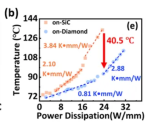
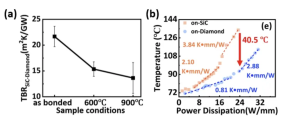
I have seen GaN HEMT on 4H-Sic/Diamond substrate recently that allowed pretty high power dissipation and you can see a chart like this just how much power dissipation can be achieved on such a substrate
Screenshot 2026-01-13 at 9.48.35 AM.png
So, supplying up to 12W/mm for 300GHz HEMT would allow for some ultra high data transmission.
 

BoraTas

Major
Registered Member
Please, Log in or Register to view URLs content!


This is an end of 2025 summary on diamond semi development globally from 2025. The most interesting one for me is this because I have not even noticed this news before.

CETC 13th Institute apparently by using ELO diamond successfully developed 300GHz HEMT with power density of 12W/mm. That is so crazily high

I have seen GaN HEMT on 4H-Sic/Diamond substrate recently that allowed pretty high power dissipation and you can see a chart like this just how much power dissipation can be achieved on such a substrate
View attachment 168093
So, supplying up to 12W/mm for 300GHz HEMT would allow for some ultra high data transmission.
These diamond stuff will probably shift the limitation to cooling of the overall system from the cooling of the chip itself. The dissipation they achieve is incredible. Expect naval radars to achieve absurd ranges very soon. This also has implications for the opposite end where it is hard to cool anything. Satellite based emitters...
 

siegecrossbow

Field Marshall
Staff member
Super Moderator
These diamond stuff will probably shift the limitation to cooling of the overall system from the cooling of the chip itself. The dissipation they achieve is incredible. Expect naval radars to achieve absurd ranges very soon. This also has implications for the opposite end where it is hard to cool anything. Satellite based emitters...
China needs to expedite reuseable rockets then. Imagine if they realized satellite based awacs before Trump’s Golden Dome even breaks ground…
 

BoraTas

Major
Registered Member
China needs to expedite reuseable rockets then. Imagine if they realized satellite based awacs before Trump’s Golden Dome even breaks ground…
For this kind of expensive sats, the launch capacity is likely not the issue. Back in the 1980s, the Brilliant Pebbles space-based ABM was deemed possible with the launchers of the era. Today, China's non-internet launch mass is higher than the USA. I believe this is because of the relative cost of the payloads. Internet satellites cost nothing compared to an expendable launcher. An ABM or a space-based early-warning satellite will cost a lot. Even ground based and terminal phase interceptors cost millions. Exoatmospheric interceptors like the SM-3 B2A cost $100 million each.

SM-3 price.png
 

tphuang

General
Staff member
Super Moderator
VIP Professional
Registered Member
Please, Log in or Register to view URLs content!

This already posted on semi thread, but it's quite significant for radar here.

西电 team using AlN thin film on SiC substrate and then GaN layer on top for RF power device. High energy ions on 3rd gen semi chip crystal make rough surface of crystal nucleation layer smooth & flat, reduces thermal resistance to 1/3 of original, solving heat dissipation problems. Power devices achieved power density of 42 W/mm & 20 W/mm in X & Ka-band. Improves performance record of these device by 30-40%.

This significantly increases the range from same surface area whether its for long range communication or radar or EW efforts.
 

taxiya

Brigadier
Registered Member
These diamond stuff will probably shift the limitation to cooling of the overall system from the cooling of the chip itself. The dissipation they achieve is incredible. Expect naval radars to achieve absurd ranges very soon. This also has implications for the opposite end where it is hard to cool anything. Satellite based emitters...
I am not sure if you mixed the EM power dissipation with thermal power dissipation.
1768677957905.png
The diagram shows lower temerature for on-Diamond at the same power dissipation. Without reading the source paper, I'd interpret this power (dissipation) as the useful power emiting EM waves instead of the thermal power which is waste heat that need to be cooled. In other words on-Diamond chip can send higher power signals at lower temperature meaning lower cooling demand.
 

BoraTas

Major
Registered Member
I am not sure if you mixed the EM power dissipation with thermal power dissipation.
View attachment 168293
The diagram shows lower temerature for on-Diamond at the same power dissipation. Without reading the source paper, I'd interpret this power (dissipation) as the useful power emiting EM waves instead of the thermal power which is waste heat that need to be cooled. In other words on-Diamond chip can send higher power signals at lower temperature meaning lower cooling demand.
It looks like the graph of thermal resistivity (p) which is the reciprocal of thermal conductivity (k). The formula for heat transfer rate per unit area is −(1/p)∇T. ∇T is the temperature difference. Lower the p, lower the temperature difference for the same dissipation. The formula has a minus because the hotter object always loses heat. K.mm/W unit you see on the graph is exactly the unit of thermal resistivity. The plain word explanation for the graph is on-diamond chips are much easier to cool hence could be pumped more power.
 

taxiya

Brigadier
Registered Member
It looks like the graph of thermal resistivity (p) which is the reciprocal of thermal conductivity (k). The formula for heat transfer rate per unit area is −(1/p)∇T. ∇T is the temperature difference. Lower the p, lower the temperature difference for the same dissipation. The formula has a minus because the hotter object always loses heat. K.mm/W unit you see on the graph is exactly the unit of thermal resistivity. The plain word explanation for the graph is on-diamond chips are much easier to cool hence could be pumped more power.
This explanation would mean that it is easier to cool an on-dimanond chip working on higher power than other type of chips. That is opposite to what you were concerned in #932, right?
 

BoraTas

Major
Registered Member
This explanation would mean that it is easier to cool an on-dimanond chip working on higher power than other type of chips. That is opposite to what you were concerned in #932, right?
Nope. It is not. If removing the heat from the chips becomes easy, the limitation becomes the overall heat rejection by the system. So the systems which are already limited by it, such as the F-35, would not benefit much. The space is different. Most things aren't cooled well in the space. There is no weight or cost margin for big heat exchangers. Hence the chip itself being more conductive would still make a significant difference.
 
Top