PLA Strategy in a Taiwan Contingency

Andy1974

Senior Member
Registered Member
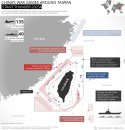
Two main reasons. First, I think the invasion will start like the PLAs exercise around Taiwan, see Straight-Thunder 2025A.

IMG_0247.jpeg
I think that if the invasion happens it will start from this position or very similar with the main difference being the addition of amphibious forces.

I expect Taiwan, and the world, to expect an exercise but it will in fact be an invasion.

But the main reason for my theory is the weather.

From this forum there are hints that the PLA will prefer very clam sea conditions in the straight, the type of conditions that occur on just a few days per year going by historical patterns.

This extreme calmness in the straight will allow the PLAs amphibious armored equipment, with flotation devices attached to deploy from far out in the straight, or even from the mainland directly. We have seen this equipment being tested.

Thus the timing of the assault is weather dependent, and not on whether the bombardment has achieved all it’s goals or if a blockade is effective.

Chinas weather forecasts can predict 10 days in advance, so once the weather is predicted to be just right I expect an exercise to be announced, then held and once everything is in place, just off the Taiwan coast the bombardment will start and as soon as the conditions become extremely calm will the main thrust of the landing will start.
 

vincent

Grumpy Old Man
Staff member
Moderator - World Affairs
Two main reasons. First, I think the invasion will start like the PLAs exercise around Taiwan, see Straight-Thunder 2025A.

View attachment 166391
I think that if the invasion happens it will start from this position or very similar with the main difference being the addition of amphibious forces.

I expect Taiwan, and the world, to expect an exercise but it will in fact be an invasion.

But the main reason for my theory is the weather.

From this forum there are hints that the PLA will prefer very clam sea conditions in the straight, the type of conditions that occur on just a few days per year going by historical patterns.

This extreme calmness in the straight will allow the PLAs amphibious armored equipment, with flotation devices attached to deploy from far out in the straight, or even from the mainland directly. We have seen this equipment being tested.

Thus the timing of the assault is wether dependent, and not on whether the bombardment has achieved all it’s goals or if a blockade is effective.

Chinas weather forecasts can predict 10 days in advance, so once the weather is predicted to be just right I expect an exercise to be announced, then held and once everything is in place, just off the Taiwan coast the bombardment will start and as soon as the conditions become extremely calm will the main thrust of the landing start.
That's a really bad take. Weather plays no part in the timing of the amphibious portion of the attack. US bombed all the countries it invaded for weeks, if not months, before start the ground operation.
 

Andy1974

Senior Member
Registered Member
That's a really bad take. Weather plays no part in the timing of the amphibious portion of the attack. US bombed all the countries it invaded for weeks, if not months, before start the ground operation.
You should read the art of war, page 1, lesson 1.

China is not the USA. They can bombard Taiwan with much greater intensity and in a much compressed timeline.
 
Last edited:

PigeonFood

Just Hatched
Registered Member
You should read the art of war, page 1, lesson 1.

China is not the USA. They can bombard Taiwan with much greater intensity and in a much compressed timeline.
In either case, there will be significant bombardment before the initial invasion. Whether or not that step comes after a blockade is a different question, but by the time the troops hit the shores, most of Taiwan's defenses need to be thoroughly neutralized, or the invasion won't happen.
 

PigeonFood

Just Hatched
Registered Member
I don’t think China can afford to wait for very long between starting MLRS strikes and launching amphibious operations at all incase the US decides to get heavily involved.

I think they would do a huge and continuous strike, everywhere, and start the amphibious ops straight away.
Unlikely. No matter how large the initial strike is, you'll need follow-up strikes in the period afterwards because Taiwan will have units dispersed, under hardened shelters, and stragglers.

The goal is to reduce overall PLA casualties and to have as much effect as possible. This means that an initial strike, either following or during a blockade, with follow-up strikes, will be the best way to go.

To add to that, if you start amassing troops for amphibious ops, Taiwan will know and start to more heavily disperse their assets, decreasing the overall effect on the initial strike. This is basic knowledge, both sides know it, and China knows the play would be a thorough, systematic unraveling of Taiwan's defenses before sending forces in.
 

latenlazy

Brigadier
You are still treating Chinese strike capabilities far too much like Iran’s.

Even Iranian ballistic missiles were giving the best the west has to offer major headaches and breaches when it comes to ABM over Israel, and those Iranian missiles were basically equivalent to stuff the PLA has already, or are in the process of retiring.

The Ukrainians have also had pretty abysmal intercept rates against Russian Islanders and Kinzhals, which are at least a generation or two behind the latest hypersonics the PLA are fielding.

China doesn’t need to play the saturation and attrition route as it has weapons that opfor defences have minimal chances of successfully intercepting. So it can use those high end weapons to punch holes in opfor air defences, command structures and core assets to disable or at least massively degrade opfor defensive capabilities and intercept rates against cheap low tier weapons.
It’s useful to argue the point with an Iran baseline because what Iran did to Israel serves as a demonstrable objective reference point outside theoretical or hypothetical discussion, and establishes that even if we apply a performance penalty for those with prejudices against China at this point the jig is basically up.
 

Engineer

Major
As Patch pointed out in 2022, the US is unable to generate sufficient fires to penetrate the IADS in mainland China.

Plus the scenario assumption is that China is militarily dominant in the Western Pacific, but can't reach past.
And that the US can't reach into the Western Pacific, but is militarily dominant elsewhere

You can debate whether such a scenario is relevant today, in 5 years time, or 10 years time, but it is almost certain to be the balance of power at some point.

So perhaps you can suggest an alternative course of action in such a scenario.
You are counting the chicken before they hatch. Until US actually leaves Asia Pacific, your assumptions don't work, because US still has bases in Asia Pacific to take potshots at China. Furthermore, IADS isn't fool proof, and disruptive technologies could suddenly appear and render IADS useless overnight, much like what drones did to land warfare. Your scenario of "an uninterrupt production just more" for naval vessels could only occur in peace time, and would not happen in war time. Your scenario is just shit, simple as that. I don't need to suggest an alternate course of action.

This statement is incorrect.

Heavy manufacturing is fundamentally a complicated process rather than a complex one.
And since WW2, it has only become more complicated, and less complex

1. We now have digital models for the shipyards, the ships and their components.
2. Inspection technology is way better than back in WW2 and robots can reliably repeat operations

So you can put in place rules, systems and processes, so that it becomes a complicated (but manageable) process.

Here's an old example of welding with robots with the Virginia SSNs, so I expect the situation in China to be far more advanced today.
Please, Log in or Register to view URLs content!


Gavekal Research states that Chinese shipyard workers are 3x more productive than in America.

EDIT. We can also use airliners as an example. Since the 1970s, airliners have gotten more complicated. But production times have gone down substantially.
This argument doesn't work. Top-notch processes are already in-place, hence why China is No 1. in manufacturing. No one is sitting on a top-top-notch process until wartime to bring you that magic 15x increase in aircraft carrier production.

That is incorrect.

Look at what is happening in the automobile industry for example.

1. Automation is substantially reducing production timelines.
2. Granted, cars are smaller than ships, but cars can be used a proxy for the components that make up ship modules.

Any process can be automated, but the question is whether the upfront initial cost and time is worth it. For aircraft carriers which are only built once every 5 years and are essentially unique one-off builds, it's not feasible.

But if you have a construction programme which assumes significant numbers of identical ships , it is worth developing the automation, then implementing this everywhere.
Irrelevant example. Cars are produced in the number of tens of millions. Naval vessels even with "significant numbers" are a few dozen at best, and carriers are in single digit. The production method is different, with one on a pulsed assembly line and the other one isn't. The size is different. There is no comparison.

I feel this is just cope now. "Social factors" are the bottleneck in China expanding shipbuilding in a wartime scenario?
Just because you don't think about it, doesn't mean it is cope. How many experienced workers are retiring in the next 10 years versus how many Gen-Z to replace them? Do Gen-Z even want to do hard labour in a shipyard? This is a people-problem, whereas you only thought about technologies and assumed human act like robots.
 
Last edited:

HighGround

Senior Member
Registered Member
Two main reasons. First, I think the invasion will start like the PLAs exercise around Taiwan, see Straight-Thunder 2025A.


I think that if the invasion happens it will start from this position or very similar with the main difference being the addition of amphibious forces.

I expect Taiwan, and the world, to expect an exercise but it will in fact be an invasion.

But the main reason for my theory is the weather.

From this forum there are hints that the PLA will prefer very clam sea conditions in the straight, the type of conditions that occur on just a few days per year going by historical patterns.

This extreme calmness in the straight will allow the PLAs amphibious armored equipment, with flotation devices attached to deploy from far out in the straight, or even from the mainland directly. We have seen this equipment being tested.

Thus the timing of the assault is weather dependent, and not on whether the bombardment has achieved all it’s goals or if a blockade is effective.

Chinas weather forecasts can predict 10 days in advance, so once the weather is predicted to be just right I expect an exercise to be announced, then held and once everything is in place, just off the Taiwan coast the bombardment will start and as soon as the conditions become extremely calm will the main thrust of the landing will start.

Even accepting the premises of your logic, it does not explain why PRC forces have any kind of time pressure or incentive to begin amphibious operations shortly after the hostilities begin.

All of what you said could be true, and PRC would initiate amphibious operations, but against limited targets like Kinmen, while at the same time striking major targets on Taiwan. How long this shaping operationg takes can be anywhere from days to weeks. The variable here is of coures Taiwan's defences, as well as international reactions. Particularly, from Japan, Australia, and USA.
 

4Tran

Junior Member
Registered Member
Two main reasons. First, I think the invasion will start like the PLAs exercise around Taiwan, see Straight-Thunder 2025A.

View attachment 166391
I think that if the invasion happens it will start from this position or very similar with the main difference being the addition of amphibious forces.

I expect Taiwan, and the world, to expect an exercise but it will in fact be an invasion.

But the main reason for my theory is the weather.

From this forum there are hints that the PLA will prefer very clam sea conditions in the straight, the type of conditions that occur on just a few days per year going by historical patterns.

This extreme calmness in the straight will allow the PLAs amphibious armored equipment, with flotation devices attached to deploy from far out in the straight, or even from the mainland directly. We have seen this equipment being tested.

Thus the timing of the assault is weather dependent, and not on whether the bombardment has achieved all it’s goals or if a blockade is effective.

Chinas weather forecasts can predict 10 days in advance, so once the weather is predicted to be just right I expect an exercise to be announced, then held and once everything is in place, just off the Taiwan coast the bombardment will start and as soon as the conditions become extremely calm will the main thrust of the landing will start.
This reads like an American wet dream. Amphibious invasions are very risky affairs, and trying to pull one off quickly before first reducing the opposition's defences incurs the maximum risk while stray far away from China's greatest strengths. A surprise attack is something that thinktanks keep talking up, but there doesn't seem to be based on what China would actually do.

The other thing that I think is important to point out is that the urgency to invade before the US can intervene probably doesn't exist; or at least the timeframe is very relaxed. Technically the Seventh Fleet can get to Taiwan fairly quickly, but what are they going to do when they get there? Face off against the entirety of the PLAN, PLAAF, and PLARF at the same time? That's just going to get a lot of ships sunk for very limited returns. No, what they're going to do is to assemble a much larger force of multiple CBGs before they respond, and that's going to take at least a couple of months.

It's a big purchase to be sure, and it would seem to boost the ROCA's capabilities by quite a bit. But it just doesn't feel like it would help all that much. It's just more high-end targets for the PLAGF to knock out. Maybe if the ROCA were able to hide most of them there'd be more value, but that doesn't seem likely so I don't know how much it's going to accomplish.
 
Top