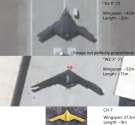
CH-7 is indeed a very large flying-wing UAV. But precisely because it’s a big flying wing, in China’s defense-industrial world it can’t even “make it to Malan,” and its first flight ended up happening at a place like Pucheng—on top of that, they arranged conspicuous, high-profile media coverage. And even more telling: while it “debuted” at Pucheng with all that fanfare, the write-up tried as hard as possible to avoid explicitly saying it flew at Pucheng. Even Caihong’s own products that actually had real users in the past didn’t play this kind of PR game. I wouldn’t write the project off completely, but these details say plenty about its status: it looks all sharp and angular, yet the treatment it’s getting is basically “same table as the Jiutian drone.”
Compared with several similar systems that are already out and have clearly identified customers, CH-7 looks like a “straw dog” in technical terms. That’s only in comparison to the domestic cutting edge—globally it’s still decent. Criticizing it isn’t about looking down on anyone; it’s that things far stronger than it are moving faster and more smoothly, which leaves CH-7’s product positioning in a pretty awkward spot.
From this angle, CH-7’s chances of finding someone to take it off their hands may even be worse than Jiutian’s. Jiutian may be designed by the First Aircraft Institute, but from project start to airshow debut to first flight it still doesn’t even have a formal “model number”—just an ancient-style name—so you can say it’s truly nameless and unofficial. But because it’s a contrarian, against-the-trend concept, at least it faces less direct peer competition pressure than CH-7 does. Still, when they did the same kind of high-profile promotion a few days ago, they didn’t go so far as to refuse to say it flew at Pucheng, did they?



![[话筒]](https://face.t.sinajs.cn/t4/appstyle/expression/ext/normal/48/2018new_huatong_org.png "[话筒]")