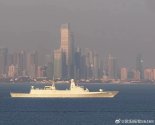
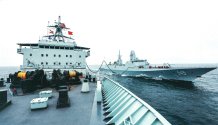
054B/new generation frigate

lcloo

Major
I think most of us already take that type 054B is a stop gap design, waiting for a certain technology to mature, much like when they built type 052C while waiting for type 052D.

IMO the next iteration would be a design with similar hull to type 054B with some adjustment and new propulsion and some new air defense with more emphasis on enhanced short range defense against drones and small sea crafts.

The changes on the next iteration might be sufficient to deserve a new class designation, may be the long awaited type 057.
 
054B is also a completely different design from 054A in other regards, both for the hull and displacement, therefore it seems to me PLAN designation rationale is indeed centered on the propulsion arrangement first and foremost for such distinctions.
This is all based on observations across a relatively small sample size (051 line and 052 line) and has never been stated or confirmed by official sources. The prior frigate line- the 053 classes - contradict the naming by propulsion arrangement practice (with the original Jianghus using steam turbine and the later Jianweis using CODAD).
 
Last edited:

AndrewS

Brigadier
Registered Member
I think most of us already take that type 054B is a stop gap design, waiting for a certain technology to mature, much like when they built type 052C while waiting for type 052D.

IMO the next iteration would be a design with similar hull to type 054B with some adjustment and new propulsion and some new air defense with more emphasis on enhanced short range defense against drones and small sea crafts.

The changes on the next iteration might be sufficient to deserve a new class designation, may be the long awaited type 057.

What technology would be awaiting maturation for a Type-054B Frigate successor?

---

For long-range air defence., the Chinese Navy already has the modern Type-055/Type-052D design.

---

For medium-range air defence, we have the Type-054B Frigate with a modern rotating AESA radar and HQ-16 SAMs

---

So that would just leave new short-range air defence weapons of last resort such as lasers. But continuing to use existing systems doesn't detract from the primary Frigate mission of medium-range air defence.

Plus remember Chinese Frigates occupy an affordability role. Current lowish-powered <100kW lasers are costing $200 million and my guess is that a Type-054B costs less than $500 million. It may well be that they decide a laser isn't worth it.

But if they do, in a successor Frigate class, there would likely only be a single laser (presumably replacing a 30mm Gun CIWS), and a figure of 600kW is being touted by the US as acceptable.

But the Type-054B could have already been designed with possibility in mind, with power cables capable of supplying an extra 2MW of electricity generation to a laser.

---

If the current Type-054B is not fast enough, the only reason would be to keep up with a carrier group. But from what we see of current doctrine, only 1-2 such Frigates would be required per carrier group (primarily for ASW), and there won't be enough carriers for some years to justify a new faster Frigate design (from a cost-effectiveness perspective), considering that the Type-052D and Type-055 already exist.

It may also end up that the new 1000? tonne high-speed semi-submersible trimaran corvette (DDC?) with a VDS performs the ASW role in a carrier group. Such a ship could easily be unmanned (since it is operating as part of a carrier group) and should be significantly lower-cost than even a Type-054B.

If you want to operate the VDS in active sonar mode or interpose a ship between a submarine and the carrier, using a DDC is a better option that using a Frigate.
 

lcloo

Major
What technology would be awaiting maturation for a Type-054B Frigate successor?

---

For long-range air defence., the Chinese Navy already has the modern Type-055/Type-052D design.

---

For medium-range air defence, we have the Type-054B Frigate with a modern rotating AESA radar and HQ-16 SAMs

---

So that would just leave new short-range air defence weapons of last resort such as lasers. But continuing to use existing systems doesn't detract from the primary Frigate mission of medium-range air defence.

Plus remember Chinese Frigates occupy an affordability role. Current lowish-powered <100kW lasers are costing $200 million and my guess is that a Type-054B costs less than $500 million. It may well be that they decide a laser isn't worth it.

But if they do, in a successor Frigate class, there would likely only be a single laser (presumably replacing a 30mm Gun CIWS), and a figure of 600kW is being touted by the US as acceptable.

But the Type-054B could have already been designed with possibility in mind, with power cables capable of supplying an extra 2MW of electricity generation to a laser.

---

If the current Type-054B is not fast enough, the only reason would be to keep up with a carrier group. But from what we see of current doctrine, only 1-2 such Frigates would be required per carrier group (primarily for ASW), and there won't be enough carriers for some years to justify a new faster Frigate design (from a cost-effectiveness perspective), considering that the Type-052D and Type-055 already exist.

It may also end up that the new 1000? tonne high-speed semi-submersible trimaran corvette (DDC?) with a VDS performs the ASW role in a carrier group. Such a ship could easily be unmanned (since it is operating as part of a carrier group) and should be significantly lower-cost than even a Type-054B.

If you want to operate the VDS in active sonar mode or interpose a ship between a submarine and the carrier, using a DDC is a better option that using a Frigate.
About the laser weapon, i.e. if they decided to install one on the next iteration of 054B with same class designation of a new class designation, which laser weapon would they choose? Fact is we don't know, and we also do not know if the cost of US$100 million is true for that particular laser to be installed.

I know cost is always your concern, in military doctrine the cost is not the frigate itself, the cost center is the subject that is being protected by the frigate which could be an aircraft carrier costing more than $15 billion if we include the costs of the airwing, aviation weapons and the human life, and also the cost could be a failure of an operation which could affect the whole war, example the cost could be mission failure of an amphibious assault group consisting of half a dozen mix of type 071, type 075 and type 076 on their way to AR of Taiwan.

Even if you statement that the laser weapon would cost US$100 million each is true, the question is can China afford this? Spending additional $100 million may tilt a sea battle in China's favor is definitely affordable and desirable, because sometimes a single sea battle could end the whole war unless the opponent has extremely strong nationalist sentiment to fight to the last man which rarely happen.

The semi-submersible "arsenal ship" (to be confirmed by new intel) is nice to have but it will be a supplement rather than replacement of others, so are drones too. Frigates still will have their place along with these new assets.

I won't neglect the role of frigates in future sea battles, it is a part of the multi-platforms to be integrated into a reliable defensive circle protecting larger "capital" ships or ships carrying critical cargo or troops.
 

AndrewS

Brigadier
Registered Member
About the laser weapon, i.e. if they decided to install one on the next iteration of 054B with same class designation of a new class designation, which laser weapon would they choose? Fact is we don't know, and we also do not know if the cost of US$100 million is true for that particular laser to be installed.

I know cost is always your concern, in military doctrine the cost is not the frigate itself, the cost center is the subject that is being protected by the frigate which could be an aircraft carrier costing more than $15 billion if we include the costs of the airwing, aviation weapons and the human life, and also the cost could be a failure of an operation which could affect the whole war, example the cost could be mission failure of an amphibious assault group consisting of half a dozen mix of type 071, type 075 and type 076 on their way to AR of Taiwan.

Even if you statement that the laser weapon would cost US$100 million each is true, the question is can China afford this? Spending additional $100 million may tilt a sea battle in China's favor is definitely affordable and desirable, because sometimes a single sea battle could end the whole war unless the opponent has extremely strong nationalist sentiment to fight to the last man which rarely happen.

The semi-submersible "arsenal ship" (to be confirmed by new intel) is nice to have but it will be a supplement rather than replacement of others, so are drones too. Frigates still will have their place along with these new assets.

I won't neglect the role of frigates in future sea battles, it is a part of the multi-platforms to be integrated into a reliable defensive circle protecting larger "capital" ships or ships carrying critical cargo or troops.

I'm going with US Navy statements that they want a 600kW laser. At 20km, in bad weather conditions, that would still be 60kW of power.

---

In a carrier group, currently there would be 1 Frigate, mainly conducting ASW operations in the middle zone.

There would also be five destroyers, with the two Type-055 as close-in escorts.

So we could see an carrier with 4 lasers plus 2 more on the Type-055s. That would be at least 2 lasers covering every angle, on top of all the other defences.

Remember that for a carrier, the primary air defence are the aircraft. Then it's the long-range SAMs, then medium-range SAMs, then finally the last-ditch point defence like lasers.

---

I think all warships will end up with at least one laser in the future. But my point is that the existing Type-054B design should be sufficient to accommodate a future laser, and there is no need for a new high-speed Frigate design which will only be built in small numbers because there are so few carrier groups.
 

AndrewS

Brigadier
Registered Member
The semi-submersible "arsenal ship" (to be confirmed by new intel) is nice to have but it will be a supplement rather than replacement of others, so are drones too. Frigates still will have their place along with these new assets.

I won't neglect the role of frigates in future sea battles, it is a part of the multi-platforms to be integrated into a reliable defensive circle protecting larger "capital" ships or ships carrying critical cargo or troops.

I think the DDC(?) would replace some roles.

Consider a convoy or amphibious group.
Currently it would have 1 destroyer/frigate plus 2 frigates as escorts for example.

A DDC (with VDS) could replace one of the frigates.

Note that there's so much commercial shipping that there are never enough frigates.
 

Heliox

Junior Member
Registered Member
Remember that for a carrier, the primary air defence are the aircraft. Then it's the long-range SAMs, then medium-range SAMs, then finally the last-ditch point defence like lasers.

I think what's interesting is that there might be a need for a rethink of fleet defence moving forward into the age of "cheap" drone swarms. The one big takeaway from recent conflict is that of magazine depths being tested significantly by waves of Shaheed type UAV.

Traditional threats of AShM might conjecture a scenario where a CSG is facing a few 10s or up to ~100 incoming AShM and it can probably face that down a couple or more times with the entirety of it's AAM and VLS magazine. But very likely now, you may have 100s to 1000s Shaheed+ style drones layered over that wave of AShM. I cannot imagine having to triage incoming radar contacts to distinguish between which incoming to assign a VLS AAM and which to leave to the HHQ-10/CIWS/Deck guns but there you have it - saturation and depletion of the magazine is a real thing now, not necessarily over multi-day attacks but simply in one big well coordinated attack.

How is a CSG going to deal with this? Having to rotate out to port to replenish magazines is as good as a mission kill on the entire CSG - very good trade off if the price is a couple thousand Shaheeds analogues. (Besides the tactical issue of not getting hit by a AShM, there is also the strategic issue of the economics of exchange where the cost of the interceptor can be up to 10x the cost of the drone target. Not a problem to be solved in the immediacy of an attack but certainly something that needs to be addressed in terms of the economics and industrial capability to fight a sustained conflict.)

So a laser defence system, or another other system, with high repeatability and high cycle rates may be happenstance, just what is needed. Not as a "last ditch" layer but as something integral to manage possible swarm attacks? The difference may be subtle but it is everything when it comes to defining CONOPs
 

Wrought

Captain
Registered Member
I think what's interesting is that there might be a need for a rethink of fleet defence moving forward into the age of "cheap" drone swarms. The one big takeaway from recent conflict is that of magazine depths being tested significantly by waves of Shaheed type UAV.

Traditional threats of AShM might conjecture a scenario where a CSG is facing a few 10s or up to ~100 incoming AShM and it can probably face that down a couple or more times with the entirety of it's AAM and VLS magazine. But very likely now, you may have 100s to 1000s Shaheed+ style drones layered over that wave of AShM. I cannot imagine having to triage incoming radar contacts to distinguish between which incoming to assign a VLS AAM and which to leave to the HHQ-10/CIWS/Deck guns but there you have it - saturation and depletion of the magazine is a real thing now, not necessarily over multi-day attacks but simply in one big well coordinated attack.

How is a CSG going to deal with this? Having to rotate out to port to replenish magazines is as good as a mission kill on the entire CSG - very good trade off if the price is a couple thousand Shaheeds analogues. (Besides the tactical issue of not getting hit by a AShM, there is also the strategic issue of the economics of exchange where the cost of the interceptor can be up to 10x the cost of the drone target. Not a problem to be solved in the immediacy of an attack but certainly something that needs to be addressed in terms of the economics and industrial capability to fight a sustained conflict.)

So a laser defence system, or another other system, with high repeatability and high cycle rates may be happenstance, just what is needed. Not as a "last ditch" layer but as something integral to manage possible swarm attacks? The difference may be subtle but it is everything when it comes to defining CONOPs

The textbook answer is maintaining a sufficient buffer of controlled battlespace so as to have plenty of time and space to identify and prioritize interceptions to targets optimally. One could imagine a sufficiently distributed and networked joint task force getting the heads up, vectoring aircraft patrols, dispatching naval pickets, and otherwise repositioning assets to whittle down incoming salvos efficiently—perhaps with guns/lasers/rockets instead of more sophisticated missiles—as they slowly cruise towards high-value targets. If you have thousands of kilometers of space in which to triage, that takes the pressure off somewhat. Of course, there are many ways to make munitions faster and stealthier and more survivable, but the costs of doing so makes them not so cheap.

The more interesting question in my opinion is how the fairly obvious aforementioned approach will inevitably be contested at the peer level by opposing air and naval assets. It's one thing to maintain a safety cordon under permissive conditions, and another thing altogether when you have to fight for every inch of control because the other guy has an airforce and navy too.
 

AndrewS

Brigadier
Registered Member
I think what's interesting is that there might be a need for a rethink of fleet defence moving forward into the age of "cheap" drone swarms. The one big takeaway from recent conflict is that of magazine depths being tested significantly by waves of Shaheed type UAV.

Traditional threats of AShM might conjecture a scenario where a CSG is facing a few 10s or up to ~100 incoming AShM and it can probably face that down a couple or more times with the entirety of it's AAM and VLS magazine. But very likely now, you may have 100s to 1000s Shaheed+ style drones layered over that wave of AShM. I cannot imagine having to triage incoming radar contacts to distinguish between which incoming to assign a VLS AAM and which to leave to the HHQ-10/CIWS/Deck guns but there you have it - saturation and depletion of the magazine is a real thing now, not necessarily over multi-day attacks but simply in one big well coordinated attack.

How is a CSG going to deal with this? Having to rotate out to port to replenish magazines is as good as a mission kill on the entire CSG - very good trade off if the price is a couple thousand Shaheeds analogues. (Besides the tactical issue of not getting hit by a AShM, there is also the strategic issue of the economics of exchange where the cost of the interceptor can be up to 10x the cost of the drone target. Not a problem to be solved in the immediacy of an attack but certainly something that needs to be addressed in terms of the economics and industrial capability to fight a sustained conflict.)

So a laser defence system, or another other system, with high repeatability and high cycle rates may be happenstance, just what is needed. Not as a "last ditch" layer but as something integral to manage possible swarm attacks? The difference may be subtle but it is everything when it comes to defining CONOPs


For slow (200km/h) piston-engine cruise missiles like Shaheeds, fighter jets equipped with low-cost APKWS ($30K each) seems like a viable solution.
Assuming detection is 400km away, that gives an aircraft carrier 2 hours to deal with them.

I imagine ten J-15s could carry 420 APKWS-equivalent missiles, like the F-15 can.

Letting large numbers of Shaheeds approach to within 20km (for a laser to deal with) seems like too much risk.

---

I've also just noticed that APKWS has shot down incoming Mach 0.9 cruise missiles, which is how fast the Tomahawk or JASSM travels.

And the LLM is saying a JASSM can be detected by:
UHF band radar at 30-80km
VHF band radar at 50-150km

That doesn't seem like enough time to organise naval fighter jets to take off and use APKWS to deal with a large number of missiles however.
 
Top