A dying /sunset industry anywayChina's EV transition is picking up pace.
Nikkei Asia: China has first rate internal combustion engine tech for PHEV.

You are using an out of date browser. It may not display this or other websites correctly.
You should upgrade or use an alternative browser.
You should upgrade or use an alternative browser.
New Energy Vehicles (NEVs) in China
- Thread starter supercat
- Start date

(Video in Chinese)
The BYD DaTang, top-of-the-line 850km range version, as a large SUV, achieves a remarkable 66.6% range on the highway at an average speed of 116 km/h. This is an astonishing achievement, top-tier even among pure electric sedans, far surpassing other full-size pure electric SUVs.
This demonstrates the absolute strength of BYD's battery, electronic control, and motor technologies. I can't even imagine how powerful the DAHan, launching later this year, will be.
Highway range used to be one of the last advantages of gasoline-powered cars for family use, but now gasoline-powered cars can no longer compete with pure electric cars on highways.
The BYD DaTang, top-of-the-line 850km range version, as a large SUV, achieves a remarkable 66.6% range on the highway at an average speed of 116 km/h. This is an astonishing achievement, top-tier even among pure electric sedans, far surpassing other full-size pure electric SUVs.
This demonstrates the absolute strength of BYD's battery, electronic control, and motor technologies. I can't even imagine how powerful the DAHan, launching later this year, will be.
Highway range used to be one of the last advantages of gasoline-powered cars for family use, but now gasoline-powered cars can no longer compete with pure electric cars on highways.

European sales were up significantly in May, particularly for Chinese marques.
According to EAMA, the increase in EV sales in May stood at 39.1%, with plug-in hybrids gaining 13.2%, and hybrid car sales rising by 8.2%. “The market continued to benefit from robust consumer demand for a range of electrified technologies across key European markets, sustained by new and revised tax benefits and incentive schemes,” the European Automobile Manufacturers’ Association said.
In terms of manufacturers, Chinese EV makers were the biggest winners. Companies including BYD, Leapmotor, Chery, and Geely saw their European sales soar by 465% for Leapmotor, 244% for Chery, and 137% for BYD. Europe’s own carmakers posted modest sales declines, on the other hand, in the latest evidence that competitiveness is a serious problem for many European industries, and especially car manufacturing.

yes I put the figures here. You can see that between the Chinese automakers, which includes Geely's European brands like Volvo, they are above Japanese automotive group now. Although, if we cross out Volvo, we are still probably at 10%+
Exports to ASEAN also surged last month, helped along by favourable local policies.
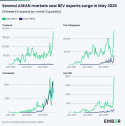
Chinese EV exports to ASEAN countries reached a record $1.2 billion in May as governments across the region push to electrify transportation. Thailand led the way, importing more than 36,000 Chinese EVs, while shipments to the Philippines topped 33,000 vehicles. Meanwhile, Cambodia and Laos both posted record monthly import volumes as governments rolled out incentives, expanded charging infrastructure, and encouraged local assembly. Cambodia cut customs duties on BEVs to zero in late March and slashed tariffs on PHEVs from 35% to 7%. BEVs remain the dominant type of Chinese EV entering the country, although PHEVs are gaining ground.
Laos has reduced EV registration and service fees and now requires transportation companies to have EVs make up at least 10% of their fleets by the end of 2026. In May, the country also temporarily banned imports of ICE cars through the end of the year as it works to reduce its dependence on imported fossil fuels. The impact of that policy will likely become clearer in the months ahead.
Ember says higher fuel prices linked to the conflict in the Middle East are accelerating the shift to electric transportation across the region. “The current energy crisis has reinforced the value of electrification as a pathway to greater energy security, reduced fuel import exposure, and long-term transport cost savings,” said Lam Pham, Ember’s energy analyst for Asia. The record month also reflects a much bigger trend of accelerated EV adoption across Asia. Euan Graham, Ember’s senior electricity and data analyst, said, “Southeast Asia is fast becoming one of the most dynamic destinations for electric vehicles, and China is supplying that demand at scale and speed.”
So I'm reading about the Slate EV pick up being sold at 25K USD and featuring manual windows.
It really sounds like some "America Kill Line" stuff, product regression being re-marketed as progress.
If we look at the explosion of popularity of Chinese cars across the world, we can chalk up the primary attraction as features for value.
I once watched a feature on the popularity of Chinese brands in Mexico, the people interviewed are talking about things like power seats, Carplay/Android Auto, wireless charging pads, these were features that are now obtainable at a more affordable price point for Mexican shoppers. Moving to a more developed market like the UK, you look at the Jaecoo and the story is similar, PHEV powertrain, panoramic sunroof, large Tesla like center console screen, again, value added features.
The Slate truck, no power windows, no screen, it's a car no one really wants, but people say they want (I think along the lines of the iPhone Air, slimmed down, simplified, cheaper, sold like crap). Granted, I think the barebones model is just a marketing gimmick, but you put typical features on it, and the price is not going to be better than something like the BYD Shark, and most likely inferior quality and still behind on features
It really sounds like some "America Kill Line" stuff, product regression being re-marketed as progress.
If we look at the explosion of popularity of Chinese cars across the world, we can chalk up the primary attraction as features for value.
I once watched a feature on the popularity of Chinese brands in Mexico, the people interviewed are talking about things like power seats, Carplay/Android Auto, wireless charging pads, these were features that are now obtainable at a more affordable price point for Mexican shoppers. Moving to a more developed market like the UK, you look at the Jaecoo and the story is similar, PHEV powertrain, panoramic sunroof, large Tesla like center console screen, again, value added features.
The Slate truck, no power windows, no screen, it's a car no one really wants, but people say they want (I think along the lines of the iPhone Air, slimmed down, simplified, cheaper, sold like crap). Granted, I think the barebones model is just a marketing gimmick, but you put typical features on it, and the price is not going to be better than something like the BYD Shark, and most likely inferior quality and still behind on features

This is why they need to keep something like BYD seagull out of the States — you get a utility vehicle that’s not a complete death trap.So I'm reading about the Slate EV pick up being sold at 25K USD and featuring manual windows.
It really sounds like some "America Kill Line" stuff, product regression being re-marketed as progress.
If we look at the explosion of popularity of Chinese cars across the world, we can chalk up the primary attraction as features for value.
I once watched a feature on the popularity of Chinese brands in Mexico, the people interviewed are talking about things like power seats, Carplay/Android Auto, wireless charging pads, these were features that are now obtainable at a more affordable price point for Mexican shoppers. Moving to a more developed market like the UK, you look at the Jaecoo and the story is similar, PHEV powertrain, panoramic sunroof, large Tesla like center console screen, again, value added features.
The Slate truck, no power windows, no screen, it's a car no one really wants, but people say they want (I think along the lines of the iPhone Air, slimmed down, simplified, cheaper, sold like crap). Granted, I think the barebones model is just a marketing gimmick, but you put typical features on it, and the price is not going to be better than something like the BYD Shark, and most likely inferior quality and still behind on features

I don't think the Slate will be a death trap, rather I think selling "less is less" is not something people usually want, so it's a questionable tactic. Furthermore, I think you can only sell less is less in the kind of economy where people are financing their groceries.This is why they need to keep something like BYD seagull out of the States — you get a utility vehicle that’s not a complete death trap.
No one in the US would buy the Seagull. It is the size of car that has failed over and over again in North America (Yaris, Fit, Ecosport, Fiesta, Mazda2, Spark, etc.). However, something like the Seal U at 30K would raise significant interest.
Keeping Chinese EVs out of the US
Chinese automakers are making huge progress in Thailand, Indonesia & Singapore so far this year