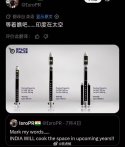
...the interesting part, however, is AMCA.
As we established, Tejas line, for all it's hardship, is neat and logical, producing two well-rounded and well thought aircraft.
It is more complex with AMCA.
First of all, AMCA itself is more or less a translation of Tejas mk2 tech stack onto a parallel medium weight counterpart.
The more interesting is what AMCA is.
Pylon configuration is complex: 1 standard wide IWB, 6 underwing points; 1 shoulder point for targeting pod.
I.e. jet doesn't carry neither IRST nor EOTS inside.
This is rather counterintuitive: in 5 gen, you can do it 3 ways:
- you don't really think about fighting other 5 gens(f-22) and just aim at bullying 4.5 gens. For this, just one radar set is good enough. A sensible choice for a 2006 aircraft.
- you are strike/multirole, and install EOTS inside. EOTS doubles as a worse IRST v stealth aircraft.
- you are A2A first, and you supplement your radar with means more effective v stealth equals: IRST, DBR.
Some aircraft don't bother chosing (Kaan/Kizilelma).
The problem is that some don't bother picking anything: and that's AMCA.
It doesn't have IRST; i.e. it's ability to target 5th generation is ironically below Tejas mk.2 and potentially even Rafale. It will always lose detection/id race.
It doesn't have internal bombsight either - i.e., as a multirole, it's rather constrained in LO configuration(or, in permissible configuration, it's barely better than Tejas mk.2...for twice the aircraft and golden F414).
Finally, at least to date, India didn't really demonstrate much in suitable internal weapons for it's bays. Granted, 500kg bombs(gravity and glide kits) will probably fit. But this isn't a very high bar, certainly not enough to justify an aircraft.
Do I miss something? What's it supposed to be good at? The only clue I could come up with is AMCA is almost exactly same size with mig-29, i.e. (similarly to LCA) is a heavier interceptor designed to fit into same HAS. But it was never explicitly written, and frankly this isn't enough of a reason to exist.
I generally sympathise with your points on the Tejas topic before the Pakistani troll presenting as Jaihind derailed the thread with some internet airforce ranking nonsense.
So much of AMCA requires the Tejas program and the systems nurtured along with it to become successful and matured. At the moment, the only ones within this set is the Astra missile and the ability to manufacture the aircraft itself. Yes these are still achievements but the Uttam has yet to even make an appearance within a service Tejas. Much further from becoming a mainstay first generation AESA fighter radar with IAF and even further from maturing in that role and developing as a baseline for AMCA's radar technologies.
I fail to see how India can truly produce AMCA by even 2040s to even the degree Turkey has been able to bring KAAN into today. Being close to 20 years behind Turkey (assuming India produces AMCA flying prototypes in mid 2040s) is clearly unacceptable to IAF. Let's speed things up by 10 years then. Pakistan would likely have serious numbers of J-35. While Indians celebrate nonsense, their real world power standing would falter even against Pakistan and every real conflict and every real after effect will reflect this. Maybe Indians and their leadership is destined to be at the lower rungs globally because there doesn't appear to be a stabilising/correcting mechanism for India. They only deal in fantasies and internet cope delusions.
This whole idea of AMCA is plain silly when Tejas absolutely needs to go through this journey properly and become domesticated component by component. They wanted to do a single bigger leap but took 40 years longer than China doing smaller leaps while developing domestic industries.
Let's ignore engines. Why are they not putting Uttam into service and improving it over the years or in Indian time, over the next decades? That should be step 1. Astra is a good showing. At least it's there doing it's thing, working, improving.
Mk1A is a good step albeit slower than snails pace. Mk2 should be redefined. They absolutely need to pour into their domestic Tejas. The reason for not doing is the thinking/belief that IAF requires a certain number to counter Pakistan effectively. This simply isn't true. PAF quite easily is an equal to the IAF in overall effectivenes but Pakistan would not be able to counter India's sheer weight no more than Japan could counter China's sheer weight. India should simply invest in ability to hit Pakistan harder than Pakistan can do to India with all price for doing so considered, which is something it already does and has. This half arsed, one foot in both bets strategy India always takes, will not produce for them any semi-decent domestic military aviation ecosystem for much longer than they require.
Take money out of IAF's ability to purchase internationally and invest all that into developing India's domestic talent. They can already hit Pakistan harder than Pakistan can do to India. Maybe these investments will bear fruit in the mid term future and India could complete its first step with the Tejas in full and kickstart domestic engine program with a serious effort which bears fruit in further decades. They don't like long term planning and don't appear capable of it. Instead of this "we buy 100+ RAfales at over 200M per pop total package while we invest a pittance into HAL and blame it every time we get a reality check and make delusions about ""ToT"" for engines while we try to rebrand the M88 modified as Kevari".
Last edited: