After two weeks of actual driving, here is my review of the Han L EV!
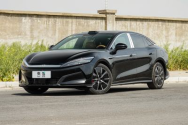
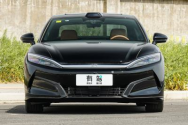
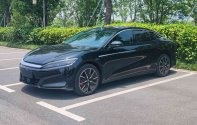
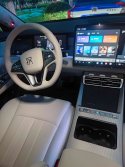
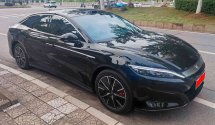
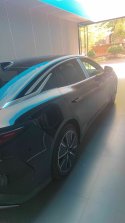
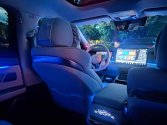
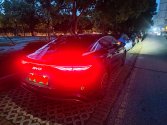
Starting with the exterior, I think this car actually looks better than many people imagine. Last year, a lot of people said this model didn’t gain market traction because of its unattractive design, but I personally really like the way it looks. It has a sporty coupe design but also a sense of family-friendly stability, with a silver trim strip running from the front edge all the way to the door handles. As for space, I’m 180 cm tall and find the front seats very comfortable. There’s plenty of legroom in the back, but due to its coupe silhouette, headroom in the rear is somewhat limited. If you’re over 183 cm tall, sitting in the back will feel noticeably cramped. My model is the standard trim, so it doesn’t come with heated or massaging rear seats or a cooler, but it still features ventilated, heated, and massaging front seats. The audio system is by Devialet, though I don’t have a keen ear for sound quality, so I can’t say how impressive it is.
In terms of mechanical performance, this car accelerates incredibly fast—and not just from 0 to 100 km/h. Thanks to its unique 500-kilowatt super motor, it also accelerates from 100 to 200 km/h with remarkable speed. No matter what speed you’re currently traveling at, the harder you press the accelerator, the more relentless power the car delivers. I usually only dare to press the accelerator pedal very gently, for fear that if I floor it, the car will shoot off to who knows where. The suspension features an all-aluminum double-wishbone front and five-link rear setup, built with very solid materials. The chassis tuning leans toward family comfort, and the “Cloud Ride” system allows the vehicle to automatically adjust suspension firmness when driving over uneven terrain. Of course, in terms of active and passive safety, this vehicle is equipped with BYD’s top-tier features, so I won’t go into further detail here.
Regarding battery charging, the Han L EV isn’t equipped with the second-generation Blade Battery, but it does feature a 1.9-generation Blade Battery. It can charge from 10% to 70% in just 6 minutes, and at non-BYD charging stations, it supports “dual-cable charging” by plugging in two charging cables simultaneously. The CLTC range is 701 kilometers. If I were to drive at a slow speed of 40 km/h in the city, I believe this car could even achieve 100% of its CLTC range. As verified by the media, this car also has an exceptionally high range achievement rate on the highway, which is one of its core selling points. However, I have not yet conducted a range test on the highway at speeds exceeding 120 km/h.
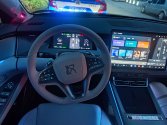
In terms of smart features, this car is highly advanced. You can control nearly all of its major functions via your smartphone or voice commands, and many features support remote control—you can operate the car from thousands of meters away while at home. The vehicle’s navigation software is Amap, which supports lane-level navigation. The AI voice assistant provides alerts in many critical situations; for example, it will notify you if there are children in the car or if a phone has been left behind, and it will also alert you if a bicycle is passing behind the vehicle. Regarding autonomous driving, the Tian Shen Zhi Yan B system gives me a very decisive and agile impression. However, I feel it still falls short in “defensive driving.” On several occasions, the autonomous system sped through crosswalks with vehicles parked side-by-side without slowing down, or cut in between two massive trucks while passing. I believe the best current autonomous driving mode should be “human-machine collaborative driving,” where you can manually intervene using the control lever and steering wheel buttons to guide the system in real time. That said, I now use autonomous driving for both parking and exiting parking spaces. After all, if an accident occurs during automated parking, BYD will provide free repairs as part of their accident coverage. The vehicle’s camera system is also a highly useful standard feature: it automatically activates the 360-degree panoramic view when driving through narrow areas or turning, and it provides real-time millimeter-wave distance data. Additionally, after exiting the vehicle, you can enable Sentinel Mode to monitor for suspicious individuals near the car.
Now, regarding the car’s shortcomings: overall, the Han L EV has given me a truly excellent smart driving experience, and my general impression of it is fantastic. However, there are indeed quite a few aspects that leave something to be desired—
For one, the massive front trunk cannot be opened via voice command and lacks a power strut; you have to pull the lever under the driver’s seat twice to open it, and closing the trunk is also a very poor experience.
Another issue is interior rattling. While this car boasts a very solid mechanical structure and safety features, it’s surprisingly disappointing in terms of interior build quality. The center console, doors, and sunroof all have odd rattling noises from plastic components, which tend to recur frequently, especially after the plastic expands and contracts due to temperature changes from the air conditioning.
To add a personal note, we were originally eligible for a 15,000 RMB government subsidy under the trade-in program—which is a significant amount of money. However, the print quality of my family’s old car’s official registration certificate was terrible; the text was crooked and very blurry. After applying for the subsidy, the government informed me that the information on the original document was unclear. By that time, I had already sold my old car, and the original document had changed hands multiple times and was nowhere to be found. There’s nothing I can do about it now, which means I’ve effectively lost 15,000 RMB for nothing. This has really upset me, and I’ve had trouble sleeping for several nights.
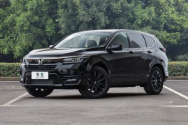
Additionally, BYD cars are often perceived by the public as “taxis,” even the high-end Dynasty series sedans. To those unfamiliar with cars, my Han L EV seems easily confused with the black Han EV that uses the older platform, though a closer look can still distinguish between the Han and Han L series.
Incidentally, based on the overseas price of the Tang L, the starting price of the Han L in overseas markets could be as high as 480,000 RMB. Although this model has been discontinued and may not be sold in the future, this demonstrates that it is indeed possible to purchase high-performance cars at extremely low prices in China.
Putting aside the unfortunate incident mentioned above, let me summarize my overall impression: this car is truly outstanding. It’s like a “suited thug”—boasting stable and reliable mechanical performance, comfort, and safety, along with powerful acceleration, while its smart features act like a loyal butler. As many people say, once you’ve driven an electric car, you’ll never go back to a gas-powered car.
View attachment 175348View attachment 175347
View attachment 175349
View attachment 175350
View attachment 175352
View attachment 175351
View attachment 175353