
You are using an out of date browser. It may not display this or other websites correctly.
You should upgrade or use an alternative browser.
You should upgrade or use an alternative browser.
PLAN Anti-ship/surface missiles
- Thread starter tphuang
- Start date
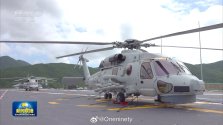

Jane's has just published this:
1800km seems an absurdly long range for YJ-15, the entire point of which I thought was that it does NOT need to be carried by H-6 (which has the similar but larger YJ-12).
Also not seeing any intakes for scramjet propulsion on YJ-20.
1800km seems an absurdly long range for YJ-15, the entire point of which I thought was that it does NOT need to be carried by H-6 (which has the similar but larger YJ-12).
Also not seeing any intakes for scramjet propulsion on YJ-20.
Last edited:
Janes has become very lazy (or perhaps always was). "Relatively large fuselage compared with similar missiles in class" while YJ-15 is very small and compact for a Ramjet cruise missile.Jane's has just published this:
1800km seems an absurdly long range for YJ-15, the entire point of which I thought was that it does NOT need to be carried by H-6 (which has the similar but larger YJ-12).
Excerpts from academic paper titled "高海情舰船横摇对导弹垂直弹射的影响" (The Impact of Ship Roll on Vertical Missile Launch). Posted by @Crosshairs十字线 on Weibo.
(Note that despite bearing similar looks from the outside, this is NOT the same as the land-based launch system proposal which I posted here in this thread sometime ago.)
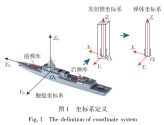
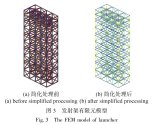
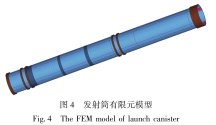
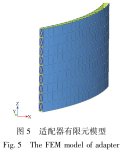
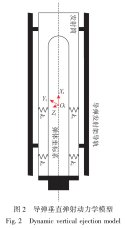
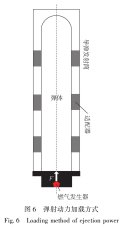
(Note that despite bearing similar looks from the outside, this is NOT the same as the land-based launch system proposal which I posted here in this thread sometime ago.)

Is it known whether the YJ-18C is a land-attack or anti-ship missile? I don't think a definitive description was provided by the Sept. 03 parade announcers. The missile was grouped in the "strategic" parade formation alongside other land-attack systems like the CJ-20 and CJ-1000, but the "YJ" designation heavily implies an anti-shipping role. It is possible that both land-attack and anti-shipping variants exist within the YJ-18C sub-family.
If it is purely a land-attack missile, then it is almost certain that an anti-shipping variant would be developed from it, since VLS-borne, low-observable, long-range anti-shipping capabilities would be highly sought after in a potential Pacific conflict.
As a comparison, the PLAAF counterpart to the YJ-18C, the AFK-98, is known to have both land-attack and (extrapolating from its export variant's capabilities). It would then be logical to assume that the YJ-18C would follow a similar path.
If it is purely a land-attack missile, then it is almost certain that an anti-shipping variant would be developed from it, since VLS-borne, low-observable, long-range anti-shipping capabilities would be highly sought after in a potential Pacific conflict.
As a comparison, the PLAAF counterpart to the YJ-18C, the AFK-98, is known to have both land-attack and (extrapolating from its export variant's capabilities). It would then be logical to assume that the YJ-18C would follow a similar path.
Is it known whether the YJ-18C is a land-attack or anti-ship missile? I don't think a definitive description was provided by the Sept. 03 parade announcers. The missile was grouped in the "strategic" parade formation alongside other land-attack systems like the CJ-20 and CJ-1000, but the "YJ" designation heavily implies an anti-shipping role. It is possible that both land-attack and anti-shipping variants exist within the YJ-18C sub-family.
If it is purely a land-attack missile, then it is almost certain that an anti-shipping variant would be developed from it, since VLS-borne, low-observable, long-range anti-shipping capabilities would be highly sought after in a potential Pacific conflict.
As a comparison, the PLAAF counterpart to the YJ-18C, the AFK-98, is known to have both land-attack and (extrapolating from its export variant's capabilities). It would then be logical to assume that the YJ-18C would follow a similar path.
The entire family of the YJ-18 has long been primarily known to be anti-ship missiles. Land-attack capability is more often a plus rather than a dominating feature.
Ever since the YJ-18, it seems like PLAN stopped using different designations for anti-ship and land-attack versions of the same missile. That’s why you’ll see the YJ-18—and even the newer YJ-17, 19, and 20—being used for land-attack missions.Is it known whether the YJ-18C is a land-attack or anti-ship missile? I don't think a definitive description was provided by the Sept. 03 parade announcers. The missile was grouped in the "strategic" parade formation alongside other land-attack systems like the CJ-20 and CJ-1000, but the "YJ" designation heavily implies an anti-shipping role. It is possible that both land-attack and anti-shipping variants exist within the YJ-18C sub-family.
If it is purely a land-attack missile, then it is almost certain that an anti-shipping variant would be developed from it, since VLS-borne, low-observable, long-range anti-shipping capabilities would be highly sought after in a potential Pacific conflict.
As a comparison, the PLAAF counterpart to the YJ-18C, the AFK-98, is known to have both land-attack and (extrapolating from its export variant's capabilities). It would then be logical to assume that the YJ-18C would follow a similar path.
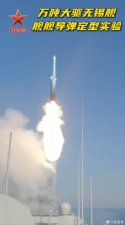
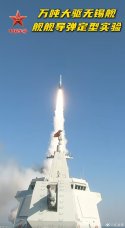
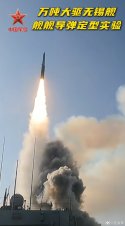
055 DDG-104 Wuxi launching a YJ-20 AShB/HM. Posted by @拓跋尊 on Weibo.
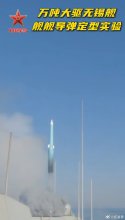
Last edited:

Before the YJ-20 made its debut at 9·3, it was mostly just General (Xi Yazhou) and I clamoring online about how advanced our hypersonic tech was. When the General mentioned the YJ-XX, he was referring to the YJ-20. I'd even throw in that odd expression “stand off weapon” like US military's “stand off.” The YJ-20 was always meant to be the next-generation advanced anti-ship weapon: we developed it early, mass-produced it early, deployed it early, and in massive numbers.
Now, with its upgraded variants long since perfected and deployed, it has finally made its public debut. We can now openly share launch footage—a significant milestone. Yet when scramjet technology has already been finalized, our trump cards extend far beyond just the YJ-20.
Last edited:

I think that should translate as "scramjet" rather than "supercruise ramjet".
In any case, YJ-20, YJ-17 and the UVLS hypersonic cruise missile/scramjet AShM (not YJ-19, which is the 553mm torpedo tube sized hypersonic cruise missile/scramjet AShM for submarines), make up quite a potent shipborne organic anti ship weapons suite for the ships which accommodate them.